The software industry is undergoing a massive transformation driven by AI advancements. Companies that once thrived on traditional subscription models are now facing steep challenges as AI agents boost productivity, reduce software license needs, and disrupt business models. The winners in this new era won’t be those with the flashiest features or interfaces - they’ll be the ones that:
- Control proprietary data: Decades of unique, hard-to-replicate data give these companies an edge AI models can't match.
- Embed deeply into workflows: Systems that businesses rely on for critical operations are harder to replace, even with better alternatives.
- Move beyond per-user pricing: Outcome-based or usage-based pricing aligns with the value AI delivers, replacing outdated models.
Recent examples highlight this shift: AI tools are reducing workforce needs, replacing standalone SaaS products, and making systems built on public data obsolete. To survive, companies must focus on owning exclusive data, becoming indispensable to operations, and rethinking pricing strategies. The future of SaaS lies in delivering irreplaceable value, not just better software.
The SaaS Apocalypse Is Real: Why AI Will Kill Shallow SaaS
sbb-itb-9cd970b
What Sets Companies Apart: Proprietary Data and Critical Workflows
The software companies thriving in this era of rapid AI advancements aren't standing out because of sleeker designs or faster performance. Their success comes down to two irreplaceable assets: proprietary data painstakingly built over time and workflows so integral to business operations that removing them would disrupt entire organizations.
When AI can replicate functional software in just days, traditional code alone no longer guarantees a competitive edge. However, AI can't replicate decades of unique industrial data, exclusive customer insights, or the decision-making frameworks that businesses rely on. These elements create a lasting advantage.
Why Proprietary Data Matters
Proprietary data grows in value exponentially over time, offering insights that generic AI models simply can't match. For instance, a decade of industrial sensor readings provides far more accurate predictive capabilities than just one year of data. AI can't conjure up a history like that out of thin air [1].
Take Bloomberg Terminal, which charges $24,000 per user annually - not because of its interface, but because it provides access to 40 years of trusted financial data [1][7]. Similarly, JPMorgan Chase's "COiN" system uses a proprietary database of legal agreements to analyze 12,000 commercial credit contracts in seconds, replacing what used to take 360,000 lawyer hours every year [7].
The most powerful form of proprietary data is "Interaction Data" - information that tracks how users refine and validate AI outputs within a product. Generic models lack access to these unique usage patterns [6].
"A B2B founder came to us devastated. They'd spent six months perfecting their AI feature, only to watch three competitors launch nearly identical solutions in the same quarter. The problem wasn't execution - it was architecture. They built on sand instead of bedrock." – Alessandro Marianantoni, M Studio [6]
Another key advantage lies in deterministic cognition - systems that provide consistent, auditable results based on established methods. Unlike AI, which operates probabilistically and can sometimes "hallucinate", these systems deliver reliable, repeatable answers. This consistency is essential for audits and compliance. For example, credit analysts rely on specific methodologies to structure comparables, creating a language that clients use to make decisions. Switching to another system would involve steep costs in both time and trust [1][2].
While proprietary data is a formidable barrier to competition, embedding it into critical workflows solidifies a company's position even further.
Creating Mission-Critical Workflows That Drive Results
Owning unique data is only part of the equation. To secure a lasting edge, companies need to integrate their solutions into workflows that are essential to their customers' operations. These aren't just convenience tools - they're operational software that businesses can't function without. Think payroll, billing, compliance reporting, and logistics systems [9]. These tools aren't just helpful; they're the backbone of daily operations.
The key to building such indispensable workflows is becoming the "system of record" - the central platform that other tools rely on. This creates what’s known as "API gravity" [7]. When dozens of downstream applications depend on your data, replacing your system becomes prohibitively expensive, no matter how polished a competitor’s interface might be.
For example, in 2024, Klarna replaced Salesforce and Workday with internal AI tools and a streamlined data stack. This shift reduced customer service costs from $287 million in 2022 to $203 million in 2024, with $39 million in savings directly tied to AI [7]. However, such transitions highlight how challenging it is to reconfigure core systems, especially when they are deeply embedded in operations.
Switching costs tied to operations are far more durable than those based on user habits. While a better AI interface can quickly attract users, replacing a system that’s integrated into compliance frameworks or spans multiple departments involves reworking workflows, retraining employees, and migrating years of structured data. For example, healthcare organizations face penalties ranging from $100 to $50,000 per HIPAA violation, with annual caps reaching $1.9 million. This creates a significant barrier for competitors trying to unseat established providers like Epic [7].
The companies that thrive in this landscape won't necessarily have the most features. They'll be the ones that own irreplaceable data and are so deeply embedded in critical operations that switching to another provider becomes more trouble than it’s worth.
What Happens When Companies Ignore the AI Shift
Overlooking AI's growing influence doesn't just threaten traditional business models - it also underscores the importance of proprietary data and seamless integration into critical operations. The repercussions are striking, particularly in financial markets. Take early 2026, for example: the software industry faced what analysts called the "SaaSpocalypse", which wiped out between $1 trillion and $2 trillion in market value[8]. In one trading session alone, Salesforce shares plummeted nearly 30%, while Intuit saw a 34% drop[8]. The MSCI Software Index also tumbled by nearly 21% during the first weeks of 2026[13].
This wasn't just a temporary market dip - it marked a fundamental shift in how software companies are valued. Investors began to realize that traditional models, especially those relying on per-user pricing, were under serious threat. AI agents, capable of performing tasks that previously required multiple employees, are reshaping these business models entirely.
How AI Disrupts Existing SaaS Business Models
The traditional SaaS approach - charging customers based on the number of users - faces a direct challenge in the age of AI. When one AI-powered employee can handle the workload of five people, the demand for user licenses drops sharply. This phenomenon, known as "seat count compression", has already impacted companies like Atlassian, which has seen a notable decline in its market value. And it's not just a one-off case: Gartner estimates that by 2030, 35% of standalone SaaS tools will either be replaced by AI agents or absorbed into larger ecosystems[4].
But the disruption doesn't stop at pricing. AI agents are increasingly bypassing traditional user interfaces, connecting directly to data layers via APIs. This shift reduces software to a passive data repository, stripping away the value once tied to intuitive interfaces. Microsoft CEO Satya Nadella has even cautioned that "Business applications could collapse in the agent era"[7].
Software focused on basic CRUD (Create, Read, Update, and Delete) functions is particularly vulnerable. Many tools, like project management platforms, basic CRMs, and workflow organizers, can now be replicated by AI agents with simple prompts[8]. Adding to this is the rise of "vibe coding", where non-technical users leverage AI to create custom internal tools. By 2026, 78% of enterprise software developers plan to build more custom tools to replace existing SaaS products[7].
And there’s more: AI doesn’t just compress pricing models - it also threatens tools that rely on publicly available data.
Why Tools Built on Public Data Face Higher Replacement Risk
Software that depends on public data is at an even greater risk. With AI capable of querying and synthesizing public information - like government records or labor market data - through natural language, specialized interfaces become redundant. This creates what’s known as the "wrapper problem." As AI models improve, products that merely provide a polished interface over public data lose their value[1].
"If the underlying model gets 10x better next year, does my product get more valuable or less? Less valuable means the model now does what you were doing. More valuable means a smarter model does more with your data. The first is a wrapper. The second is a moat."
Product strategist Lewis Lin captures this dynamic perfectly: a "wrapper" diminishes as models improve, while a "moat" thrives by leveraging smarter data usage[1].
Software tools without proprietary data or critical workflows - often referred to as "Walking Dead" - are at the greatest risk of obsolescence. This includes scheduling apps, basic analytics platforms, and content generation tools[12]. The trend is already underway: in the past year, 35% of enterprises have replaced at least one SaaS tool with a custom-built AI alternative[7].
Consider these examples: In 2025, an engineer rebuilt a specialized data management tool in-house, cutting out a $5,000-per-seat annual subscription[3]. Similarly, in 2024, Duolingo reduced its contractor workforce by 10% after adopting generative AI tools for content creation and translation. These tools helped the company produce 148 new language courses entirely through AI[7].
Companies most at risk share some clear traits: they rely on public or easily replicable data, focus on workflow automation rather than offering comprehensive systems of record, and lack deep integration into compliance or mission-critical operations. Without proprietary data or deeply embedded workflows, these tools struggle to build a lasting competitive edge.
How to Build a Software Business That Withstands AI Disruption
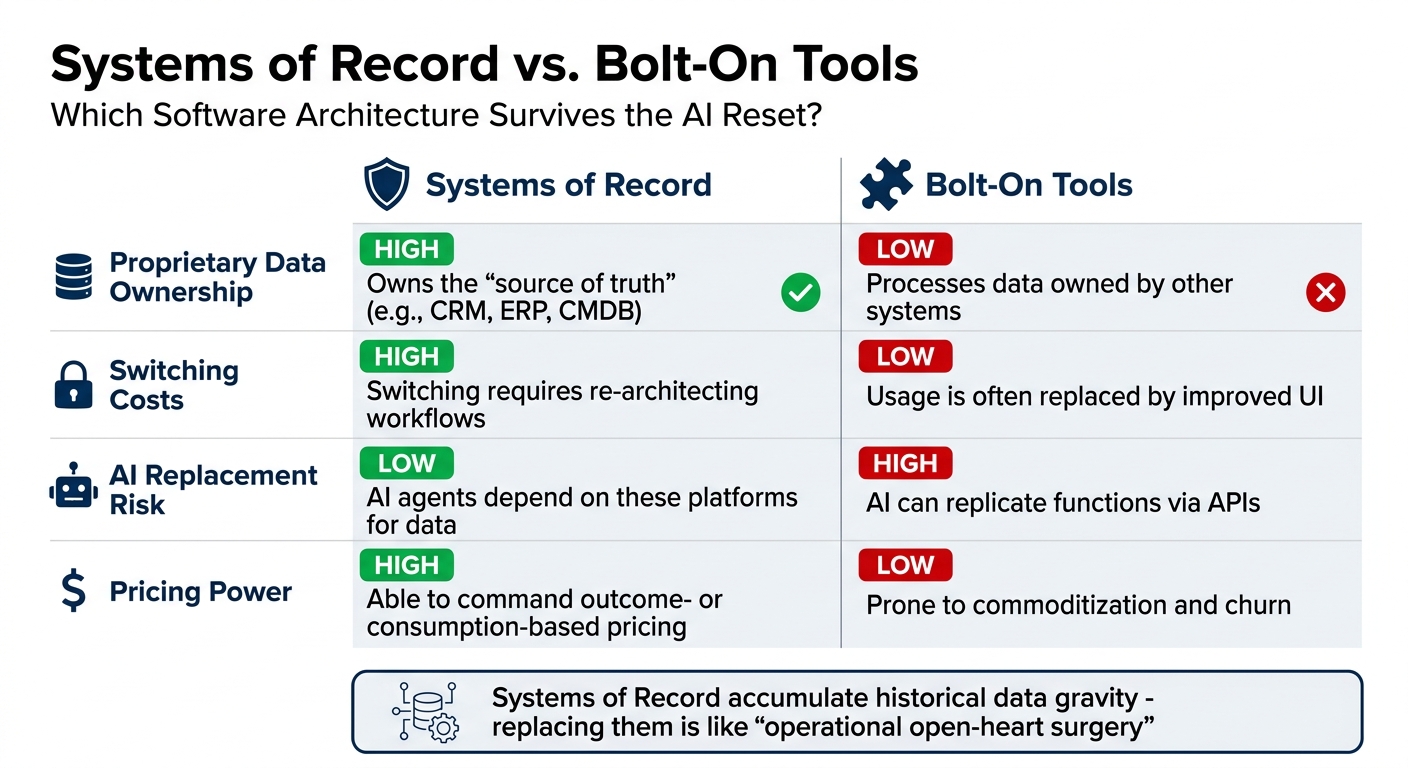
Systems of Record vs Bolt-On Tools: AI Disruption Resistance Comparison
The companies thriving amidst AI disruptions aren’t just slapping on trendy AI features - they’re focusing on long-term strategies. This means gathering data that AI models can’t easily replicate and embedding themselves so deeply into customer workflows that switching becomes almost impossible. Businesses already using these tactics are seeing measurable results, proving that adapting business models and product designs is essential for staying relevant in the AI era.
How to Acquire Proprietary Data and Integrate Into Customer Workflows
To secure a competitive edge, focus on creating a "data moat" - unique, proprietary data that AI models can’t replicate. This isn’t about scraping public datasets; it’s about building exclusive assets that grow in value over time.
Start by identifying the exclusive data your product generates. For instance, does your software capture structured logs like user requests, API responses, or corrections made by users? This type of "data exhaust" can become a proprietary dataset that improves your AI models with every interaction [15]. A real-world example: In June 2025, Walmart’s CEO Doug McMillon highlighted how the company used multiple large language models (LLMs) to enhance over 850 million catalog data entries. Walmart also introduced AI agents, such as Sparky and Marty, which reduced store managers’ shift planning time by 67%, from 90 minutes to just 30 [10].
Specialization is key. Industry-specific software - whether it’s for insurance claims, clinical trials, or home service dispatch - offers domain expertise and unique data that generic AI can’t reproduce [14]. Take Bloomberg Terminal as an example: it charges around $24,000 per seat annually, thanks to decades of proprietary financial data and a strong reputation [7].
Additionally, securing industry certifications (e.g., SOC 2 Type II, HIPAA, FedRAMP) strengthens trust and ensures you remain deeply embedded in customer operations. For instance, healthcare providers face penalties ranging from $100 to $50,000 per HIPAA violation, with annual fines capped at $1.9 million [7]. Products that serve as the "system of record" force downstream integrations, making them indispensable infrastructure rather than optional tools.
Adjusting Business Models for AI Integration
Once you’ve built a strong data moat, it’s time to rethink your business model to fully leverage its value.
Traditional per-seat pricing is becoming outdated [10]. With AI agents capable of replacing multiple employees, the demand for individual user licenses is shrinking. Instead of resisting this change, align your pricing with the value AI delivers.
Outcome-based pricing - where fees are tied to completed tasks - is gaining traction. This model is projected to grow at a 30% annual rate through 2035, while traditional subscription models lag at just 2% growth [5]. By 2025, 85% of SaaS companies were already using hybrid pricing models to factor in AI-related compute costs [5]. For example, in February 2026, Australian health insurer NIB launched "Nibby", an AI agent that handled 60% of customer inquiries without human intervention. This reduced the human workload by 15% and saved the company $22 million [10]. NIB didn’t pay for a set number of seats - they paid for results.
Product architecture also needs to evolve. As Satya Nadella cautioned, "Business applications could collapse in the agent era" [7]. Instead of traditional interfaces, companies are moving toward "control tower GUIs", where humans supervise AI decisions and set guardrails [8]. APIs are becoming more critical than user interfaces, as AI agents interact with your software programmatically rather than through clicks.
Incorporating correction loops is another must. Every time a user adjusts an AI-generated output, they’re providing "ground truth" data that makes your product smarter and harder to replicate [15][11]. This feedback mechanism creates a self-reinforcing advantage over competitors.
Comparison: Systems of Record vs. Bolt-On Tools
| Dimension | Systems of Record | Bolt-On Tools |
|---|---|---|
| Proprietary Data Ownership | High; owns the "source of truth" (e.g., CRM, ERP, CMDB) | Low; processes data owned by other systems |
| Switching Costs | High; switching requires re-architecting workflows | Low; usage is often replaced by improved UI |
| AI Replacement Risk | Low; AI agents depend on these platforms for data | High; AI can replicate functions via APIs |
| Pricing Power | High; able to command outcome- or consumption-based pricing | Low; prone to commoditization and churn |
Systems of Record - like Salesforce, Workday, and ServiceNow - are the backbone of enterprise operations. They accumulate historical data that becomes more valuable over time, a concept often referred to as "historical data gravity" [5]. Replacing these systems is so disruptive that it’s likened to "operational open-heart surgery."
Bolt-On Tools, on the other hand, are more vulnerable. These tools often rely on public or commodity data and focus on polished interfaces. This leaves them exposed to what’s called the "wrapper problem." As product strategist Lewis Lin puts it:
"If the underlying model gets 10x better next year, does my product get more valuable or less? Less valuable means the model now does what you were doing. More valuable means a smarter model does more with your data" [1].
In short, while bolt-on tools quickly become obsolete as AI improves, systems with robust data moats and deep workflow integration stand the test of time. The takeaway? Aim to become a System of Record or develop specialized expertise that generic AI can’t replicate. Anything less risks fading into irrelevance.
Conclusion: What SaaS Leaders Need to Remember
The AI reset is forcing SaaS leaders to rethink their strategies. The recent $2 trillion market cap loss in the software industry[16] sends a clear signal: code alone is no longer enough to stay ahead. By 2026, AI will be capable of replicating functional apps in just days. The companies that thrive won't be those relying on features - they'll be the ones building strong defenses around proprietary data and essential workflows.
Lewis Lin's "10x Better Test" offers a valuable lens: if a 10x improvement in the underlying AI model makes your product less useful, you're likely building a wrapper that's at risk of becoming irrelevant[1]. To remain competitive, SaaS leaders need to focus on three critical areas: proprietary data that's impossible to replicate, mission-critical workflows that make your system indispensable, and compliance measures AI can't duplicate.
The shift is clear: SaaS is moving from selling software to delivering labor substitution. A striking example is NIB Health Insurer's launch of "Nibby" in February 2026. This AI agent handled 60% of customer inquiries, saving the company $22 million[10]. With AI taking over tasks once managed by entire teams, traditional pricing models like per-seat licensing are becoming outdated. Instead, outcome-based pricing is gaining traction. By 2035, this model is expected to grow at an annual rate of 30%, while subscription models will likely stagnate at just 2%[5].
"UI is pre-AI"
Naval Ravikant's observation highlights a crucial point[7]: traditional user interfaces were built for a time when machines couldn't process language. In the AI era, the API becomes the product itself. The takeaway? Success in this new landscape isn't about flashy features - it’s about delivering irreplaceable value through data and seamless workflow integration. With 78% of enterprises already planning to build internal replacements instead of renewing SaaS contracts[7], the message is clear: adaptability is key.
To survive, SaaS companies must focus on controlling exclusive data, embedding deeply into essential workflows, and maintaining rigorous compliance. These are the pillars that create a true competitive edge in the AI-driven future.
FAQs
What counts as proprietary data that an LLM can’t copy?
Proprietary data stands apart because it’s rooted in exclusive access or processes that can’t be mimicked by a language model. This includes data gathered through physical means, secured through exclusive partnerships, or built up over years of dedicated effort. Think of examples like sensor data collected from physical devices or insights derived from unique customer interactions that evolve over time. These datasets often become embedded in workflows, carrying a logic and depth that competitors can’t replicate or scrape. This makes them a powerful asset, offering a lasting edge by being both irreplaceable and tightly woven into a company’s operations.
How can a SaaS product become a true system of record?
A SaaS product earns its place as a system of record when it becomes the go-to hub for essential business data and workflows that are tough to duplicate or automate. This means pulling together proprietary information - like costs, usage metrics, and contracts - and integrating it into workflows that span across teams. The result? Consistent data, better compliance, and long-term usefulness. By achieving this, the product not only strengthens its competitive edge but also plays a key role in driving strategic decisions.
What pricing model works when AI reduces seat counts?
A consumption-based or per-agent pricing model can be a smart choice when AI leads to fewer required seats. This model links revenue directly to actual usage and the value delivered, rather than sticking to fixed, seat-based fees. It offers flexibility, ensuring costs adjust to business needs as automation transforms workflows.
Related Blog Posts
- Is Your SaaS an AI “Wrapper”? Why Most Thin AI Layers Will Collapse (And How to Build a Defensible Data Moat).
- 8. $4.9 Trillion in M&A in 2025. A Record. 25% of Every Deal Over $5 Billion Had an AI Theme. This Is Not a Cycle. This Is a Structural Shift in Who Controls Valuable Assets. CNBC
- 16. The Era of "Growth at All Costs" Is Over. The Era of "Whoever Controls the Data Controls the Exit Multiple" Has Begun. Most Founders Are Still Playing the Old Game.
- 17. Investors Aren't Looking for Workflow Stickiness Anymore. They're Asking: "If an AI Agent Does This Work, Who Needs Your Software?" If You Don't Have an Answer, Your Valuation Already Does. TechCrunch