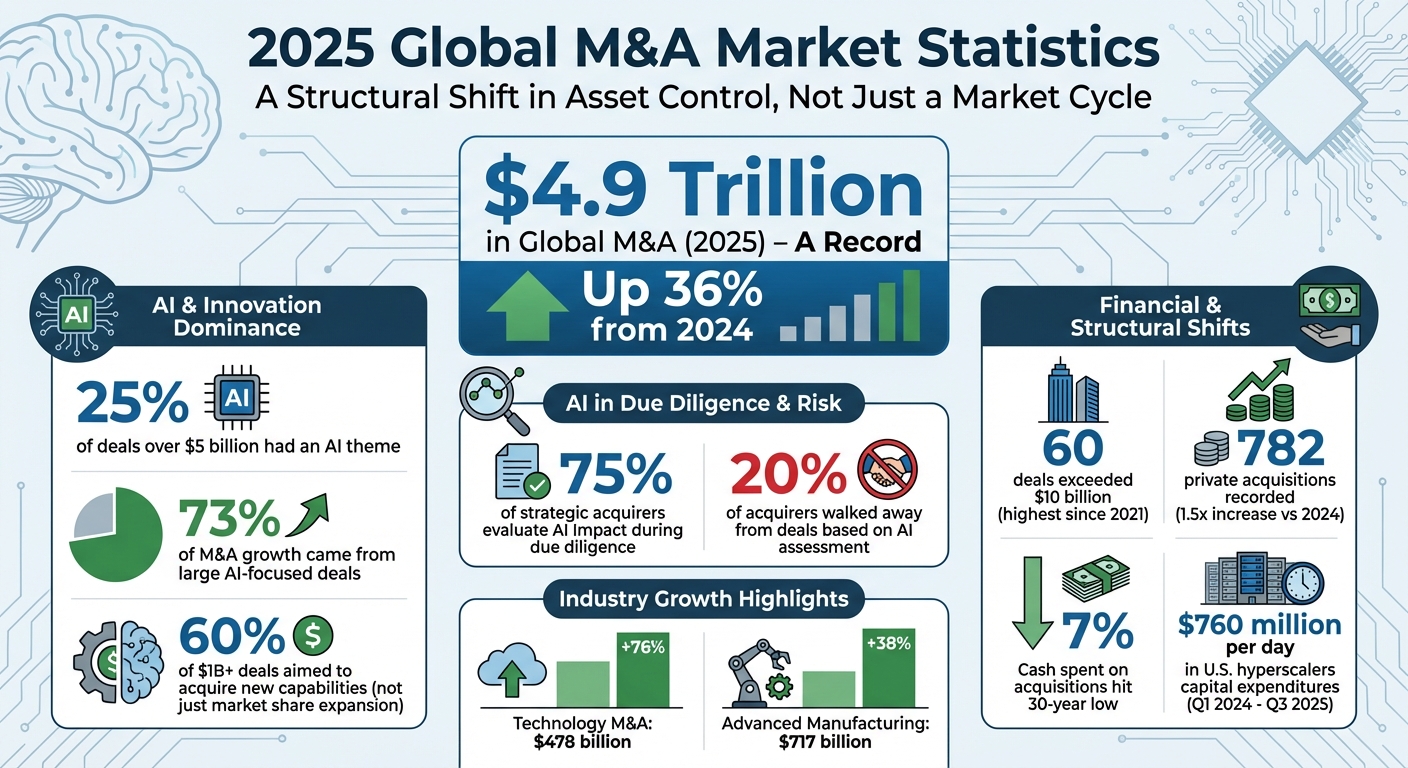
The global M&A market reached a record $4.9 trillion in 2025, up 36% from 2024. AI played a central role, driving 25% of deals over $5 billion. This isn't a short-term trend - it marks a shift in how companies secure critical assets, like data, chips, and energy, to compete in an AI-driven world.
Key Highlights:
- 73% of M&A growth came from large AI-focused deals.
- 60% of $1B+ deals aimed to acquire new capabilities, not just expand market share.
- Companies like Meta, Nvidia, and Alphabet made bold moves to dominate AI infrastructure.
This transformation is reshaping competitive strategies across industries, with businesses prioritizing AI capabilities over traditional growth models.
2025 M&A Market: $4.9 Trillion Record with AI Driving 25% of Megadeals
What's Driving the M&A Surge
AI's Growing Role in Large Transactions
By 2025, nearly half of strategic technology deals exceeding $500 million involved companies deeply rooted in AI or highlighted AI as a central reason for the acquisition [1]. These were not small, cautious moves - around 40% of these large transactions were valued at more than half of the acquiring company's market capitalization [1].
Why the rush? Building AI capabilities from the ground up simply takes too much time. Companies that hesitated found themselves falling behind more aggressive competitors. For example, Meta's $14.3 billion investment in Scale AI and Salesforce's multibillion-dollar purchase of Informatica [4] underscore a trend: buying AI expertise is often more practical - and faster - than developing it internally.
The AI boom also pushed acquisitions beyond software. In December 2025, Alphabet acquired Intersect Power for $4.75 billion to secure large-scale solar and storage projects meant to fuel Google's AI data centers [8]. Sheldon Kimber, CEO of Intersect Power, explained the challenge:
"AI today is stuck behind one of the slowest, oldest industries... There isn't enough electricity for all the racks full of GPUs" [8].
This urgency and demand for AI infrastructure set the stage for massive, market-shaping deals.
How $5 Billion+ Deals Are Changing the Market
The rise of megadeals redefined the M&A landscape in 2025. Deals exceeding $5 billion didn’t just contribute to the surge in activity - they dominated it. These transactions accounted for 73% of the total increase in deal value for the year [6]. Even more striking, the number of deals surpassing $10 billion reached 60, the highest count since 2021 [6].
A unique aspect of 2025 was the profile of the buyers. Companies that rarely engage in M&A - referred to as "infrequent acquirers" - were behind 60% of the $5 billion-plus megadeals [1]. These were not routine acquisitions; they were bold, high-stakes decisions. Suzanne Kumar from Bain & Company captured the sentiment well:
"This was a year of big bets by companies that traditionally make few deals, and often large-ticket deals become make-or-break moves" [1].
The AI boom also fueled a sharp rise in private acquisitions, with 782 deals recorded - a 1.5x increase compared to 2024 [3].
Interestingly, despite the frenzy of mergers and acquisitions, the percentage of cash spent on acquisitions hit a 30-year low, at just 7% of total expenditures [6]. Instead, companies channeled their resources into AI-related R&D and infrastructure. U.S. hyperscalers alone averaged $760 million per day in capital expenditures between Q1 2024 and Q3 2025 [6]. In an era where AI is becoming essential, these investments highlight its role as the backbone of survival.
sbb-itb-9cd970b
AI is transforming everything. What's the deal for M&A?
Major AI-Focused M&A Deals in 2025
These major acquisitions highlight how companies are prioritizing AI as a central part of their strategies.
3 AI Deals That Defined 2025
One of the most talked-about deals was xAI's acquisition of X (formerly Twitter) in March 2025. Valued at $45 billion, including $12 billion in debt, this move brought together X's massive social conversation data with xAI's Grok models. The goal? To harness real-time data at scale for advancing AI capabilities [5].
Another standout was Nvidia's $20 billion acquisition of Groq's assets and intellectual property in December 2025. By structuring the deal as an asset and IP licensing agreement, Nvidia sidestepped potential regulatory hurdles. Jensen Huang, Nvidia's CEO, shared the vision behind the acquisition:
"We plan to integrate Groq's low-latency processors into the NVIDIA AI factory architecture, extending the platform to serve an even broader range of AI inference and real-time workloads" [9].
Lastly, Meta's $14.8 billion investment in Scale AI secured a 49% stake in the company. This partnership brought Scale AI's data labeling and training expertise into Meta's operations. Alexandr Wang, Scale AI's co-founder, joined Meta as Chief AI Officer to lead its AI efforts. The deal tackled a critical issue in AI development: ensuring a steady supply of high-quality, labeled data for model training [5][11].
The table below provides a snapshot of these deals alongside other notable transactions.
Deal Comparison Table
| Acquirer | Target | Value | AI Focus Area | Expected Business Impact |
|---|---|---|---|---|
| xAI | X (formerly Twitter) | $45B (Enterprise Value) | Real-time Data & Distribution | Combines social data with model development to enhance Grok training [5] |
| Nvidia | Groq (Assets/IP) | ~$20B | Inference Infrastructure | Incorporates low-latency LPU technology into Nvidia's "AI Factory" [9] |
| Meta | Scale AI (49% stake) | ~$14.8B | Data Labeling & Training | Strengthens data supply chains for advanced AI model development [5] |
| Salesforce | Informatica | ~$8B | Data Integration/ETL | Enhances AI-driven CRM workflows with improved data governance [5] |
| ServiceNow | Moveworks | $2.85B | Enterprise Automation | Integrates generative AI and internal workflows into enterprise software [5][3] |
| Meta | Manus | ~$2B - $3B | Autonomous AI Agents | Embeds reasoning and execution capabilities in social and messaging platforms [5][3] |
Why This Isn't Just Another Market Cycle
The staggering $4.9 trillion in M&A activity recorded in 2025 isn't just a blip caused by cheap credit or market hype. Instead, it represents a deeper transformation in how businesses compete and sustain themselves. Unlike past cycles fueled by speculative optimism, these deals are anchored in solid profitability and substantial cash reserves [7][2]. This isn't just another cycle - it's a long-term shift.
One of the clearest indicators? Companies are focusing on "scope deals." These are acquisitions aimed at gaining entirely new capabilities, a departure from the traditional focus on scaling operations. As businesses face the limits of their old growth strategies, AI has emerged as a practical and powerful alternative. Reflecting this, the percentage of capital devoted to M&A hit a 30-year low in 2025, as firms became more selective, targeting strategic, high-return opportunities [6]. This new M&A landscape is centered on acquiring the tools and technologies needed to compete in a rapidly evolving market.
The Shift to Capability-Focused Acquisitions
The old M&A playbook - focused on expanding scale and slashing costs - is no longer relevant. By 2025, companies shifted their focus to acquiring what they couldn't build quickly enough: cutting-edge AI infrastructure, advanced data management systems, and entire vertical technology stacks [6][1]. Specialized AI capabilities have become the cornerstone of competition.
Major tech players are no longer limiting themselves to buying software companies. Instead, they're vying for control over specialized silicon, data management platforms, and even the energy infrastructure required to support AI operations [2][7]. Today, 75% of strategic acquirers evaluate the potential impact of AI on a target's business before moving forward with a deal [1].
The numbers tell the story. Technology M&A value soared by 76% in 2025, hitting $478 billion, while advanced manufacturing saw a 38% increase, reaching $717 billion [1]. These figures highlight a massive shift as businesses rush to secure the capabilities that will shape their competitive edge for years to come.
Take the Salesforce–Informatica deal as an example. In mid-2025, Salesforce acquired Informatica for $8 billion to strengthen its Einstein AI and Data Cloud offerings by integrating a critical data management and integration layer [2].
Which Industries Are Leading the Change
The transformation is being driven by financial services, manufacturing, and technology - each with its own motivations.
In financial services, companies are using M&A to build new powerhouses that can challenge traditional banking models. For example, Capital One's $35 billion merger with Discover Financial Services created a credit card giant designed to leverage AI-driven scale against larger banks [7].
Manufacturing is undergoing its own revolution. The sector saw a 38% surge in M&A value, reaching $717 billion in 2025, as companies raced to acquire "physical AI" capabilities. This includes autonomous systems, robotics, and AI-driven automation that enable factories to operate with minimal human oversight [1].
In the tech sector, the focus is on acquiring complete vertical stacks - from chips and software to the energy grids that power them. ServiceNow's $7.75 billion acquisition of cybersecurity firm Armis in late 2025 is a case in point. The deal aimed to integrate AI-native, proactive security into enterprise workflows [2]. Similarly, Palo Alto Networks' $25 billion acquisition of CyberArk was a bold move to dominate the identity security market [2][7].
Here's a quick snapshot of how these industries are reshaping their M&A strategies around AI:
| Industry | 2025 M&A Value Growth | Primary AI Focus |
|---|---|---|
| Technology | +76% | AI Infrastructure, Agents, & Specialized Silicon |
| Advanced Manufacturing | +38% | Physical AI, Robotics, & Autonomous Systems |
| Financial Services | High (Megadeal driven) | Data Integration, AI-driven Credit, & Identity Security |
The trend is unmistakable: businesses that secure AI capabilities are positioning themselves to lead their industries, while those that fall behind risk becoming targets for acquisition. These industry-specific shifts offer a roadmap for SaaS and AI companies aiming to stay ahead of the curve.
How SaaS and AI Companies Can Prepare
As the M&A landscape shifts toward capability-based acquisitions, SaaS and AI companies that position themselves wisely can become attractive targets. The key lies in understanding what buyers truly value - and it’s not flashy features or surface-level appeal. Strategic adviser Itay Sagie explains it best:
"The real question is not how impressive the tech is. It is how difficult the company would be to replace" [13].
In 2025, 75% of strategic acquirers evaluated the impact of AI on a target’s business during due diligence, with 20% walking away from deals based on their findings [1]. Being prepared can set apart companies that get acquired from those that don’t.
Building Revenue That Attracts Buyers
Buyers today aren’t chasing speculative growth or risky ventures. They’re after disciplined businesses with strong unit economics and predictable revenue streams. Companies are channeling their cash reserves into acquiring scalable, profitable assets instead of betting on experimental ideas [7].
One way to stand out is by building a data moat within a specific vertical. Take Clio, a legal practice management firm, which acquired vLex to combine its case management data with vLex’s proprietary legal research data and AI capabilities. Within 100 days of signing, they integrated key workflows, showcasing the value of specialized data and operational readiness [12].
Your revenue model should also allow for one-directional cross-sales, where your product can quickly be sold to an acquirer’s existing customer base. This is especially important for AI companies, which often lack large customer bases, making traditional two-way cross-selling less viable [12]. Design your pricing and onboarding processes to align seamlessly with enterprise sales strategies.
While revenue strategies are critical, operational readiness is just as important when preparing for acquisition.
Getting Your Company Acquisition-Ready
Operational readiness is often the deciding factor between companies that get acquired and those that are overlooked. Start by adopting scenario-based planning. Develop two or three potential AI futures for your company and update your roadmap quarterly. This approach keeps your technology adaptable for buyers navigating rapid changes in inference economics and model capabilities [12].
Audit for AI compliance immediately. With regulations like the EU AI Act now in effect, buyers are scrutinizing data training sets and algorithmic transparency. Non-compliance isn’t just a concern - it can kill deals outright [7]. Document everything, from data sources to training methods and decision-making processes.
Focus on infrastructure over novelty. Buyers are moving away from experimental models and looking for companies that can operate reliably, securely, and at scale [13]. That means investing in deployment pipelines, security protocols, and performance monitoring - areas that might not seem glamorous but are crucial.
Talent retention is another key factor. AI acquisitions are often about the people behind the technology. Ensure your team feels motivated and aligned with a compelling vision that positions them as industry leaders, not just employees waiting for a payout [12].
Beyond operational readiness, integrating AI into your processes can further enhance your company’s appeal.
Using AI to Increase Company Value
Leveraging AI internally not only boosts operational efficiency but also signals to buyers that your company is AI-native. Use AI tools for lead generation, sales automation, and enterprise search to demonstrate that you’re not just building AI products - you’re living by them [14].
Prioritize solving mission-critical workflows over creating flashy interfaces. For example, ServiceNow’s $2.85 billion acquisition of Moveworks highlights the value of AI agents that can scale for enterprise use. Similarly, Alphabet’s $32 billion acquisition of Wiz underscores the demand for end-to-end security solutions designed for AI infrastructure [3][14].
Another area to focus on is energy efficiency. Buyers are increasingly rewarding companies that demonstrate sustainable practices. As tech giants invest in energy infrastructure for AI data centers, firms that align their operations with "green growth" gain a competitive edge [14][15].
The market is split into two main segments: billion-dollar infrastructure plays on one side and smaller, capital-efficient acquisitions focused on domain expertise on the other [13]. Regardless of where you fit, the goal is the same: develop a value proposition that makes your company irreplaceable. Whether you’re creating specialized silicon or vertical SaaS for regulated industries, the focus should always be on making your company indispensable.
Conclusion
The staggering US$4.9 trillion in mergers and acquisitions (M&A) during 2025 not only set a new benchmark but also highlighted a shift in asset control strategies. Notably, 25% of deals exceeding US$5 billion were fueled by AI, while megadeals accounted for 73% of the overall value growth [6]. It's clear that companies are no longer just pursuing scale - they're targeting capabilities, data, and talent that are tough to build internally.
This evolution reflects a broader change in strategy. The focus has moved from cost-cutting measures to bold, capability-driven expansion. The question isn't whether a deal can happen anymore - it's how quickly it can be integrated to seize AI's first-mover edge [7]. This urgency is reshaping competitive dynamics, pushing companies to rethink their strategies and act fast.
For SaaS and AI players, the time to prepare is now. Building disciplined revenue and financial models, ensuring transparent data governance, and developing irreplaceable capabilities are no longer optional. With 75% of strategic acquirers assessing AI's role during due diligence - and 20% choosing to walk away based on their findings - being ready for acquisition is critical [1][10].
The divide between companies with proprietary AI assets and those without is growing. Businesses with exclusive AI tools and clear operational practices are commanding premium valuations. On the other hand, those relying on unclear algorithms or lacking compliance risk being left behind [7][3]. Whether you're creating next-gen AI infrastructure or specialized SaaS for regulated industries, the mission remains clear: make your company essential.
This wave of transformation leaves no room for hesitation. The structural shift is already underway. The question isn't if AI will reshape your industry - it’s whether you’re prepared to harness its potential in the next wave of consolidation.
FAQs
Why is AI making 2025’s M&A surge a structural shift, not a cycle?
AI is reshaping the M&A landscape in 2025, marking a major shift in how industries manage valuable assets. Unlike previous surges driven by short-term factors, this wave is anchored in sustained investments in AI infrastructure and advancements. With a staggering $4.9 trillion in M&A activity and 25% of deals exceeding $5 billion linked to AI, businesses are zeroing in on strategic assets that will shape the future of technology and commerce.
What “irreplaceable assets” are acquirers buying for AI?
Acquirers are prioritizing infrastructure, proprietary data, and talent - the essential resources for deploying, scaling, and maintaining AI systems. Interestingly, AI models themselves are now viewed as less critical, often treated as interchangeable commodities.
How can a SaaS or AI company become acquisition-ready for AI-driven deals?
To get ready for AI-focused acquisitions, SaaS or AI companies should prioritize building scalable infrastructure and showcasing strategic value. This means putting resources into reliable AI platforms, advanced orchestration tools, and secure, efficient data pipelines. These elements are crucial to meeting the expectations of potential buyers who seek dependable solutions.
Additionally, it's essential to highlight your revenue potential. A solid customer base and clear, proven use cases can make a big difference in how your company is perceived. Stay aligned with emerging trends, such as AI infrastructure advancements and agent capabilities, to position your business as a must-have asset in this rapidly evolving market.
Related Blog Posts
- Musk’s “Inside Game”: How xAI Buying X Rewrote a ‘Bad LBO’ Narrative
- From Hype to High-Value Exits: AI's Role in Private Equity's Future
- The Future of Exits: How PE and AI Are Colliding to Redefine Valuation
- 3. From 2015 to 2025, PE Acquired 1,900 Software Companies for $440 Billion. AI Is Now Dismantling the Thesis Behind Every Single One. Nobody on Wall Street Wants to Say It First. SaaStr