AI hasn’t ended SaaS - it’s exposed a major weakness: SaaS founders relying too much on third-party platforms for customer acquisition. While AI tools can now replicate products quickly, the real issue is poor distribution strategies. Founders who don’t control their customer relationships are left vulnerable to algorithm changes, platform fee hikes, and AI integrations that make their tools obsolete.
Key takeaways:
- Owning distribution channels (like email lists, communities, and direct partnerships) is crucial for long-term success.
- Third-party dependency is risky: Platforms can absorb your functionality or cut off your reach.
- Growth loops outperform funnels: Self-sustaining systems like referrals reduce reliance on paid ads.
- Metrics matter: Focus on CAC, LTV, retention, and activation to ensure sustainable growth.
The future of SaaS isn’t just about having a good product - it’s about ensuring people know it exists through repeatable, cost-effective distribution systems.
SaaS Distribution Strategies: How to Sell Software in 2025
sbb-itb-9cd970b
The Problem: Depending Too Much on Third-Party Platforms
For years, SaaS founders leaned heavily on rented distribution channels - app stores, marketplaces, Google's search algorithm, and aggregator platforms - to bring in customers. This strategy worked well for a time, but the rise of AI has completely rewritten the rules.
Here’s the core issue: When you don’t control how customers discover your product, you’re at the mercy of external changes. Algorithm updates or fee hikes can suddenly cut into your traffic and margins. And now, with AI, foundational platforms can absorb your product’s functionality as a native feature, making your business obsolete faster than you can adapt.
Consider this: Between January and mid-February 2026, the software sector lost a staggering $2 trillion in market capitalization[6]. The iShares Expanded Tech-Software ETF (IGV) also saw a 22% decline year-to-date in early 2026[6]. This wasn’t just a blip - it reflected a fundamental shift in how the market valued companies that lacked control over their distribution. The financial fallout was a direct result of overreliance on unstable, third-party channels.
Why Third-Party Platforms Are Failing in the AI Era
AI has introduced a new challenge: the risk of becoming irrelevant almost overnight. Take the case of Ryze, a San Francisco-based startup founded by Ira Bodnar. Ryze built an AI agent to manage digital advertising on platforms like Meta and Google, achieving an impressive 70% deal close rate with hundreds of paying customers. But in February 2026, Anthropic updated Claude with deeper automation and direct Meta Ads integration. Suddenly, Ryze’s specialized tool became redundant. Within weeks, their close rate sank to 20% as prospects realized the foundational AI could handle the same tasks[7].
"When building is free, distribution becomes everything." - Ira Bodnar, Founder, Ryze[7]
AI agents are also eroding user loyalty. Tools like OpenAI Frontier and Claude Cowork can now navigate existing software interfaces, enabling companies to replace dozens of employee seats - and their associated software licenses - with a single orchestration layer[6]. For example, Microsoft Copilot’s share of SaaS AI traffic skyrocketed from 0.3% to 9.6% in just 14 months, capturing user intent directly within the work environment rather than relying on external search[8]. When AI agents deliver results without users needing to visit your platform, third-party distribution channels lose their effectiveness, making it even more critical to own your customer relationships.
The economic pressures are just as intense. Traditional SaaS companies enjoyed gross margins of 75–85%, but AI-native SaaS businesses face margins of only 40–60% due to the high costs of inference and tokens[10]. Add platform fees to the mix, and the financial model becomes unsustainable.
SaaS Companies Hurt by Distribution Dependency
The list of companies struggling with this dependency keeps growing. In early 2026, Atlassian reported its first-ever drop in enterprise seat count, as AI agents began automating workflows that tools like Jira used to handle. This news sent Atlassian’s stock tumbling 35%[6]. Similarly, Salesforce and ServiceNow saw their stock prices fall by 31% and 28%, respectively, as the market reevaluated the "more employees = more seats = more revenue" business model[6][9].
"The equation that built modern SaaS - more employees equals more seats equals more revenue - is running in reverse." - AI Business Dispatch[6]
Gartner estimates that by 2030, 35% of point-product SaaS tools will be replaced by AI agents[6]. For companies dependent on third-party platforms to attract customers, there’s no safety net. When a platform offers a "good enough" version of your tool - or when an AI agent can replicate your functionality without users even logging in - you’re left with no way to compete. These examples show just how vulnerable even well-established SaaS companies are when they don’t own their distribution.
The takeaway is stark: relying on platforms for distribution is no longer viable in the AI era. The only path forward is to take control of your distribution from the very beginning.
Why SaaS Founders Must Own Their Distribution Channels
Creating software has become easier than ever, thanks to advancements like AI. But the real hurdle? Reaching and engaging with customers. In a landscape where nearly anyone can develop a functional SaaS product, owning your distribution channels is what sets you apart.
Why does this matter so much? Because relying on third-party platforms is risky. These platforms can change their rules or algorithms overnight, leaving your business vulnerable. On the other hand, owning channels like email lists, online communities, and direct partnerships gives you control and stability. These assets grow in value over time and help reduce costs in the long run. With the average customer acquisition cost (CAC) payback period for public SaaS companies now stretching to a staggering 57 months [14], depending on unstable channels can quickly lead to financial trouble.
The rise of AI has made this even more critical. Peter Thiel once said, "Superior sales and distribution by itself can create a monopoly, even with no product differentiation." [5] In an era where AI can replicate features at lightning speed, your ability to distribute effectively becomes your only lasting advantage. Consider this: referred users spend 25% more and churn 18% less than those acquired through other means [14]. But you can’t build a referral engine if you don’t own the customer relationship from the start.
Here’s a sobering thought: 42% of startups fail because of "no market need" [5]. Often, this isn’t because the product lacks value - it’s because it never reaches the right audience. By 2026, it’s clear that having the best product won’t guarantee success. The best-distributed product will win [13]. Without control over your distribution, you risk being outpaced by competitors who can undercut you, thanks to their superior reach. This makes owning your distribution channels not just smart but essential.
How AI Changed Customer Acquisition and Retention
AI has completely reshaped how businesses attract and keep customers. For instance, zero-click searches surged to 69% in 2025 [14], while cold calls became almost obsolete, with success rates dropping to just 2.3% - a 50% decline in only one year [14]. Cold emails haven’t fared any better, with 96% going unanswered as buyers grow immune to AI-generated outreach [14]. The result? Traditional channels are drowning in a sea of automated content, and trust has become the only reliable signal customers can count on.
This shift has made direct relationships and authentic connections more important than ever. Buyers now rely on communities, referrals, and real social proof to cut through the noise. If you don’t own the channels where this trust is built - whether it’s a Slack group, an email list, or a partner network - you’re unlikely to reach your audience when they’re ready to act.
Retention has also been redefined. Integrated users churn 58% less [14], but AI is changing how customers interact with products. As Sam Altman put it, "Every company is now an API company whether they want to be or not." [12] If your product isn’t embedded into tools like Slack, Teams, or Salesforce, AI agents may steer users toward competitors that are. Controlling your distribution channels ensures customers experience ongoing value, keeping your product top of mind.
The stakes are high. In December 2025, Publicis Sapient cut traditional SaaS licenses by 50%, replacing them with generative AI tools and chatbots. This affected major players like Adobe. An executive explained that AI agents are "10x faster, 100x smarter" than junior staff, making traditional seat-based revenue models vulnerable [11]. This isn’t some distant possibility - it’s happening now. The only way to safeguard your business is by owning the customer relationship so deeply that switching becomes more than just inconvenient - it becomes unthinkable.
How to Build and Control Your SaaS Distribution Channels
With the risks tied to third-party channels, creating and managing your own distribution system has become more important than ever. A strong distribution strategy relies on channels that build momentum over time. Founders who succeed in the AI era understand this shift:
"Distribution is no longer a channel problem. It's an operating system problem." - GTMnow [14]
The key is moving from traditional funnels to growth loops. Funnels rely on constant input: pay for ads, get leads, repeat. Growth loops, on the other hand, create self-sustaining cycles. For instance, a satisfied customer refers a friend, who integrates your tool, and the cycle repeats. These loops improve efficiency over time - an essential feature when the median customer acquisition cost payback period stretches to 57 months [14]. Growth loops also help establish direct, personal channels that are less affected by algorithm changes.
Build Direct Channels Through Email and Communities
Email is one of the few platforms that offers direct access to your audience without interference from algorithms [17]. Unlike social platforms, no one can suddenly change the rules and cut off your reach. Building an email list, however, can take over a year. A quicker option is acquiring an existing newsletter with 5,000–15,000 engaged subscribers in your niche [15]. This approach gives you an immediate audience and a compounding asset. Over time, consistent communication builds trust, and trust converts better than ads.
Communities work on a similar principle, but the currency here is reputation. As Patrick McKenzie explains:
"In communities, your reputation is your distribution channel. You earn reach by being consistently helpful, not by being consistently promotional." - Patrick McKenzie [17]
Engaging in niche spaces like Reddit, Discord, or Slack - where you solve problems before pitching your tool - employs a strategy called micro-onboarding. This positions you as a trusted expert first, a vendor second [16]. A great example is Morning Brew's 2018 referral program, which accounted for 30–40% of new subscribers by 2020 at an acquisition cost under $3, outperforming paid social ads [17]. Once you establish direct access to your audience, AI can help refine and scale your outreach.
Use AI for Lead Generation and Content Distribution
AI has reshaped outreach strategies. Instead of adding to the noise, use AI to provide value. Tools can monitor high-intent conversations on platforms like Reddit, LinkedIn, and industry-specific forums. With intent scoring, prospects are rated from 0 to 100 based on their readiness to buy [16]. Once identified, engage them with personalized, human-like responses while leaving data handling to AI.
Content distribution is also evolving. Traditional SEO faces challenges like zero-click searches, which are projected to reach 69% by 2025 [14]. This has led to a focus on Answer Engine Optimization (AEO). Structuring your content for AI search engines like Perplexity or Gemini ensures it's cited as a definitive source [15]. Adding FAQ schema markup can make your content even more accessible to AI crawlers.
Another game-changer is the use of Model Context Protocol (MCP) servers. By connecting your product's API to an MCP server, AI assistants like Claude or ChatGPT can recommend your tool directly. For example, in 2026, 21st.dev - a component library - achieved $10,000 in recurring monthly revenue within six weeks of launching an MCP server, all without traditional marketing [15].
Expand Through Partnerships and Enterprise Sales
Partnerships can unlock distribution channels that are challenging to build independently. The most effective partnerships create what’s called a "distribution wedge" - a targeted channel delivering specific customers at critical moments [2]. Shopify’s Partner Program is a prime example, offering revenue shares to over 16,000 app developers and consultants, embedding Shopify into countless client projects [2].
For early-stage founders, integrating with established ecosystems like Slack, Teams, or Salesforce can provide immediate credibility and reach. While enterprise sales teams offer more control over high-value accounts and long-term relationships, they require significant upfront investment. Many SaaS companies start with partnerships to validate demand before scaling with direct sales teams.
Use AI Analytics to Optimize Distribution Performance
You can’t improve what you don’t measure. AI analytics tools can identify which channels are thriving and where your efforts need adjustment. Tracking activation rates by source and churn across cohorts can reveal which channels have long-term potential [2][14][16]. For example, if customers from Reddit have three times the lifetime value of those from ads [16], or if integrated users churn 58% less frequently [14], these insights should guide your strategy. The goal is to find one or two channels that consistently deliver and focus on them.
Zapier’s approach is a great illustration. By 2021, the company allocated 60% of its content resources to building a distribution system that brought in 6 million monthly organic visitors. Remarkably, just 500 pages accounted for 78% of that traffic [17]. This level of focus and optimization shows the power of investing in channels that compound over time.
Step-by-Step Framework: Matching Problems to Solutions
Now that the risks of relying on third-party channels are clear, let’s dive into a practical framework for diagnosing and addressing distribution challenges. This step-by-step approach helps founders regain control of customer acquisition through focused, repeatable strategies.
Most distribution failures follow familiar patterns. The critical first step is identifying the exact issue before throwing resources at it without a clear plan. As Paul Merrison aptly puts it:
"Distribution is, in fact, the thing that kills most startups. Not a bad product. Not a wrong idea. The inability to get the product in front of the right people at a cost that makes economic sense" [3].
The key is understanding which distribution challenge you're facing - because the solution depends on the problem.
Diagnosing the Problem
Start with the "Tenth Customer" Test. If you can’t clearly explain how your tenth customer - not just the first few from your personal network - will discover your product through a repeatable process, you’re relying on a network, not a distribution strategy [18].
Next, ask yourself: "Can the product spread without me constantly pushing it?" If every new user requires manual effort to acquire, your growth will eventually hit a wall [3]. These questions help identify whether your challenge lies in awareness, conversion, or retention.
Matching the Problem to the Right Solution
Once you’ve pinpointed the gap, use the Distribution Wedge Framework to find the right channel. This framework simplifies growth into a single, actionable sentence:
"We grow because [specific channel] delivers [specific ICP] at [specific moment of need] with [specific advantage]" [2].
For example, if high customer acquisition costs from paid ads are draining your budget, your wedge might look like this: "We grow because SEO comparison pages deliver frustrated users searching for '[Competitor] alternatives' when they’re evaluating options, with content that ranks in the top three results." This clarity helps you avoid spreading resources too thin across too many channels.
Executing the Plan: The 30-Day Distribution Sprint
Once you’ve defined your wedge, it’s time to act. Use the 30-Day Distribution Sprint to test your strategy. Here’s how:
- Focus on two channels only. Avoid the temptation to spread yourself across five or more.
- Define clear, falsifiable hypotheses for each channel. For example: "If I publish 8 comparison pages, I will generate 20+ demo requests in 30 days" [19].
- Stick to the sprint without making mid-course adjustments. This ensures you gather clean, actionable data.
Here’s a week-by-week breakdown:
- Week 1: Define your ICP (Ideal Customer Profile) and identify their "Aha" moment.
- Week 2: Build the minimum distribution asset, such as SEO pages or a partner pitch deck.
- Week 3: Execute 20–50 direct outreach touches to test traction.
- Week 4: Analyze your results.
If retention is strong, double down on what’s working. If curiosity is high but retention is weak, refine the product. If neither is promising, adjust your wedge and try again.
Why This Framework Works
This approach succeeds because it forces founders to be specific. As Peter Thiel famously said:
"Superior sales and distribution by itself can create a monopoly, even with no product differentiation" [5].
Ultimately, success often hinges less on having the best product and more on solving the right distribution problem with a clear, focused path to reaching customers.
How to Measure Success and Build Long-Term Resilience
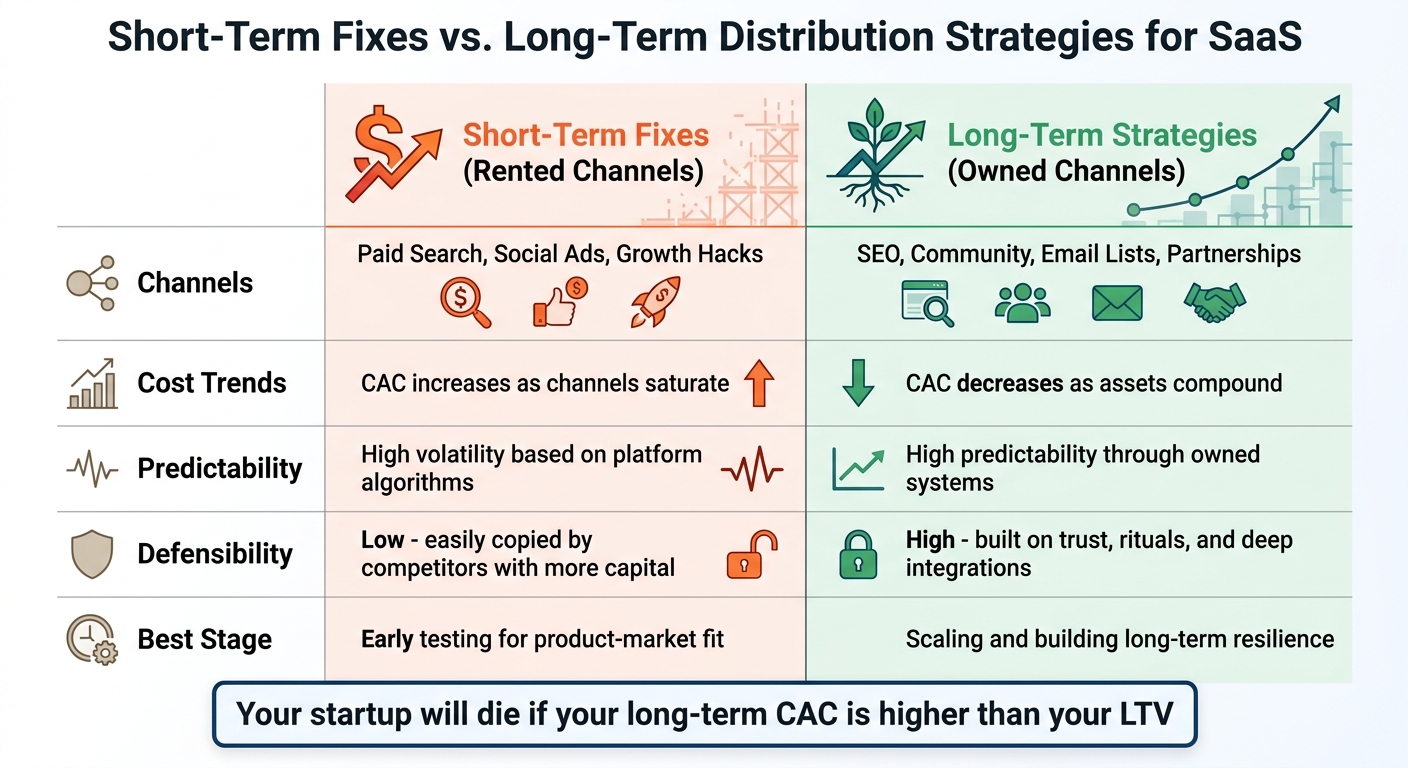
Short-Term vs Long-Term SaaS Distribution Strategies Comparison
Once you’ve put your distribution framework into action, the next step is to evaluate its impact. This means distinguishing between quick wins and strategies that build lasting resilience by closely monitoring key business metrics.
Short-Term Fixes vs. Long-Term Distribution Strategies
Not all distribution methods deliver the same results. Short-term fixes, like paid ads or Product Hunt launches, can bring an immediate boost in signups, but these effects often fade quickly. On the other hand, long-term strategies - such as SEO, community engagement, and growing email lists - tend to build momentum over time and can significantly lower your customer acquisition costs.
| Feature | Short-Term Fixes (Rented) | Long-Term Strategies (Owned) |
|---|---|---|
| Channels | Paid Search, Social Ads, "Growth Hacks" | SEO, Community, Email Lists, Partnerships |
| Cost Trends | CAC often increases as channels saturate [22] | CAC typically decreases as assets compound [2] |
| Predictability | High volatility based on platform algorithms [2] | High predictability through owned systems [2] |
| Defensibility | Low; easily copied by competitors with more capital | High; built on trust, rituals, and deep integrations [2] |
| Best Stage | Early testing for product-market fit | Scaling and building long-term resilience |
The takeaway here is clear: owned channels grow in value over time, while rented channels are more unpredictable and often dependent on external factors.
"Your startup will die if your long term number for CAC is higher than your LTV" [22].
Key Metrics for Distribution Ownership Success
To gauge whether your distribution efforts are setting your business up for lasting success, focus on these critical metrics:
- Customer Acquisition Cost (CAC): This measures the total sales and marketing expenses needed to gain a new customer [20][21]. Break this down by channel to see which strategies are the most cost-effective, as CAC can vary significantly.
- Customer Lifetime Value (LTV): This reflects the total revenue you expect from a customer over their relationship with your product [20][23]. A healthy SaaS business typically aims for an LTV to CAC ratio of at least 3:1 [20][22], though some investors might look for 4:1 [24]. If your ratio is too low, it’s a sign you’re spending too much on customers who aren’t sticking around.
- CAC Payback Period: This metric shows how long it takes to recover your customer acquisition costs [20][22]. Ideally, this should be under 12 months [22].
- Net Revenue Retention (NRR): This calculates the percentage of recurring revenue retained from existing customers, including upsells and downgrades [21][23]. An NRR above 100% - indicating “negative churn” - is a strong signal of success, as it shows your existing customers are driving additional revenue.
- Churn Rate: This tracks the percentage of customers who cancel their subscriptions [20][21]. For SaaS companies, a monthly churn rate between 5% and 7% is considered healthy [23]. Pay close attention to discretionary churn (e.g., customers with expiring contracts) to get a clear picture of overall satisfaction [22].
Additionally, monitor Activation Rate by Source to see if specific channels are bringing in users who engage with your product’s core features [2]. Similarly, measure Retention by Channel to identify which strategies are keeping users around and avoiding the dreaded “leaky bucket” effect [2].
"The readers of this blog should be focused on cashflow profitability, not revenue profitability" [22].
When relying on annual upfront payments, it’s crucial to track cashflow rather than just recognized revenue. This ensures your business has the liquidity it needs to handle daily operations.
Conclusion: Distribution Ownership Determines SaaS Survival
AI didn't destroy SaaS - what did was founders neglecting to take control of how they reach customers. In today’s landscape, technical features alone won't set you apart anymore[4]. The real edge lies in the relationship and trust you've built with your audience[4][5].
Here’s a stark reality: about 90% of new SaaS products fail[1], and 42% of startup failures boil down to "no market need." Often, this phrase is just a cover for a lack of effective distribution[16]. Peter Thiel captured it perfectly:
"Superior sales and distribution by itself can create a monopoly, even with no product differentiation."[5]
Fast forward to 2026, and this isn't a hypothetical. It's a matter of survival.
Distribution brings users in, while product quality keeps them around[4]. But if you don’t own your channels - like email lists, communities, integrations, or partner ecosystems - you’ll find yourself endlessly paying third-party platforms just to engage with your customers[2].
To thrive in the AI-driven era, focus on building your audience before your product. Look for ways to integrate into existing workflows and bake distribution into every feature you create[2]. Define your distribution strategy in one clear sentence, stick to two primary channels for at least six weeks, and track key metrics - CAC payback, retention rates by channel, and activation rates by source[2].
FAQs
What does it mean to own distribution?
Owning distribution is all about taking charge of how your product gets into the hands of customers. Instead of depending only on standout features or conventional marketing efforts, it means establishing a reliable system to engage with your audience where they already spend their time. This could be through platforms like social media, niche online communities, direct interactions, referrals, or even partnerships. By doing this, you safeguard your SaaS product from becoming just another option in a crowded market and maintain steady visibility and user adoption.
How do I pick my best distribution channel?
Pick distribution channels that you can directly manage and control instead of banking on product features or the hope of going viral. To get started, test two channels that align closely with your audience's habits and preferences for a 30-day period.
During this test, track actionable metrics - such as signups or paying customers - rather than getting distracted by vanity metrics like likes or shares. The goal is to identify which channels are driving real results.
For the best outcome, focus on platforms where your target audience is already engaged. This ensures your efforts are directed where they’ll have the most impact.
How can AI help me grow without ads?
AI can play a key role in helping your SaaS business grow without relying on ads by supporting scalable distribution strategies. The idea is to "own the channel" - connect with your audience where they already spend their time, such as social media platforms or online communities. With AI tools, you can automate tasks like content creation, outreach, and engagement. This approach encourages organic growth through referrals, integrations, and community-driven initiatives, cutting down on ad spend while achieving steady, cost-efficient growth.
Related Blog Posts
- How AI Improves Retention Campaigns in SaaS
- AI Native SaaS The New Blueprint for Startups Scaling to 8 Figures
- Is Your SaaS an AI “Wrapper”? Why Most Thin AI Layers Will Collapse (And How to Build a Defensible Data Moat).
- I Analyzed 19 Viral SaaS Founder Interviews. The #1 Pattern: Distribution Beats Product, Every Time.