Here’s what’s happening:
- AI is changing the game: By late 2025, nearly 50% of venture capital funding ($238 billion) went to AI startups, signaling a shift in focus. SaaS stocks dropped 20% as AI-first solutions gained traction.
- Workflow lock-in is obsolete: AI agents bypass traditional user interfaces, completing tasks directly via APIs. This makes many SaaS tools redundant.
- Pricing models are under pressure: Per-seat pricing is fading as AI agents replace human users. Investors now favor platforms with proprietary data and full workflow control.
- Big platforms are taking over: Companies like Salesforce and Microsoft are embedding AI into their ecosystems, reducing the need for standalone tools.
What SaaS Companies Must Do:
- Focus on proprietary data: Exclusive datasets are a durable advantage AI can’t replicate.
- Own end-to-end workflows: Products that manage entire processes are harder to replace.
- Build API-first architectures: AI agents interact directly with APIs, not UIs.
- Target regulated industries: Compliance-heavy sectors like healthcare and finance provide natural barriers to AI disruption.
If your software doesn’t deliver unique value beyond automation, its relevance - and funding - are at risk.
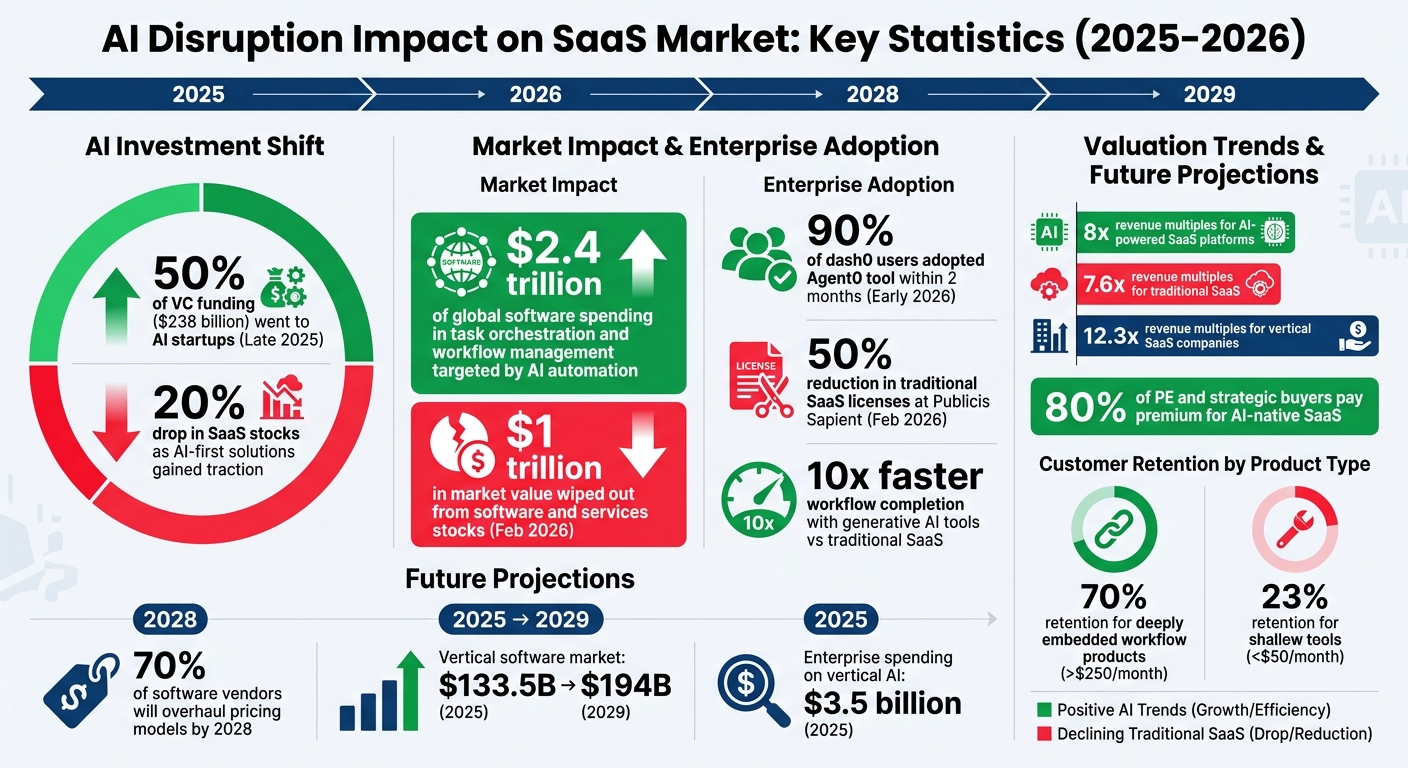
AI Disruption Impact on SaaS Market 2025-2026: Key Statistics
Are we in a 'SaaSapocalypse'? Tech VC explains AI's disruption of software
sbb-itb-9cd970b
Why Old SaaS Advantages Are Breaking Down
The long-standing advantages that SaaS companies once relied on - like sticky workflows, complex integrations, and polished user interfaces - are no longer the barriers they used to be. With the rise of AI agents, these traditional defenses are quickly losing their relevance.
How AI Agents Bypass User Interfaces
AI agents are changing how software is used by completely skipping user interfaces. Instead of relying on onboarding flows or manual navigation, these agents connect directly to APIs to get things done. The focus has shifted from keeping users engaged in a specific UI to delivering outcomes. Humans now set goals, and AI agents handle the execution, automating tasks from start to finish via APIs [6].
This automation is eliminating many of the intermediate steps that used to define workflows. Tasks like sending follow-ups, reconciling records, or updating databases - once the backbone of entire software categories - are now handled autonomously [6]. For example, in early 2026, the observability platform dash0 saw 90% of its users adopt its "Agent0" tool within just two months. This tool shifted the product's focus from manual dashboard monitoring to autonomous agent-driven oversight [6]. As a result, the value of traditional UI-based workflows has plummeted, putting entire SaaS categories at risk.
SaaS Categories Losing Investor Interest
As AI agents make traditional UIs less relevant, certain SaaS products are losing their appeal to investors. Here are a few examples:
- Thin AI wrappers: These are tools that merely layer a user interface on top of existing LLM APIs. They are easily replicated by AI-native teams [1][3].
- Generic productivity and task management tools: Products designed to coordinate human workflows are becoming unnecessary as AI agents take over task execution [1][3].
- Standard CRM clones and basic analytics dashboards: Tools that simply retrieve and display API data are being replaced by AI agents capable of generating insights and visualizations on demand [1][5].
Abdul Abdirahman, an investor at F-Prime, explains this shift:
"Workflow automation and task management tools that enable the coordination of human work become less necessary if, over time, agents just execute the tasks." [1][3]
The numbers are staggering. Approximately $2.4 trillion of global software spending in task orchestration and workflow management is now being targeted by AI automation [8]. In February 2026, investor sell-offs wiped out nearly $1 trillion in market value from software and services stocks as the market adjusted for the impact of AI disruption [7][9]. This shift is happening alongside major platforms embedding AI directly into their ecosystems, reducing the need for standalone SaaS products.
How Big Platforms Are Replacing Third-Party Tools
Big platforms are stepping in and embedding AI agents directly into their ecosystems, making many standalone tools redundant [1][10]. For instance, Salesforce launched Agentforce with a new Agentic Enterprise License Agreement (AELA), offering fixed-price, unlimited access to its AI agents [10]. Similarly, Microsoft is extending its Copilot Studio with consumption-based pricing for AI-driven offerings [10].
The results are clear. Publicis Sapient reported cutting traditional SaaS licenses by roughly 50% in February 2026, replacing them with generative AI tools and chatbots that complete workflows ten times faster [11]. Around the same time, Goldman Sachs partnered with Anthropic to deploy AI agents based on the Claude model, automating back-office tasks like trade accounting and client onboarding [10].
Adding to this shift, the Model Context Protocol (MCP) is speeding up the consolidation of tools. Often referred to as the "USB-C for AI", MCP standardizes how agents connect to data and tools, erasing the competitive edge that platforms with extensive integrations once had [1][4]. Jake Saper, General Partner at Emergence Capital, puts it bluntly:
"Being the connector used to be a moat. Soon, it'll be a utility." [3][4]
What Still Protects SaaS Companies from AI Disruption
Even as AI reshapes the landscape, some business models and barriers remain robust enough to withstand disruption. By focusing on assets that AI cannot replicate, SaaS companies can maintain their edge.
Proprietary Data as a Competitive Barrier
In 2026, proprietary data stands out as one of the most durable advantages. While AI can mimic features and automate processes, it cannot access exclusive datasets that SaaS companies have built over years of customer interactions. This data forms what investors now call a "data engine", creating a self-reinforcing advantage [13].
As Livmo explains:
"Your proprietary dataset - the one that exists because your customers have been interacting with your platform for years - is the asset. The features built on top of it are secondary." [13]
AI-powered SaaS platforms are reaping the benefits of this edge, with revenue multiples exceeding 8x, compared to 7.6x for traditional SaaS [12]. Vertical SaaS companies, especially in fields like fintech, logistics, and legal technology, are seeing even higher multiples - around 12.3x - because their specialized datasets are essential for industry-specific AI applications [12]. In fact, 80% of private equity and strategic buyers report paying a premium for AI-native SaaS due to these proprietary data advantages [13].
This defensibility is driven by a "compounding data flywheel." AI systems trained on exclusive datasets improve continuously, quarter after quarter, giving these companies a trajectory that investors now prioritize during due diligence [13].
While proprietary data is a powerful shield, controlling full workflows is another critical strategy.
Controlling Complete Workflows Instead of Single Tasks
Owning an end-to-end workflow offers far more protection than automating isolated tasks. When a product handles the entire process - initiating, routing, approving, executing, and auditing work - it becomes indispensable. On the other hand, tools that focus on single tasks are more vulnerable to being replaced by general AI agents [2][3].
Take the example of Harvey, a legal AI platform. By embedding itself into document management systems for over 1,000 customers, Harvey achieved $195 million in ARR by January 2026. Its valuation skyrocketed to $11 billion the following month, thanks to its control over comprehensive legal workflows, including quality checks - not just document generation [15].
EvenUp provides another illustration. By processing over 10,000 personal injury cases weekly and managing more than 200,000 cases by late 2025, it has gone beyond offering templates. Instead, it captures "case strategy reasoning", detailing how attorneys value injuries and structure arguments, making it an essential part of the workflow [15]. Similarly, Tractable, which has managed more than $7 billion in insurance claims, uses closed-loop outcome data to deliver actionable claims guidance, transforming itself into a "system of action" rather than just a reporting tool [15].
Data shows that deeply embedded workflow products priced above $250 per month retain 70% of customers, while shallower tools priced below $50 per month retain only 23% [15]. As Jake Saper, General Partner at Emergence Capital, puts it:
"One owns the developer's workflow, the other just executes the task." [2][3]
In addition to workflow control, embedding specialized industry expertise further strengthens a company's position.
Specialized Knowledge and Live Collaboration Features
Vertical SaaS platforms that integrate deep industry expertise are especially hard for generic AI agents to replace. This is particularly true in industries with strict regulatory requirements, complex compliance needs, or deterministic systems where accuracy is non-negotiable [11][14][16]. For example, software managing deterministic systems like accounting, ERP, or payroll remains essential because of the precision these workflows demand. AI agents, which are inherently probabilistic, are not reliable enough for tasks where errors could lead to financial or legal consequences [11]. Industries requiring compliance with standards like HIPAA, FedRAMP, or PCI also pose significant barriers, as AI agents cannot independently meet these certifications [14][1].
Capturing "recorded expert decision-making" - the systematic documentation of how experts handle complex rules, exceptions, and approvals - creates a moat that generic AI cannot cross [15]. Systems that track their own recommendation effectiveness and improve based on feedback develop a "closed-loop" advantage that strengthens over time [15].
The numbers back this up: enterprise spending on vertical AI reached $3.5 billion in 2025, highlighting the value of domain-specific expertise [15]. Vertical software is projected to grow from $133.5 billion in 2025 to $194 billion by 2029, further emphasizing the resilience of these tailored solutions [17].
How SaaS Founders Can Prepare for an AI-First Market
The rise of AI agents isn't some far-off possibility; it's already reshaping the landscape. To stay competitive, SaaS founders need to rethink their architecture, assets, and features to ensure their platforms remain relevant and valuable.
Building for API-First Integration
By 2026, the API becomes the centerpiece of your product. AI agents don’t rely on graphical interfaces - they interact directly with your backend, executing workflows at speeds far beyond human capabilities. This means your API must be robust enough to handle hundreds of calls in the time it takes a person to click a mouse [14].
Shifting to an API-first or headless architecture ensures your software is ready for this agent-driven future. Standards like MCP make it easier for AI to navigate your system, preventing your platform from fading into the background. As Nicolas Mialaret from Asteri Partners explains:
"The API is the Product. A robust, documented and scalable API will become more important than an easy to use, responsive GUI." [14]
Instead of focusing solely on user-friendly interfaces, think of your UI as a "Control Tower" - a space where humans can audit AI decisions, set approval thresholds, and monitor outcomes rather than performing tasks themselves [14]. This approach not only improves operational efficiency but also reassures investors that your platform won’t be sidelined in an AI-dominated workflow.
Creating Assets AI Cannot Copy
To stand out, your focus should shift to building assets that AI cannot replicate - namely, proprietary, high-quality data. This includes capturing structured context like user roles, task specifics, and feedback on whether AI-driven recommendations actually deliver results [18].
Nick Talwar, CTO and AI Engineer, puts it succinctly:
"Your moat isn't the model you use. It's what you capture while using it." [18]
Another safeguard is ensuring deterministic outcomes - tasks where precision is non-negotiable, such as payroll processing or tax calculations. These mission-critical functions leave no room for AI errors or "hallucinations" [14]. Similarly, compliance and liability create natural barriers. AI agents cannot hold certifications like FedRAMP, HIPAA, or PCI, nor can they accept legal responsibility for failures or breaches [14][1].
To build a strong position, target regulated industries where complexity and compliance create entry barriers. Use this opportunity to collect high-quality usage data and corrections in real-time, creating a unique training dataset [18]. By owning the operational risk and liability that AI cannot assume, you carve out a space that’s hard for competitors to penetrate.
Adding AI Features That Go Beyond Automation
Automation is no longer enough to differentiate your product. The edge lies in creating "Systems of Action" - features that don’t just present data but take action based on it [1][3]. For instance, instead of showing a dashboard highlighting churn risk, build a system that automatically initiates retention strategies.
To achieve this, focus on capturing "structured thinking" - the logic behind how experts make decisions. This includes triage rules, policy reasoning, and exception handling, which are far more challenging for generic AI models to replicate [15].
Outcome feedback loops are another key element. These loops track whether AI-driven actions are successful and use that data to improve continuously [15][2]. Proprietary testing frameworks tailored to industry-specific benchmarks - rather than generic ones - can further enhance your AI’s effectiveness [15].
Additionally, consider implementing voice AI to capture expert reasoning in real-time conversations, such as those between doctors and patients. This allows you to encode not just what decisions are made, but why they’re made, creating a deeper competitive advantage [15]. By focusing on these strategic shifts, you ensure your software remains indispensable in the AI-first era, maintaining both relevance and investor trust.
Conclusion: Building SaaS Companies That Last
What SaaS Founders Need to Remember
In the evolving landscape shaped by AI, the focus for SaaS companies has shifted. The real value today lies in owning complete workflows and exclusive data. The concept of "workflow stickiness" is fading fast. Investors are now scrutinizing software by asking a tough question: if an AI agent can handle the task, why is your software necessary? And the answer can't just be a sleek interface or standard integrations.
To stay indispensable, your software must become the backbone where work is defined, routed, audited, and controlled - whether it's handled by a person or an AI. This means creating systems of action that automate tasks seamlessly. Invest in assets like proprietary data and structured processes that grow in value over time. Regulated industries such as healthcare, legal, or finance present unique opportunities, as their compliance complexities create natural barriers to entry.
Igor Ryabenkiy, Founder & Managing Partner at AltaIR Capital, captures this shift perfectly:
"Investors are reallocating capital toward businesses that own workflows, data, and domain expertise - and away from products that can be copied without much effort." [1]
This trend calls for a fundamental rethinking of your product's architecture to stay competitive.
Maintaining Value in a Changing Market
Staying relevant means embracing change. By 2028, it's projected that 70% of software vendors will overhaul their pricing models, with per-seat billing becoming a relic of the past [1]. If your revenue still depends on headcount, it's time to rethink your approach. Consumption-based or outcome-based pricing - aligned with the actual work performed - offers a more sustainable path forward [20].
To remain competitive, prioritize API-first integration. Standards like the Model Context Protocol (MCP) allow agents to interact with your backend effortlessly [1][3]. Focus on building assets that AI can't duplicate, such as deterministic outcomes, liability frameworks, and real-time validation systems. These ensure that autonomous agents operate within trusted and governable boundaries [19].
And here's the ultimate litmus test: if you strip away the UI and are left with just data and workflow controls, does your product still stand out? [2] If the answer is no, your valuation likely reflects that reality already. It might be time to rebuild before the market forces you to act.
FAQs
How do I prove my SaaS is needed if an AI agent can do the work?
To ensure your SaaS stays relevant in an era dominated by AI agents, it’s crucial to underscore the unique value your platform offers - something AI struggles to replicate. This could include leveraging proprietary data, embedding deeply into users' workflows, or addressing specialized needs in highly regulated industries.
Highlight assets that make your software indispensable, such as mission-critical workflows, services with inherent complexity, or tasks that demand expertise beyond AI’s reach. By doing so, you reinforce your platform’s role as irreplaceable and demonstrate its lasting importance to potential investors.
What proprietary data should my product capture to stay defensible?
To keep your edge as AI reshapes SaaS workflows, prioritize gathering proprietary, domain-specific, or context-rich data that general AI models can't easily mimic. Data that highlights outcomes - like metrics demonstrating how your workflows enhance operations - adds even more value. By shifting focus from AI models to the data itself, you ensure your product stands out. This approach emphasizes data that reinforces your workflows, results, and customer connections, rather than depending solely on AI technology.
What should I replace per-seat pricing with in an agent-driven world?
In a world increasingly influenced by AI-driven agents, it might be time to rethink the traditional per-seat pricing model. Instead, consider alternatives like pay-for-performance, usage-based pricing, or even higher per-seat charges that align with the enhanced productivity brought by AI agents. These pricing strategies are better suited to reflect the value AI agents deliver and adapt more effectively to the changing dynamics of the SaaS industry.
Related Blog Posts
- The SaaS Valuation Gap: Why Typical Firms Stall at 4-6× While AI-Enabled Ones Hit 10×+
- Is Your SaaS an AI “Wrapper”? Why Most Thin AI Layers Will Collapse (And How to Build a Defensible Data Moat).
- 8. $4.9 Trillion in M&A in 2025. A Record. 25% of Every Deal Over $5 Billion Had an AI Theme. This Is Not a Cycle. This Is a Structural Shift in Who Controls Valuable Assets. CNBC
- 15. Blackstone, KKR, and Silver Lake Aren't Competing With Each Other. They're All Buying the Same Asset - Data-Controlled Distribution - From Founders Who Don't Know What They Actually Have.