Private equity giants Blackstone, KKR, and Silver Lake are not vying for AI models or flashy tech. Instead, they’re targeting the invisible infrastructure that powers AI workflows: data-controlled distribution systems. These systems ensure AI outputs - like contracts or financial reports - are verified, traceable, and seamlessly integrated into enterprise operations. The real value lies in owning the "pipes" that deliver and validate data, not the AI itself.
Here’s the key takeaway:
- Blackstone focuses on physical infrastructure like data centers and secure systems (e.g., Smartsheet, Citrix).
- KKR invests in AI-enabling assets like power grids and hyperscale data centers.
- Silver Lake targets tech companies with strong data distribution and workflow dominance.
These firms aim to control the backbone of AI operations - what some call the "toll booths" for AI workflows. While founders obsess over features, these investors see the overlooked value in compliance, integrations, and workflow systems.
1. Blackstone

Investment Focus
Blackstone is steering its investments toward secure and verified data infrastructures. The firm refers to these systems as "Forensic Fortresses", which are designed to log, structure, and audit enterprise outputs. These platforms function as both relational databases and secure containers, capturing and verifying AI-generated outputs [4].
The firm's strategy focuses on two key asset types: Evidence Lockers, like Smartsheet, which store the "what" of work, and Secure Pipes, such as Citrix, which handle the "how" of data transmission. In January 2025, Blackstone, alongside Vista Equity Partners, completed an $8.4 billion acquisition of Smartsheet [4]. Earlier, the two firms executed a $16.5 billion takeover of Citrix, ensuring sensitive AI workflows could operate securely without relying on the public internet [4]. These acquisitions are central to Blackstone's broader plan to control the critical data pipelines that underpin AI workflows.
Beyond software, Blackstone is also targeting the physical infrastructure that powers AI. The company privatized QTS for $10 billion in 2021, and by 2025, QTS had become the top-performing asset in Blackstone's $1.3 trillion portfolio [5]. To address the energy demands of these facilities, Blackstone acquired TXNM Energy, a utility holding company, for $11.5 billion in 2026 [5]. This focused investment approach underscores the scale and ambition of Blackstone's strategy, evident in the size of its deals.
Deal Sizes
Blackstone's infrastructure platform saw remarkable growth in 2025, expanding by 40% to reach $77 billion, with returns of 23.5%. The firm also reported $239 billion in total inflows that year - the highest since 2021 - driven largely by growing investor interest in AI-related assets [5]. In 2024, Blackstone led a group to provide a $7.5 billion loan to CoreWeave, a data center operator, to support its AI infrastructure expansion [5].
Value Creation Strategy
Blackstone's investments are guided by a clear value creation goal: to own the toll booth for AI workflows. As Stephen Schwarzman explained:
The historic pace of investment taking place in the US to facilitate the development of artificial intelligence... is the key driver of economic growth today [5].
sbb-itb-9cd970b
2. KKR

Investment Focus
KKR is zeroing in on the physical networks that enable and authenticate AI workflows, aligning with the broader shift toward data-driven distribution. Their investments are centered on the physical infrastructure that powers computation, such as data centers, power grids, and connectivity assets. These assets are critical to supporting hyperscalers like Amazon, Google, Microsoft, and Meta. KKR targets structural bottlenecks in AI distribution, including access to power, land with grid connections, and essential permits.
Since 2019, KKR has committed a staggering $31.3 billion in equity capital to digital infrastructure. This includes five major data center platforms spanning hyperscale, colocation, and edge infrastructure [8]. In April 2026, the firm closed its North America Fund XIV with around $23.0 billion in capital. Shortly after, its portfolio company, CyrusOne, was chosen by the U.S. Army to construct and operate a large AI-focused data center [9].
KKR also employs Agentic AI to streamline processes like market scanning, KPI standardization, and pricing optimization. These efforts set the stage for the significant capital commitments outlined below.
Deal Sizes
KKR’s investments reflect the enormous capital demands of AI infrastructure. Hyperscalers are projected to spend over $350 billion on capital projects in 2025 - a year-over-year increase of more than 30%. By mid-2025, AI-related capital expenditures already represent about 5% of U.S. GDP. McKinsey forecasts that global data center infrastructure capital expenditures will approach $7 trillion by 2030 [8].
Value Creation Strategy
KKR’s strategy for generating returns builds on its extensive investments and scale. As the firm's Global Infrastructure Team noted:
Those who own the tangible resources and master the intangible ones are in a better position to win [8].
The firm emphasizes take-or-pay contracts, ensuring tenants pay for capacity regardless of usage, which secures predictable cash flows even before full utilization. KKR prioritizes profitability by focusing on unit economics rather than speculative market sizes. Projects are evaluated based on returns after factoring in power and capital costs. Additionally, KKR leverages its "One KKR" model, which integrates expertise and resources across digital, power, renewables, and industrial sectors where data and computation intersect [8].
3. Silver Lake

Investment Focus
Silver Lake takes a different path compared to firms like Blackstone and KKR. Instead of focusing on physical infrastructure, it zeroes in on the data distribution layer - a critical component in driving enterprise AI value. Managing around $110 billion in assets, the firm targets established tech companies with strong data flows and dominant market positions [14].
Silver Lake’s strategy revolves around investing in "established tech leaders operating at scale." These are not fledgling startups but companies with proven business models that thrive on significant user engagement and robust data streams. Its portfolio spans sectors like SaaS, data management, e-commerce, and AI-driven enterprises. Together, these investments represent over $1 trillion in cumulative enterprise value [13][14]. This approach not only sets Silver Lake apart but also positions it for high-impact, large-scale deals.
Deal Sizes
Silver Lake’s focus on major players is reflected in the size of its transactions, which typically range from $1 billion to over $50 billion [13][14]. A standout example came in September 2025, when the firm led the largest leveraged buyout in history, acquiring Electronic Arts for $55 billion. This deal was completed in partnership with Saudi Arabia's Public Investment Fund and Affinity Partners, with JPMorgan Chase contributing $20 billion in debt financing [10][14].
Other notable deals include:
- Endeavor: Valued at $25 billion (2024–2025)
- Qualtrics: Acquired for $12.5 billion (2023)
- Vantage Data Centers: $6.4 billion in equity reinvestment
- Software AG: Purchased for $2.6 billion
Additionally, Silver Lake closed its seventh flagship fund in May 2024, securing $20.5 billion in capital commitments [13].
Value Creation Strategy
Silver Lake’s approach to value creation emphasizes proprietary data flows and mission-critical workflows - key elements in AI ecosystems. By focusing on these areas, the firm ensures its investments remain indispensable in the evolving tech landscape. It also takes advantage of market disruptions, such as the sharp decline in public software company valuations. Between 2021 and 2026, forward revenue multiples dropped from 15×–25× to just 3.9× - a 70% to 80% contraction - creating opportunities to acquire high-quality assets at reduced prices [11].
The firm’s Co-CEOs, Egon Durban and Greg Mondre, have highlighted this focus:
As the promises and risks of the AI era accelerate, our talented team, strong industry network, and ability to commit substantial strategic and operational resources means our horizon of opportunity to make highly select, impactful investments... has never been more compelling [13].
Silver Lake evaluates investments based on two main criteria: proprietary data that cannot be replicated by large language models and workflows with clear automation value [12]. Over the past 15 years, its flagship funds have delivered a 21% net rate of return after fees [13]. The firm’s long-term strategy reflects a shift in private equity dynamics, with roughly 40% of returns now driven by revenue growth and margin expansion rather than the multiple expansion and leverage that dominated previous cycles [12].
Silver Lake typically holds its investments for over six years, focusing on operational transformations. A key part of this strategy involves transitioning assets from seat-based pricing to outcome-based models, ensuring sustained value and relevance in a rapidly changing market [12].
Move Over Private Equity. Private Infrastructure Investing: AI Boom Beneficiary? Feat Mike Dorrell
Strengths and Weaknesses of Each Firm's Approach
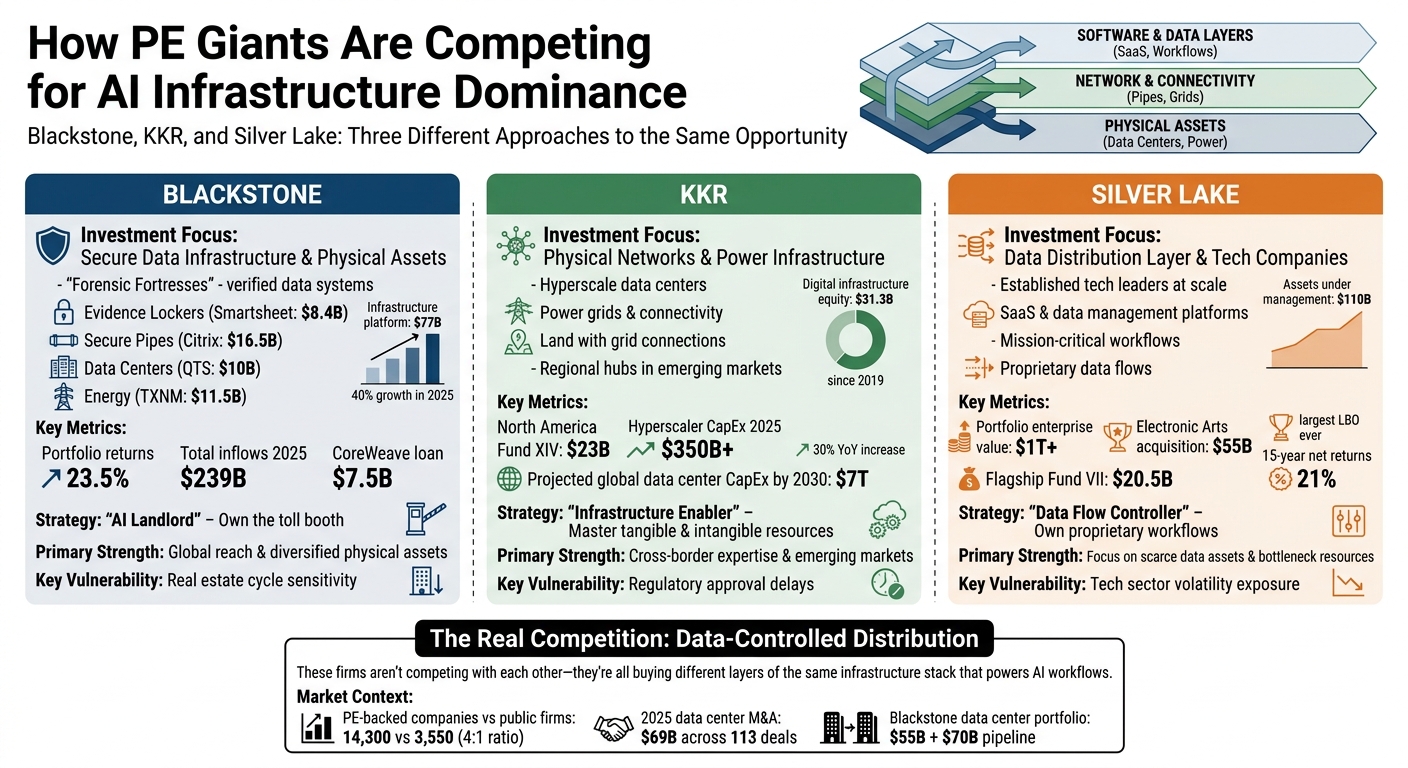
Private Equity AI Infrastructure Investment Strategies: Blackstone vs KKR vs Silver Lake
Each firm has its own strengths and vulnerabilities, shaped by their strategic priorities and operational methods. Here's a breakdown of their approaches, highlighting what sets them apart and the risks they face.
Blackstone takes advantage of its global presence and diversified portfolio of physical assets. According to Jon Gray, President and COO at Blackstone:
Blackstone seeks to be the leading digital infrastructure investor in the world across the ecosystem, including data centers, power and related services [7].
This "AI landlord" model gives Blackstone an expansive reach but also ties its fortunes to fluctuations in real estate cycles and interest rates [15].
KKR shines in cross-border transactions and investments in emerging markets. Their focus on these regions is evident in their strategic moves. Tara Davies, Co-Head of KKR EMEA, remarked:
The Middle East is a fast-growing region for hyperscale deployment... we believe it is today one of the most attractive investment destinations for long-term capital [7].
However, KKR’s reliance on telecom infrastructure carve-outs can lead to challenges with regulatory approvals and legal delays, complicating deal execution [15].
Silver Lake distinguishes itself through a sharp focus on scarce resources and data-intensive assets. In August 2025, they launched a $400 million platform aimed at creating a global portfolio of "powered land" sites, targeting over six gigawatts of power across the U.S., Canada, and the U.K. Lee Wittlinger, Managing Director at Silver Lake, stated:
Our innovative approach to land and power solutions... will enable us to meet the evolving demands of hyperscalers with a holistic, differentiated approach [6].
However, its heavy concentration in the tech sector exposes it to risks from software repricing and disruptions driven by AI. For instance, a $1.2 trillion drop in software equities over five trading sessions in early 2026 highlighted the volatility of this sector [12].
The table below provides a side-by-side comparison of each firm's strengths, vulnerabilities, and strategic direction:
| Feature | Blackstone | KKR | Silver Lake |
|---|---|---|---|
| Primary Strength | Global reach and diversified assets | Expertise in emerging markets | Focus on scarce inputs and data assets |
| Key Vulnerability | Sensitivity to real estate cycles | Regulatory and legal hurdles | High exposure to tech sector volatility |
| Strategic Focus | Physical infrastructure for AI | Regional hubs with energy advantages | Bottleneck assets and content delivery |
Each firm's strategy reflects its tolerance for risk and its area of specialization. Blackstone spreads its exposure across a broad range of physical assets, KKR dives into emerging markets with all their complexities, and Silver Lake zeroes in on precision investments, despite the concentrated risk. While their methods differ, all three are vying for dominance in the infrastructure and assets that drive AI operations.
Conclusion
Blackstone, KKR, and Silver Lake aren’t battling over algorithms or AI models - they’re doubling down on the infrastructure that powers data workflows. The real advantage lies in controlling the pipelines that verify, structure, and deliver data outputs [1].
By 2024, private equity-backed companies outnumber public firms by an astonishing ratio of 4:1 - 14,300 compared to just 3,550 [3]. These PE firms have a unique edge: they own vast networks of portfolio companies, allowing them to test AI tools in a few businesses, demonstrate their effectiveness, and then scale across the entire network. This approach eliminates the need for the traditional, lengthy enterprise sales process. In a world where AI models become commodities in months, the true edge is in distribution [1][2].
This shift highlights a critical insight: the hidden institutional meaning within workflows is the real source of competitive advantage. For SaaS and AI founders, the most valuable part of your business isn’t the technology itself - it’s your ability to capture and leverage institutional meaning. Platforms that manage decision-making contexts, prioritize workflows, and create clear, interpretable data layers possess assets far more valuable than many founders realize [16]. Marc Benioff summed it up perfectly:
Data and context is the true fuel of Agentforce, and without clean, connected, trusted data there is no intelligence, only hallucination [16].
The transformation is already happening. In 2025, mergers and acquisitions in the data center sector reached a record $69 billion across 113 deals [17]. Blackstone alone reported a $55 billion data center portfolio, with an additional $70 billion pipeline projected by early 2026 [17]. These firms are not just investing in compute and power - they’re building the infrastructure that controls the entire distribution layer, where customer relationships and value are anchored.
For SaaS and AI founders, it’s time to evaluate your institutional knowledge platforms - the decision histories, contexts, and workflows that define your value. This is the asset private equity firms are targeting, and it’s often the most overlooked yet critical part of your business, as this analysis has demonstrated.
FAQs
What is data-controlled distribution?
Data-controlled distribution is a strategy where businesses focus on dominating distribution channels and using data to their advantage. Rather than putting all their energy into the product itself, they aim to control the routes that connect them to their users. This ensures consistent and reliable access to their audience. In the world of AI and SaaS, this method creates a powerful "moat" by securing control and reach, making these assets tough for competitors to imitate or challenge.
Why do investors value workflows and integrations more than AI models?
Investors tend to focus more on workflows and integrations rather than just AI models. Why? Because these are the elements that truly fuel scalability, deliver consistent value, and create a competitive edge in the market.
While AI models are becoming more of a commodity, the real power lies in how they're integrated into workflows. This integration allows companies to build a lasting advantage by improving operational efficiency, embedding AI into existing systems, and creating proprietary data loops. On top of that, owning distribution channels and ensuring a smooth user experience adds even more long-term value - something standalone AI models simply can't achieve.
How can a founder tell if they own “toll booth” infrastructure?
Founders can spot "toll booth" infrastructure by determining whether they manage a data or distribution asset that acts as a gatekeeper in their ecosystem. This type of setup creates value through data-controlled distribution, rather than relying solely on product features. Typically, it involves having some degree of control over essential data flows or access points that others depend on to function.
Related Blog Posts
- The #1 Thing That Shocked Me When I Entered Private Equity
- What Founders Misunderstand Most About Private Equity
- 3. From 2015 to 2025, PE Acquired 1,900 Software Companies for $440 Billion. AI Is Now Dismantling the Thesis Behind Every Single One. Nobody on Wall Street Wants to Say It First. SaaStr
- 12. PE Has $2 Trillion in Dry Powder and a "Deploy or Return" Mandate. Every Dollar Chasing the Same Thesis: Own the Data. Own the Distribution. Everything Else Is Leverage. FinancialContent