Private equity (PE) firms don’t prioritize products, technology, or teams when acquiring businesses - they focus on distribution. Why? Distribution channels, customer relationships, and logistics are harder to replicate than innovative products. An analysis of 83 acquisitions revealed this core strategy:
- Distribution drives value: PE firms buy small distributors at 2.5×–4.5× EBITDA, consolidate them, and sell at 5×–7× EBITDA or more.
- Key strategies: Proven sales channels, add-on acquisitions, and diversified customer bases reduce risks and boost valuations.
- Investor readiness: Businesses with scalable, data-backed distribution systems command higher valuations.
The takeaway? A strong, scalable distribution network is the most critical factor in attracting PE buyers and achieving higher exit multiples. Focus on building repeatable systems, leveraging AI for scale, and reducing customer concentration risks.
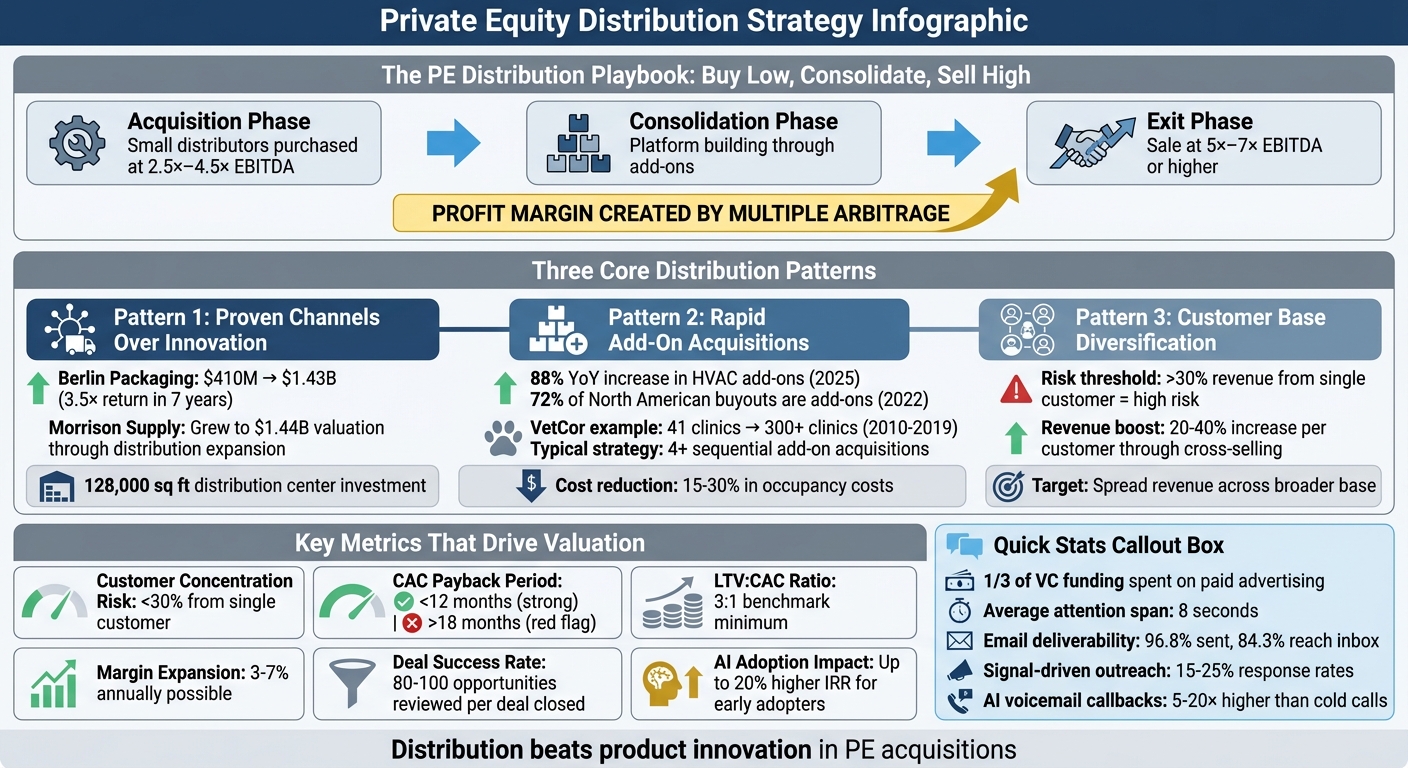
How Private Equity Firms Create Value Through Distribution: The Multiple Arbitrage Strategy
How Private Equity Leaders Evaluate Distributors
sbb-itb-9cd970b
Why PE Firms Value Distribution Over Everything Else
Founders often zero in on their product and team, but for private equity (PE) firms, customer reach takes center stage. Why? Because distribution - your audience and partnerships - is much harder to replicate than product features, which can often be duplicated via standardized AI APIs[5][6].
PE firms understand that many businesses don’t fail due to weak products. Instead, they struggle because they lack a dependable way to connect with customers[4]. As Chris Petkas, General Partner at Contrarian Thinking Capital, aptly explains:
"A decent product with great distribution will beat a great product with no distribution."[4]
How Distribution Drives Valuation Multiples
The unique challenge of replicating distribution makes it a key driver of valuation multiples. PE firms often leverage a strategy called multiple arbitrage. This involves acquiring smaller distributors at lower multiples, typically 2.5x–4.5x EBITDA, consolidating them into a larger platform, and then selling at higher multiples - 5x–7x EBITDA or more[7]. The gap between these multiples can translate into millions in profit, but only when the distribution network is strong enough to sustain growth.
During due diligence, PE teams closely analyze revenue models to gauge customer concentration risk[7]. If more than 30% of revenue comes from a single customer, the business is deemed overly reliant on that customer, which can lower its valuation[7].
A robust distribution network also allows for price hikes without significant customer churn. This can lead to annual margin expansions of 3–7%, significantly increasing the valuation of a $20 million EBITDA business at the time of exit[7].
Why Founders Often Overlook Distribution
Despite its importance, many founders underestimate distribution’s value. They often focus on product features, market share, or team credentials - elements that feel more tangible and within their control. Distribution, by contrast, can seem abstract, even though it’s critical from an investor’s perspective.
Here’s a telling statistic: roughly one-third of all venture capital raised is spent on paid advertising[4]. That’s billions of dollars funneled into chasing distribution after the product is already developed - a less efficient approach than integrating distribution strategies from the outset.
Another factor founders often miss is how fragmented consumer attention has become. With the average human attention span now hovering around 8 seconds[4], existing and trusted distribution channels are more valuable than ever. Trust isn’t something you can buy in bulk; it’s built gradually through reliable service and consistent customer engagement.
These realities highlight why prioritizing distribution from the beginning can make your business far more attractive to investors.
3 Distribution Patterns Observed in 83 Acquisitions
An analysis of 83 acquisitions highlights three recurring distribution strategies that private equity (PE) firms consistently employ. These aren't random occurrences - PE firms actively identify and implement these patterns during due diligence and post-acquisition. These strategies not only illustrate their approach but also offer valuable insights for businesses looking to strengthen their own distribution frameworks.
Pattern 1: Prioritizing Proven Sales Channels Over Product Innovation
This pattern revolves around the idea that strong distribution channels drive value more reliably than investing in new product innovations. PE firms favor established sales channels that ensure predictable cash flow over the uncertainties tied to developing new products [1].
Take Berlin Packaging, for example. In 2007, Investcorp acquired the company for $410 million. Instead of focusing on new product lines, they expanded its distribution network through four add-on acquisitions. By 2014, Oak Hill Capital Partners purchased the platform for $1.43 billion - over three times the original investment [8][2].
This approach isn’t limited to one industry. Advent International followed a similar path with Morrison Supply Company (MORSCO), an HVAC and plumbing distributor. After acquiring the company in 2011, Advent invested in a massive 128,000-square-foot distribution center and completed multiple acquisitions, both large and small. By focusing on distribution rather than product differentiation, they grew the business to a $1.44 billion valuation when Reece Group acquired it in 2018 [8].
Hugh MacArthur, a partner at Bain & Company, explains the rationale behind this strategy:
"A GP can justify the initial acquisition of a relatively expensive platform company by integrating smaller add-ons with lower multiples later on. This multiple arbitrage brings down the firm's average cost of acquisition." [8]
Consolidating distribution networks not only increases efficiency but also boosts valuation multiples, setting the stage for broader geographic and customer base expansion - leading directly to Pattern 2.
Pattern 2: Rapid Expansion Through Add-On Acquisitions
Rather than waiting for organic growth, PE firms aggressively pursue add-on acquisitions to expand their geographic footprint and diversify their customer base. This approach reduces risk while driving value creation at a faster pace.
The numbers back it up. In the HVAC sector, add-on acquisitions surged by 88% year-over-year through mid-2025 [9], and by 2022, add-ons accounted for about 72% of all North American buyouts [2].
VetCor provides a compelling example. Cressey & Company acquired the veterinary platform in 2010, starting with just 41 clinics. By tapping into a fragmented market, they acquired independent practices at mid-single-digit EBITDA multiples, eventually growing the platform to over 300 clinics by 2019 [8][2].
Once a platform reaches a certain scale, PE firms renegotiate supplier contracts to capitalize on consolidated buying power [1]. They also streamline logistics and warehouse operations, cutting occupancy costs by as much as 15–30% [1]. These efficiencies directly enhance EBITDA, further increasing valuation.
A typical buy-and-build strategy involves at least four sequential add-on acquisitions [7][8], with around 30% of these transactions forming part of larger roll-ups [8]. This structured approach is central to the PE playbook.
Pattern 3: Diversifying Customer Bases to Reduce Risk
Customer concentration poses a significant challenge for valuation. If a single customer represents over 30% of revenue, PE firms see the business as highly vulnerable [7]. Addressing this risk becomes a top priority after acquisition.
Cross-selling an expanded product catalog to the combined customer base is one way to tackle this issue. This strategy can boost average revenue per customer by 20–40% without increasing customer acquisition costs [1]. It also spreads revenue across a broader base, reducing reliance on a few large accounts.
PE firms also focus on acquiring businesses in adjacent geographies or complementary customer segments to further diversify revenue streams [1]. This minimizes the risk of a downturn or competitive threat significantly impacting overall revenue.
Institutionalizing customer relationships is another key tactic. By transitioning reliance from a founder's personal network to modern CRM systems and professional management, firms lower key-person risk and enhance revenue stability [1]. Additional measures, like vendor-managed inventory (VMI) and auto-replenishment programs, create high switching costs, locking in revenue across a wider customer base.
The end result? A business transformed from one overly dependent on a handful of large customers to a diversified platform with numerous smaller, more stable relationships. This type of de-risked distribution model commands a premium from strategic buyers.
These patterns highlight the importance of strong distribution systems - a critical foundation for building investor-ready businesses, as will be explored next.
How to Build Investor-Ready Distribution Systems
Understanding what private equity (PE) firms are looking for is one thing - creating a distribution system that appeals to them is another challenge entirely. Many founders struggle to turn strategic ideas into actionable systems. If you want to catch the attention of investors, you need to start building these systems now.
Here’s a three-step approach: evaluate your current channels to identify strengths and weaknesses, use AI to scale successful strategies without ballooning your team, and grow through well-chosen partnerships. These steps work together to make your business more attractive to investors.
Insights from 83 acquisitions show that systematizing your distribution channels is critical for creating value. It all starts with a thorough audit of your existing methods.
Step 1: Audit and Optimize Your Current Distribution Channels
Many founders think they have a good grasp of their distribution channels - often based on intuition or anecdotal evidence. But PE firms want to see data-backed systems, not just gut feelings. They’ll dig into every detail to ensure your approach is scalable and repeatable.
Start with "The Tenth Customer" rule. If you can’t clearly explain how your tenth customer - beyond your initial personal connections - found and chose your product, your distribution system may not yet be scalable [10]. This simple test helps you identify whether you’re relying too much on personal networks instead of building a broader, repeatable model.
Next, refine your ideal customer profile (ICP) based on data. Broad targeting often leads to poor results. For example, instead of going after generic "mid-market B2B companies", focus on a specific niche like "outpatient behavioral health clinics with $5–20 million in revenue in the Southeast." Companies that fail to narrow their ICP often struggle to build enough pipeline to meet revenue goals, as seen in 54% of businesses that missed their targets for 2024–2025 [14].
High-performing firms often use a phased approach to distribution. They typically progress through four stages:
- Outbound efforts (0–3 months)
- Inbound strategies (3–6 months)
- Marketing campaigns (6–9 months)
- Partnerships (9+ months) [11]
A channel is considered optimized when its performance is consistent across various customer segments and multiple sales reps can hit their goals [11]. Another critical metric is the customer acquisition cost (CAC) payback period. Investors view a payback period under 12 months as strong, while anything over 18 months raises red flags about long-term sustainability [13].
Once you’ve optimized your distribution channels, you can use AI tools to scale your efforts efficiently.
Step 2: Use AI Tools to Scale Lead Generation
AI has become a game-changer for scaling outreach while keeping it personalized and efficient [14]. The shift from manual prospecting to AI-driven systems allows companies to maintain personalization at scale without significantly increasing costs.
Nearly half of dealmakers (49%) use AI tools daily [17], and early adopters report up to 20% higher internal rate of return (IRR) [16]. A complete AI-powered lead generation stack - including tools for lead discovery, data enrichment, outreach automation, and personalization - can cost as little as $1,000 per month [18].
Here’s how to make the most of AI:
- Use platforms like Clay or Apollo for prospecting and data enrichment, which cost about $0.01 per verified email [17].
- Maintain sender reputation by using 5–10 domains with 50–75 emails each for outreach [15]. Even though average B2B email deliverability is 96.8%, only 84.3% of emails actually make it to the inbox due to corporate filters [15].
- Leverage AI-driven personalization to boost engagement. For instance, some platforms achieve response rates as high as 35% by tailoring messages based on prospect backgrounds and timing outreach to key buying signals [12]. Signal-driven outreach - like contacting a company after it hires a new CFO or hits a revenue milestone - can achieve response rates of 15–25% [16].
- Tools like Claude help generate personalized copy, while platforms like VoiceDrop.ai use AI voice cloning for ringless voicemails at $0.02–$0.15 per drop. These voicemails reportedly yield 5–20× higher callback rates than traditional cold calls [18].
Once your outreach system is running smoothly, focus on expanding your reach through partnerships.
Step 3: Expand Partnerships and Channel Pipelines
PE firms value businesses with repeatable partnership systems that extend reach without driving up costs. Partnerships should complement your product-market fit, not replace it [11].
Before diving into new features, validate your distribution channels. Reach out to trade associations, buying groups, or related software vendors to see if they’d promote your product as a member benefit or integration. This serves as a practical test of how effective the channel might be [10]. For example, a SaaS founder targeting K-12 facility management interviewed facilities directors at seven Alabama school districts. He discovered they shared vendor recommendations through the Alabama Association of School Business Officials. Aligning with this network helped him secure his first four customers as design partners [10].
"The graveyard of failed SaaS products isn't full of bad software - it's full of great software that nobody knew how to sell."
– Paul Evans, Founder, Phaseable [10]
PE firms also look for transferable agreements, like exclusive or preferred supplier contracts. Non-transferable deals can significantly reduce a company’s value during due diligence [1]. Additionally, if a single customer accounts for more than 20–25% of your revenue, it signals high risk [1].
Another concept to consider is "workflow lock-in." Integrating your product directly into tools your customers use daily - like Slack, Microsoft Teams, Salesforce, or ERPs - creates high switching costs. This makes your distribution channels more defensible [10][3]. In a market where software features are becoming increasingly commoditized, owning the channel often becomes your biggest advantage.
Building a distribution system that attracts investors isn’t about doing more - it’s about doing the right things in a systematic way. By focusing on measurable outcomes and creating compounding advantages, you can strengthen your competitive position and set the stage for sustainable growth.
Tactics to Apply PE Distribution Strategies in Your Business
You've built the systems - now it’s time to execute with precision. What sets companies apart in attracting investor attention often boils down to three key tactics: identifying the right customers, leveraging AI for efficient outreach, and tracking the metrics that drive results. These tactics align your efforts with the same level of discipline private equity (PE) firms use when evaluating opportunities.
Tactic 1: Segment and Prioritize High-Value Customers
One of the biggest mistakes businesses make is spreading resources too thin by treating all customers equally. PE firms take a different approach, focusing on the 10–20% of customers who generate 70–80% of revenue, while the bottom 30–40% often barely break even - or worse, lose money [19].
Start by using RFM segmentation to analyze your customer base. This method evaluates Recency (how recently a customer interacted), Frequency (how often they interact), and Monetary value (how much they spend). This analysis helps you identify your "Champions" - high-value customers worth replicating - and pinpoint "At-Risk" segments that need immediate attention [19].
From there, refine your approach with firmographic data like company size, industry, and location. For example, instead of broadly targeting "healthcare companies", narrow it down to "outpatient behavioral health clinics with $5–20 million in revenue in the Southeast" [17].
Take Gym Launch as an example. By focusing on high-value gym owners, they achieved a lifetime value (LTV) of $45,000 per customer, compared to $6,000–$8,000 for less targeted segments, resulting in 70× more profit [20].
"Spend $5,000 to land a customer with $45,000 LTV instead of spending $1,000 to land a $5,000 LTV customer."
– Alex Hormozi [20]
Another case involves a mid-market PE firm that partnered with Danish Lead Co to target industrial service companies in the Southeastern U.S. with $5–25 million in EBITDA. Over 18 months, they generated 47 qualified conversations, issued 12 letters of intent, and closed 3 deals worth $2.3 billion in deal flow - all at EBITDA multiples 0.8× below market averages [15].
Once you’ve identified your high-value segments, focus your resources on channels that attract these customers. Redirect budget away from those that primarily bring in the bottom 80%. Shifting existing customers to higher-value segments typically costs just 10–20% of what you’d spend acquiring new ones [19]. With your top segments defined, you can use AI to scale your outreach efforts effectively.
Tactic 2: Use AI for Targeted, Personalized Outreach
AI has transformed prospecting, making it possible to automate and personalize outreach at scale. Early adopters of AI-driven strategies report up to 20% higher internal rate of return (IRR) on deals [16].
To protect your sender reputation, use multiple domains - 5–10 with daily limits of 50–75 emails per domain. A full AI-powered sourcing stack, including tools for discovery, enrichment, automation, and personalization, typically costs around $1,000 per month [18].
Focus on signal-driven outreach. Instead of sending generic messages, use AI to detect buying signals like leadership changes, funding announcements, or job postings. This approach can boost response rates to as high as 35% [12].
For example, VoiceDrop.ai uses AI voice cloning to send ringless voicemails at $0.02–$0.15 per drop, achieving callback rates 5–20× higher than traditional methods [18]. Meanwhile, LettrLabs offers robotically handwritten letters for $2–$5 each, cutting through digital noise to reach high-value prospects [18].
"The window for using AI-powered outreach to reach owners before they're flooded with AI-powered outreach narrows every month."
– Danielle Hunt, EBIT Community [18]
The trick is balancing personalization with scale. Use tools like Clay for data enrichment and Prospeo for contact verification (at just $0.01 per verified email) [17]. AI assistants like Claude can generate tailored copy for each prospect based on their background and timing [18]. Once your outreach is in motion, tracking the right metrics ensures you’re getting a solid return on your efforts.
Tactic 3: Monitor Key Metrics to Track Distribution ROI
PE firms evaluate 80–100 opportunities for every deal they close [17]. They rely on specific metrics to separate strong distribution systems from weak ones.
Instead of relying solely on blended customer acquisition cost (CAC) figures, track channel-level CAC. For example, Google Ads might cost $500 per customer, while outbound outreach could run $2,000 [21][12]. Pair this with the LTV:CAC ratio - a healthy benchmark is 3:1, while anything below 1:1 signals you're losing money on each customer [21].
Keep an eye on the CAC payback period, or how long it takes to recover acquisition costs. Investors prefer payback periods under 12 months; anything over 18 months raises red flags about sustainability [21]. For companies earning $5–20 million in annual recurring revenue (ARR), median Gross Revenue Retention (GRR) is about 88%, while Net Revenue Retention (NRR) averages 101% [7].
Another key metric is customer concentration. If a single customer accounts for more than 30% of your revenue, it’s a high-risk signal that can hurt valuation [7]. Additionally, monitor your pipeline contributions - outbound and partner channels should aim for a meeting conversion rate of 10–20% from positive replies [15].
For outbound campaigns, typical response rates range from 1–3% for cold outreach and 5–8% for warm introductions [15][12].
Set up a straightforward dashboard to review these metrics weekly. Companies that attract PE attention don’t just build strong distribution systems - they back them up with data that proves their effectiveness.
Conclusion
An analysis of 83 acquisitions highlights a clear trend: private equity firms prioritize distribution over products or technology. They typically purchase businesses at 2.5× to 4.5× EBITDA and sell them at 5× to 7× or more - not because of groundbreaking innovations, but by transforming fragmented distribution networks into scalable, efficient platforms [1].
This focus on distribution forms the backbone of their value creation strategy. Distribution doesn’t just drive growth; it stabilizes cash flow, lowers acquisition costs, and builds lasting competitive advantages. By capitalizing on historically strong markets, private equity firms secure long-term value.
"The multiple arbitrage alone - buying at sub-4x and selling at 6x - can generate exceptional returns even before operational improvements are realized."
– DealFlow OS [1]
Businesses that attract top-tier buyers are those that develop strong distribution systems well before a sale. They focus on auditing supplier agreements, professionalizing management teams, identifying high-value customer segments, and leveraging AI and sales tools to scale outreach and measure ROI. These businesses demonstrate that their revenue streams are reliable and not tied to the founder’s personal network.
If you’re aiming to boost your business’s valuation or prepare for a future acquisition, using a proven AI growth and exit engine, make distribution your top priority. Document your channels, refine your customer base, and implement these strategies to build a distribution framework that consistently delivers results. The firms offering the highest valuations aren’t hunting for the best product - they’re searching for the most effective distribution network.
FAQs
What counts as “distribution” in a business?
In business, distribution is all about how products or services reach customers and grab their attention. It covers both the physical side - like managing inventory or handling shipping - and the digital side, such as using content or engagement channels to connect with your audience.
When done well, distribution creates a steady and dependable link between a business and its customers. This connection isn't just practical; it can be a major factor in standing out from competitors and increasing a company's value.
How do I reduce customer concentration risk fast?
To reduce the risk of relying too heavily on a few customers, start by broadening your customer base. Focus on reaching new markets, industries, or customer segments. Building relationships with a variety of clients is crucial, and shorter-term contracts can provide the flexibility to adapt as needed. Additionally, gaining more control over your distribution channels or networks can lessen dependence on a handful of key customers. These strategies can help stabilize your revenue and make your business less vulnerable to losing major clients.
Which distribution metrics matter most to PE buyers?
Private equity buyers focus heavily on the stability and reliability of recurring revenue, the size and fragmentation of the market, and the management team's capability to carry out a growth-through-acquisition strategy. These elements are crucial for executing a buy-and-build approach and can significantly impact the valuation at exit.
Related Blog Posts
- Behind The Curtain: How PE Actually Thinks During Negotiations
- Operators Make Elite Acquirers (Here’s Why)
- 12. PE Has $2 Trillion in Dry Powder and a "Deploy or Return" Mandate. Every Dollar Chasing the Same Thesis: Own the Data. Own the Distribution. Everything Else Is Leverage. FinancialContent
- 15. Blackstone, KKR, and Silver Lake Aren't Competing With Each Other. They're All Buying the Same Asset - Data-Controlled Distribution - From Founders Who Don't Know What They Actually Have.