When you rely on third-party platforms for your data and operations, you risk losing control over your business. Examples like Google Maps' 1,400% price hike in 2018 or Twitter's API shutdown in 2023 demonstrate how sudden changes can disrupt your operations and inflate costs. Over time, vendor lock-in, technical limitations, and rising fees make it harder - and more expensive - to regain independence.
Here’s what you need to know:
- Vendor Lock-In: Platforms use proprietary formats and export limits to trap your data, making migration costly and time-consuming.
- Rising Costs: Providers often increase prices or change billing models with little notice, forcing businesses to absorb higher expenses or pass them to customers.
- Operational Risks: Outages and service disruptions can paralyze businesses, especially when critical systems depend on unreliable platforms.
- Security Concerns: Third-party breaches are more expensive to recover from, averaging $5.08 million in 2024.
How to Protect Your Business:
- Document Dependencies: Identify which tools you rely on and test data export processes.
- Adopt Open Standards: Use formats like JSONL or Parquet to ensure data portability.
- Build a Hybrid Infrastructure: Own critical data in-house while using third-party tools for non-essential functions.
- Run Migration Drills: Regularly test your ability to switch vendors and maintain operations.
Losing control over your data is expensive and disruptive. To safeguard your business, focus on maintaining ownership of critical systems and reducing reliance on third-party platforms.
Vendor lock-in isn’t a buzzword. It’s one of the biggest risks facing organizations right now.
sbb-itb-9cd970b
The Problem: How Third-Party Data Platforms Trap Businesses
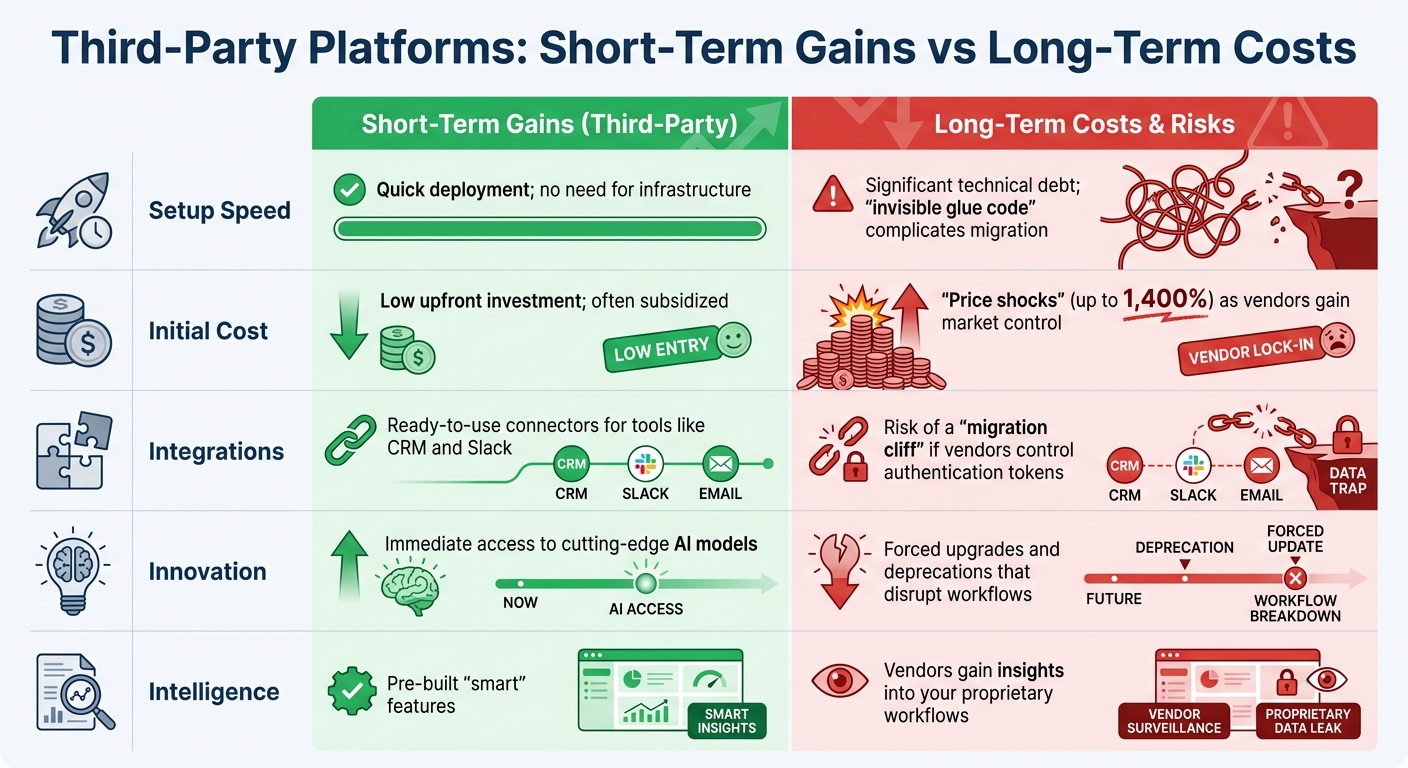
Third-Party Platforms: Short-Term Gains vs Long-Term Costs Comparison
How Vendor Lock-In Works
It all begins with platforms using proprietary data formats and imposing strict export limits. Take HubSpot as an example: it caps bulk exports at 100,000 records at a time. If your business has millions of customer interactions stored, retrieving them can turn into a multi-week ordeal [5]. Salesforce adds its own challenges - exports often strip away custom field setups and relational data, leaving teams to painstakingly rebuild critical connections [5].
These technical limitations are just the tip of the iceberg. Every new integration deepens the dependency.
AI platforms add another layer of complexity. For instance, fine-tuned model weights are usually hosted on the vendor's servers and can't be exported. Essentially, you're paying to train a model that you don’t truly own [3]. Embedding models create unique vector spaces, meaning switching to a new provider requires re-indexing your entire database [3]. Even the prompts you’ve perfected over months may only work with a specific model - success with one platform doesn’t guarantee success with another [1].
"The business model of most SaaS companies is optimized not for your success but for your inability to leave. Lock-in isn't an accident or a side effect. It's an architectural feature." – Kumar Abhirup, Founder, Dench [5]
Human factors add yet another hurdle. Teams grow accustomed to platform-specific quirks, and retraining staff often costs more than the technical migration itself [5] [7]. Then there are the contractual traps - auto-renewal clauses that activate 60 days before expiration and plans that are intentionally difficult to cancel, leaving businesses with limited options [7].
Together, these technical and organizational barriers strip businesses of control over their own data.
The Risks of Long-Term Platform Dependency
Relying on third-party platforms for the long haul comes with growing costs and risks. For example, Salesforce has raised its prices by an average of 10% annually over the past decade [5]. Sometimes, the increases are even more abrupt. In April 2026, Anthropic gave developers just one week's notice before switching from flat-rate subscription plans to pay-as-you-go API accounts [8].
Another risk? Vendors gaining competitive insights. Many platforms monitor how you use their tools, identifying high-value workflows and popular features. Armed with this knowledge, they may develop competing products, effectively "sherlocking" their own customers [1] [8]. In this scenario, you're not just paying for a service - you’re also funding research that could undercut your competitive position.
The ultimate danger is service termination. When Parse shut down in January 2016, over 600,000 apps had just one year to migrate their entire backend infrastructure before losing functionality [1]. There was no room for negotiation - just a hard deadline and a chaotic rush to rebuild.
Security risks also grow over time. For instance, attackers once exploited an integration between Salesloft and Drift, compromising OAuth tokens and gaining unauthorized access to hundreds of downstream customer environments [9]. And as data accumulates, the cost of migration only climbs [7].
These scenarios highlight the tangible dangers businesses face when they become too reliant on third-party platforms.
Comparison Table: Short-Term Gains vs. Long-Term Costs
Here’s a breakdown of what businesses gain initially versus the challenges they face down the road:
| Feature | Short-Term Gains (Third-Party) | Long-Term Costs & Risks |
|---|---|---|
| Setup Speed | Quick deployment; no need for infrastructure | Significant technical debt; "invisible glue code" complicates migration |
| Initial Cost | Low upfront investment; often subsidized | "Price shocks" (up to 1,400%) as vendors gain market control |
| Integrations | Ready-to-use connectors for tools like CRM and Slack | Risk of a "migration cliff" if vendors control authentication tokens |
| Innovation | Immediate access to cutting-edge AI models | Forced upgrades and deprecations that disrupt workflows |
| Intelligence | Pre-built "smart" features | Vendors gain insights into your proprietary workflows |
Case Studies: What Happens When You Lose Data Control
Real-life examples highlight the dangers of losing control over your data and infrastructure.
Case Study 1: SaaS Company Faces Revenue Loss During Platform Migration
A Series B SaaS company relied heavily on a major AI platform to power its customer support automation, achieving an impressive 40% ticket deflection rate [3]. But things took a turn when the vendor announced a 3x price increase with just 60 days' notice. The company discovered a major roadblock: their fine-tuned models were locked into the platform, and embeddings required a complete re-indexing to move elsewhere [3].
With no way to export their work and customers already depending on the AI-powered features, the company faced a tough decision. They could either pass the increased costs to their customers and risk losing them, or absorb the hike and see their profit margins shrink significantly. Ultimately, the business had no choice but to accept the price increase, permanently losing control over its pricing strategy.
To make matters worse, migrating a mid-sized enterprise to a new platform typically costs between $350,000 and $950,000 and delays engineering progress by 6–9 months [1]. During this time, innovation halts, competitive advantages fade, and potential revenue slips through the cracks.
This case demonstrates how reliance on locked-in systems can leave companies vulnerable to sudden, costly changes.
Case Study 2: AI Tool Provider Loses Bargaining Power
In April 2026, Anthropic made a sudden decision to remove the "OpenClaw" agent from its $200/month flat-rate pricing tiers [10]. This change hit independent developers like Marcus particularly hard. Marcus had been using the tool for production email triage in law firms, but the shift to pay-as-you-go API billing caused his costs to skyrocket - from $200/month to over $100 per day. Overnight, his business's unit economics became unsustainable [10].
Marcus found himself without options. His entire product was built on Anthropic's infrastructure, leaving him with no portable model weights, no exportable fine-tuning data, and no backup provider. Anthropic’s unilateral pricing change forced Marcus to either pay the exorbitant new rates or shut down his service entirely.
"When you build core capabilities on rented infrastructure, you're not a customer - you're a hostage." - NorthStar Software [1]
This scenario highlights a broader issue: 74% of enterprises admit their daily operations would be disrupted if their primary AI vendor suddenly ceased operations [2]. These examples underline the importance of creating independent, resilient data systems to safeguard against such risks.
Solutions: How to Protect and Recover Data Control
The examples above highlight the risks of losing control over your data. The upside? There are practical steps you can take right now to safeguard your data and minimize dependency risks.
Review and Document Your Current Data Dependencies
Start by mapping out what you truly own versus what you’re renting. Make a list of all the SaaS tools your business relies on, the data they manage, and their importance to your operations. Then, categorize these systems based on the type of data they handle - like customer details, financial records, operational workflows, or intellectual property [11].
Next, test exporting data from your most critical platform. Ensure that a full export retains all relationships and workflows intact [14]. If key connections - such as links between contacts, deals, and activities - are broken or missing, you don’t fully own that data [11].
"If an export cannot be restored with relationships intact, you do not own the outcome." - Sharp Hue [11]
Also, document how your tools integrate with one another. For instance, replacing a CRM might seem simple on paper, but it could disrupt connections with your accounting software, email marketing tools, and project management systems. This kind of disruption often costs three to five times your initial estimate when factoring in staff time, productivity losses, and rebuilding integrations [13].
Score each platform based on factors like data portability, vendor stability, integration depth, cost trajectory, and exposure of business logic. Platforms with low scores should grab your immediate attention [13].
Once you’ve mapped out your current data landscape, the next step is to adopt open standards to keep your data portable.
Use Open Standards and Data Portability
To avoid vendor lock-in and regain control, embrace open standards for data portability. True ownership means being able to move your data seamlessly. Research shows that products offering clear data export options see churn rates 15% to 25% lower among enterprise customers compared to those that make leaving difficult [15].
Opt for export formats like JSONL, Parquet, or DuckDB to retain data relationships [4][12]. These formats ensure that connections - such as between contacts, deals, and activities - stay intact, keeping your data functional.
"Ownership without portability is not ownership. It's tenancy." - Kumar Abhirup, Founder, Dench [12]
For AI tools, consider wrapping external API calls in an internal interface. Instead of directly integrating with providers like OpenAI or Anthropic, create a routing layer. Your application can then call an abstraction (e.g., llm.complete()), allowing you to switch providers in under 24 hours simply by updating a configuration file. Companies using this approach report reducing integration time by up to 70% [6][17][19].
Apply the "24-hour test": Can you export all your records, including custom fields and relationships, within 24 hours? If not, your data sovereignty is at risk [4][16]. Additionally, negotiate longer post-termination access windows (aim for at least 90 days instead of the standard 30) and ensure bulk-export options are included in your contracts [11].
To stay ahead, run quarterly migration drills to identify gaps in your export processes early [6][11].
Create a Hybrid Data Infrastructure
Building on your review of dependencies and adoption of portability standards, a hybrid data infrastructure offers a way to regain control of critical data while maintaining flexibility for less essential functions. This approach involves dividing your tools into three tiers: completely own critical data through self-hosting, rent portable platforms for mid-tier data, and use standard SaaS for lower-risk, peripheral tasks [16].
For critical data, store it in a controlled environment like your own data warehouse or lakehouse. Treat SaaS tools as data sources rather than the ultimate source of truth [11]. This setup ensures that vendor outages are inconveniences, not full-blown crises - unlike the disruptions described earlier.
Establish fallback systems for key services. For example, if OpenAI experiences downtime, automatically switch to Anthropic. Similarly, have a backup CRM ready in case your primary one fails. Businesses using cost-aware routing strategies report savings of 30% to 70% without sacrificing quality [19].
However, this approach does come with added responsibilities. Managing your data means handling tasks like patching, monitoring, and backups internally [18]. For many businesses, this tradeoff becomes worthwhile once the team grows to 15–20 employees - the point where SaaS licensing costs and workaround labor often outweigh the expense of building and maintaining your own systems [13].
Finally, run daily "golden prompts" to catch silent degradations in AI model quality. Studies show up to a 23% variance in response length for identical prompts, so circuit breakers can help halt requests to failing providers after repeated errors [19].
Action Steps: Building Better Infrastructure with AgileGrowthLabs
You've mapped out your dependencies, embraced open standards, and designed a hybrid infrastructure. Now it's time to turn those plans into action. AgileGrowthLabs provides practical tools and strategies to help you break down data silos and regain control - without having to start from scratch.
Using AI-Powered CRM Tools to Reduce Data Silos
Reducing data silos starts with integrating your CRM in a way that ensures smooth communication across systems. The real challenge arises when disconnected tools create silos, leaving your CRM unable to effectively interact with support systems or analytics platforms. This often results in fragile integrations that break during API updates. To tackle this, consider adopting a hub-and-spoke model. This approach unifies your CRM, ERP, and telemetry systems by normalizing schemas and enforcing governance policies [21]. The result? Instead of updating dozens of connections when APIs change, you only need to update one.
For added flexibility, implement an internal interface to simplify vendor transitions. With this setup, switching vendors becomes as simple as updating a configuration file instead of rewriting code. For example, in October 2025, Acme Marketing successfully switched adapters during a Black Friday campaign. They validated their pipeline with minimal disruption, safeguarding their competitive edge and retaining control over critical operations [22].
While internal systems are crucial, choosing the right tools is just as important.
Growing Revenue with SaaS Directory Resources
Maintaining data independence can be tricky, especially when vendors bury portability details in fine print or make data exports unnecessarily complicated. AgileGrowthLabs' SaaS and AI tools directory is designed to help you identify platforms that prioritize open standards and data portability - before you commit to a contract.
When evaluating tools through the directory, use the Portability Score to assess each platform on a 0–10 scale. This score considers factors like data export quality, model flexibility, integration replaceability, and operational control [6]. A platform with a score below 5 should raise immediate concerns, particularly when dealing with Tier 1 data such as customer records or financial information [16]. The directory also highlights tools that support the Model Context Protocol (MCP), an open standard that connects AI models to external tools and data sources [20]. By opting for MCP-compatible tools, you can avoid the hassle of creating custom adapters for every vendor-specific system, which only increases platform dependency.
Conclusion: Protecting Your Business Influence Through Data Control
Giving up control of your data infrastructure is a slippery slope - once it's gone, reclaiming it can be nearly impossible. A staggering 74% of enterprises face daily risks of disruption, with 27% entirely reliant on a single vendor [2]. This isn't just a tech issue; it's a matter of control. When your customer data, decision-making records, and institutional knowledge are locked into someone else's system, you're no longer the sole driver of your business's future. Past pricing shocks have shown how costly this dependency can be [1]. To safeguard your autonomy, focus on documenting dependencies, adopting open standards, and creating a hybrid infrastructure.
This doesn't mean avoiding third-party tools altogether. Instead, the key is to retain control over the assets that set your business apart. Start by documenting your current dependencies. Enforce open standards to ensure flexibility, and build a hybrid infrastructure that gives you room to adapt. Resources like AgileGrowthLabs' directory can help you identify platforms that prioritize data portability before you commit. These steps help secure not just your data but also your decision-making independence.
Your ability to stay competitive hinges on making decisions without outside interference. The businesses that will dominate in 2026 and beyond won't necessarily have the flashiest AI tools - they'll be the ones that can pivot seamlessly between vendors. Protect your future by protecting your data today.
FAQs
What data should I own vs rent from SaaS vendors?
To create a strong data strategy, focus on owning your core data - things like customer relationships, transaction details, and proprietary operational records. This gives you control over essential assets and minimizes dependence on outside platforms. On the other hand, non-core data, such as analytics insights or aggregated metrics, can often be accessed through SaaS tools for ease of use. That said, relying entirely on third-party systems can put your business identity and competitive advantage at risk, so balance is key.
How can I tell if a tool is locking in my data?
Take a close look at how your data is stored. Is it in proprietary formats? Are export options limited? Does migration come with steep costs or require a lot of effort? These are all red flags for vendor lock-in.
Some common signs to watch for include:
- Restricted or lossy exports: If exporting your data results in incomplete or degraded files, that’s a problem.
- Tier-based access to data: Vendors might limit your ability to access or export data unless you pay for higher service tiers.
- Exclusive storage on the vendor’s infrastructure: If your data lives only on their servers and you don’t have ownership rights, you might be stuck.
If you can’t fully and easily export your data, it’s a clear indication that you’re dealing with vendor lock-in.
What’s the fastest way to switch AI providers without rewrites?
To make switching AI providers smooth and hassle-free, design your system with abstraction layers and portable components. These layers act as a buffer, so you don't need to rewrite everything when making a change. Incorporating adapters or service façades can also help by reducing the amount of code that needs updating during transitions.
Another key step is ensuring your data is stored in open, exportable formats. This makes it easier to transfer data between providers. When negotiating contracts, include SLAs (Service Level Agreements) that specify clear timelines for data export and outline any transitional support the provider will offer.
By following these strategies, you can keep your architecture flexible and significantly reduce the effort required to change AI providers.
Related Blog Posts
- Is Your SaaS an AI “Wrapper”? Why Most Thin AI Layers Will Collapse (And How to Build a Defensible Data Moat).
- 15. Blackstone, KKR, and Silver Lake Aren't Competing With Each Other. They're All Buying the Same Asset - Data-Controlled Distribution - From Founders Who Don't Know What They Actually Have.
- 16. The Era of "Growth at All Costs" Is Over. The Era of "Whoever Controls the Data Controls the Exit Multiple" Has Begun. Most Founders Are Still Playing the Old Game.
- Buyers in 2026 Are Running One Question Through Every Diligence Call: "What Moat Survives the AI Disruption Cycle?" If Your Answer Lives in a Feature Set, You're Already Priced at a Discount. Substack