In 2026, software buyers have one critical question: "What moat survives the AI disruption cycle?" If your competitive advantage is based on features, you're already undervalued. Here's why:
- AI has commoditized features: Tools like Cursor and Bolt enable developers to replicate features in days, not months. This has slashed differentiation timelines by 60–80%.
- Valuations reflect this shift: AI-native companies command 8–12x revenue multiples, while feature-dependent SaaS firms are stuck at 3–5x.
- Durable moats are key: Proprietary data, network effects, and deep ecosystem integrations are now the primary drivers of value.
To thrive, businesses need to focus on assets AI can't easily replicate - like exclusive data, user networks, and embedded workflows. The future belongs to companies that build lasting, structural advantages beyond features.
Why Feature Sets No Longer Work as Competitive Moats
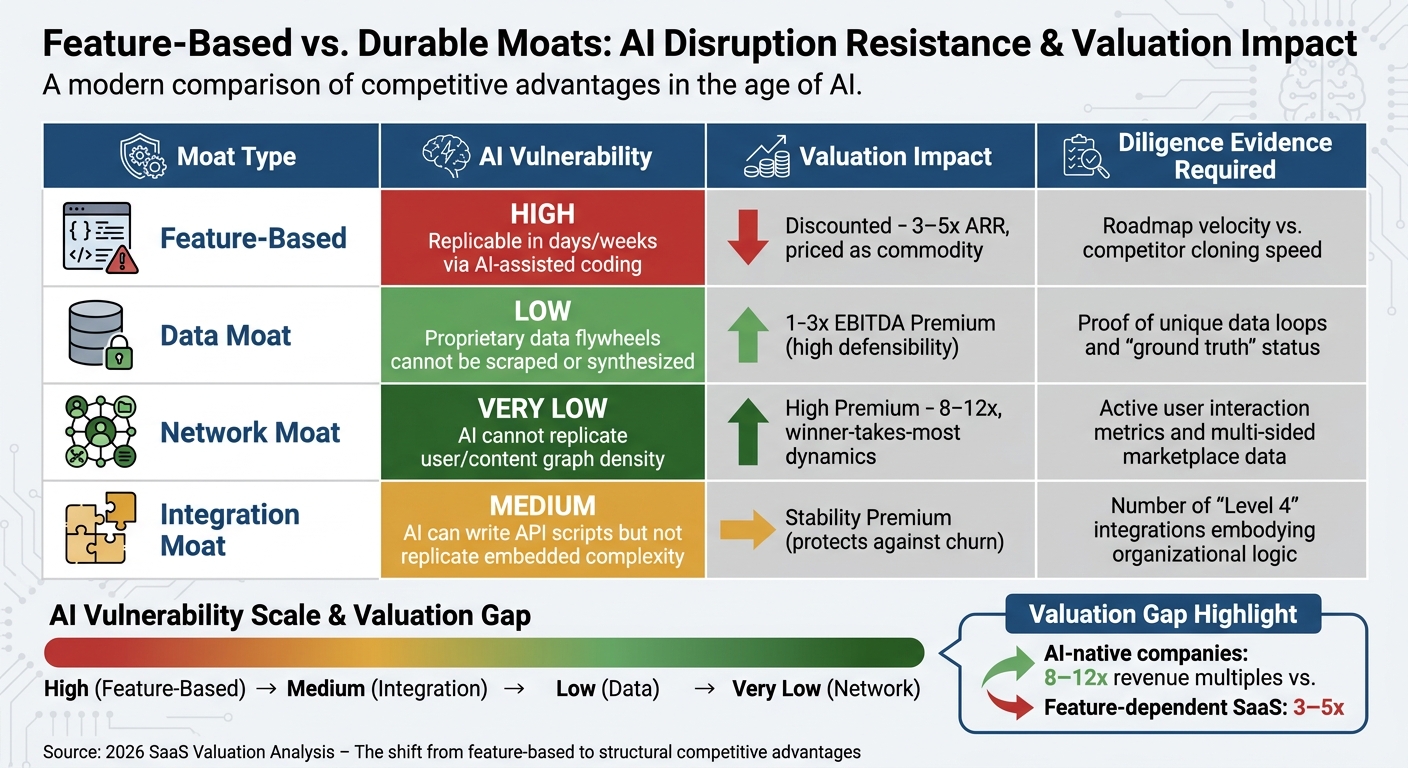
Feature-Based vs Durable Moats: AI Vulnerability and Valuation Impact in 2026
The rules for maintaining a defensible position in software have changed dramatically. This shift highlights a key theme: moving away from relying on features and focusing on building lasting advantages that are resistant to AI disruption. Back in 2024, developing a SaaS feature typically took 2–6 weeks of engineering effort. Fast forward to 2026, and AI tools like Cursor, v0, Bolt, and Claude Opus 4.6 have slashed that timeline to hours or days [1][6]. Today, 80% of a feature's implementation can be generated from a simple text prompt [1][6]. What used to require a 10-person machine learning team can now be accomplished by just three developers in a matter of weeks [5]. This rapid pace of development has fundamentally changed the landscape, leading to what’s being called the commoditization of features.
This phenomenon has resulted in what investors refer to as a "functional moat collapse" [1]. Companies that try to compete by adding more features find themselves stuck in a "Red Queen's Race", constantly scrambling to match competitors just to stay relevant. Features that once set software apart are now easily replicated, reducing software from a prized asset to something more akin to a commodity [1][11]. The critical question buyers ask during due diligence has become: "Could a solo developer with AI tools recreate your core value over a weekend?" If the answer is yes, your business likely falls into what strategists call the "Compress Zone" [11].
How AI Commoditizes Features Overnight
The ability to replicate features almost instantly has flipped traditional competitive dynamics on their head. Differentiation timelines in most B2B SaaS categories have shrunk by 60–80% [5]. Elements like UI/UX, backend logic, and API integrations - once considered technical hurdles - are now so easily replicated that they no longer provide any real edge [1][6].
"If your moat is code, you don't have a moat. Someone will clone your core functionality with AI-assisted development before your next board meeting." - Momentum Nexus [6]
Well-funded competitors can now replicate features that once took years to create in just weeks. This reality forces the market to price in these risks, often before companies themselves recognize the threat.
How Feature Dependence Lowers Your Valuation
The ease with which features are copied doesn’t just affect competition - it also impacts how the market values your business. Investors and buyers are increasingly skeptical of feature-based defensibility. If a well-funded team with access to large language models (LLMs) can replicate your offering in under 18 months, it’s no longer seen as a sustainable advantage but merely a "head start" [5]. This perception directly affects valuations. AI-native infrastructure companies now command revenue multiples of 8x to 12x, while traditional SaaS companies that simply tack on AI features often trade at 3x to 5x [7].
This valuation gap reflects a deeper shift in how buyers assess risk. By 2026, 80% of private equity and strategic buyers cited AI-driven commoditization as the top threat to SaaS valuations [9]. Companies with genuine structural advantages - such as proprietary data, network effects, or deeply embedded workflows - are commanding 1–3x multiple premiums, while those relying solely on feature roadmaps are heavily discounted [9].
"If your competitive advantage is a feature set, AI has already started to erode it - and buyers will price that risk before you realize it's happening." - Khaled Azar, M&A Advisor [9]
Adding to the pressure, application-layer AI companies are seeing their gross margins drop to 50–60% due to high inference costs, further dragging down valuations [10]. The focus has shifted from what you build (features and code) to what you own (proprietary data, trust, and network effects) [1]. Buyers now demand evidence that your competitive moat will hold up beyond the next product cycle.
Comparison Table: Feature-Based vs. Durable Moats
This table highlights how sustainable competitive advantages fare against AI disruption compared to feature-based moats, which are becoming increasingly fragile.
| Moat Type | AI Vulnerability | Valuation Impact | Diligence Evidence Required |
|---|---|---|---|
| Feature-Based | High (Replicable in days/weeks via AI-assisted coding) | Discounted (3–5x ARR, priced as commodity) | Roadmap velocity vs. competitor cloning speed |
| Data Moat | Low (Proprietary data flywheels cannot be scraped or synthesized) | 1–3x EBITDA Premium (high defensibility) | Proof of unique data loops and "ground truth" status |
| Network Moat | Very Low (AI cannot replicate user/content graph density) | High Premium (8–12x, winner-takes-most dynamics) | Active user interaction metrics and multi-sided marketplace data |
| Integration Moat | Medium (AI can write API scripts but not replicate embedded complexity) | Stability Premium (protects against churn) | Number of "Level 4" integrations embodying organizational logic |
The table underscores a clear trend: businesses that rely on features are increasingly vulnerable, while those with durable moats - such as proprietary data or strong network effects - are better positioned to thrive in an AI-dominated landscape.
sbb-itb-9cd970b
How Proprietary Data Creates AI-Resistant Moats
Proprietary data stands apart from other competitive advantages because it can't be easily replicated by AI. It’s the result of years of exclusive business operations, making it a valuable asset when buyers assess your business in 2026. Let’s explore what makes data proprietary and how it evolves into a lasting competitive edge.
What Qualifies as Proprietary Data
Proprietary data becomes a true moat when it’s tied exclusively to your business and cannot be generated elsewhere. This includes non-synthesizable data - information that can’t be scraped from the web or created by large language models. Examples include physical collection records, exclusive agreements, or unique behavioral data collected through customer interactions.
The best data moats share three key traits: exclusive access, compounding value over time, and integration with analytical frameworks. For instance:
- Veeva Systems has maintained its edge for two decades through proprietary pharmaceutical call notes, sample logs, and physician engagement data - none of which can be replicated synthetically [10].
- Epic Systems holds longitudinal health records for a third of Americans, offering unmatched clinical insights that grow in value as patient histories expand [12].
Data quality also matters. Exhaust data (basic logs) offers minimal protection, while operational data (transactions) and interactional data (user behaviors) provide stronger defenses. At the top are learning data - feedback and corrections that create self-reinforcing systems. Another standout is process data, which captures expert problem-solving steps, offering insights AI can’t replicate [10][14].
Deterministic data, which requires absolute accuracy, is especially valuable. For example, systems dealing with tax calculations or clinical trials can’t tolerate AI errors. Harvey AI trained on 20 billion tokens of specialized legal text to achieve a hallucination rate of just 0.2%, demonstrating the high precision needed for deterministic tasks [10]. Buyers value this reliability, recognizing that AI often struggles to meet such exacting standards [2].
"If the underlying model gets 10x better next year, does my product get more valuable or less? Less valuable means the model now does what you were doing. More valuable means a smarter model does more with your data."
- Lewis Lin [12]
Companies Using Data as Their Primary Defense
Several companies have built formidable defenses around their proprietary data:
- Bloomberg Terminal: Charging around $24,000 per seat, Bloomberg dominates with its exclusive financial market data and interpretation frameworks. Its insights set the standard for financial professionals, making it hard for competitors to match [12].
- OSIsoft (AVEVA): The "PI System" holds 20 years of sensor data from production lines, capturing operational realities that can’t be duplicated [12].
- Healthcare Firms: Combining proprietary datasets with regulatory protections, clinical AI systems rely on legally protected, sensitive data with traceable lineage. This dual exclusivity makes healthcare data moats especially hard to penetrate [12].
In retail, companies with 40-year agreements for scanner and point-of-sale data maintain highly defensible positions. These long-term relationships, built over decades, are nearly impossible to replicate through technology alone. Such moats are rated 4.83 out of 5.0 for defensibility [12].
How to Build and Protect Your Data Moat
Turning raw data into actionable intelligence faster than competitors is the key to building a strong moat. Here’s how:
- Instrument for correction: Capture user corrections to refine your models continuously. Real-time feedback loops on domain-specific signals can extend defensibility by over five years, while static datasets risk obsolescence within 12–18 months [10][13][14].
- Close loops quickly: Shorten the deploy-collect-retrain cycle to weekly or even daily updates. Frequent events, like daily code edits, provide richer signals than infrequent ones, such as annual reports [13].
- Use negative signals: Test multiple hypotheses simultaneously to identify what doesn’t work. Negative signals are quicker and cheaper to gather but offer valuable insights for refining AI decisions [13].
- Audit data exclusivity: If your dataset can be purchased or reconstructed within 18 months, it’s not a true moat. Focus on generating data that only your operations can produce [10].
- Integrate data deeply: Embed your data into customers’ core systems, such as ERP or CRM platforms. This creates high switching costs, making your data indispensable to their operations [10][16].
The financial payoff is clear. Companies with data moats often enjoy a 25–50% valuation premium, while those without face discounts due to commoditization risks. In mergers and acquisitions, AI-driven businesses with strong data moats achieve 1–3× multiple premiums over feature-based competitors [9][15].
"The moat is rarely the data. It is almost always the work required to turn that data into something a competitor would take years to replicate."
- Tian Pan, Engineer-Founder [10]
Regulatory compliance provides another layer of protection. Sectors like finance and healthcare demand auditable data lineage and approved sources - criteria that AI solutions often struggle to meet. This regulatory barrier further strengthens the position of companies with proprietary, legally compliant datasets [3].
Network Effects: The Moat AI Cannot Replicate
When it comes to defending against AI disruption, network effects stand out as a powerful advantage that AI simply cannot duplicate. While AI can mimic features in record time, it cannot replicate the relationships and interactions between users that drive network effects. These effects create a compounding value with every new participant, forming a defensive moat that strengthens as competitors struggle to catch up. This is why, by 2026, companies with true network effects command revenue multiples of 8x to 12x, while feature-based competitors lag behind at 3x to 5x [7].
The distinction lies in the structure. AI tools, like coding assistants used by 82% of developers daily, can replicate functionality in weeks - a task that once took months [7]. However, no level of AI sophistication can bypass the initial network-building hurdle. Competitors face an uphill battle because a product’s value only materializes once its network is firmly established [17].
"AI is a sustaining technology for companies that already own network effects, not a disruptive one." - Ben Thompson, Stratechery [3]
This dynamic explains why social and marketplace platforms weathered the February 2026 "SaaSpocalypse", during which $285 billion in software market capitalization vanished in just 48 hours [7]. Companies like Thomson Reuters and Docusign saw share prices drop by 15% and 10%, respectively, over fears of AI-driven disruption [3].
What Network Effects Are and How They Work
Network effects occur when a product becomes more valuable as more people use it [17]. For example, if User A benefits when User B joins, that’s a network effect. Without this dynamic, a product may simply have scale advantages or social proof - not the same thing as a true network effect.
Here’s how different types of network effects function:
- Direct network effects: Value grows as more users join, directly enhancing the product’s utility.
- Indirect network effects: Growth in one user group (e.g., drivers in a ride-sharing app) boosts value for another group (e.g., riders), creating a self-reinforcing cycle.
- Data network effects: User interactions generate proprietary data that improves AI models, attracting even more users.
- Social network effects: Value stems from established relationships, like LinkedIn’s professional network, which users cannot easily replicate elsewhere [17].
| Network Type | Value Creation | Resistance to AI Replication |
|---|---|---|
| Direct | Utility grows with more users | High – human connections are irreplaceable |
| Indirect | Growth in one user group benefits another | High – market liquidity is hard to simulate |
| Data | Usage improves AI models through feedback loops | Compounding – strongest when loops are closed |
| Social | Value tied to existing relationships | Very High – professional networks are unique |
Switching costs tied to network effects go beyond features. While competitors can replicate functionality or compete on price, they cannot easily recreate an established network. Take the Bloomberg Terminal, for example - its value lies in the entrenched communication network and shared risk vocabulary it facilitates, not just its code [3].
SaaS Companies Winning with Network Effects
Some companies have mastered network effects, creating defensible positions even in the face of AI disruption:
- Gong: By analyzing millions of sales calls, Gong’s AI insights remain unmatched. Each new sales team contributes data that enhances the AI’s ability to identify successful patterns, reinforcing its moat [6].
- Figma: With billions of design decisions powering its AI features, Figma benefits from a scale of design data that competitors cannot match. Every designer’s input strengthens the platform for all users [6].
- GitHub Copilot: By collecting precise accept/reject signals on code completions, GitHub Copilot continuously improves its AI, benefiting everyone on the platform [10].
- Harvey AI: By leveraging data from elite law firms, Harvey AI has reduced its hallucination rate to 0.2%. This specialized input enhances its legal reasoning capabilities across the network [10].
On the flip side, companies without network effects have struggled. For instance, in early 2026, Klarna replaced over 1,200 SaaS tools by integrating large language models with knowledge graphs, highlighting the vulnerability of standalone software [7].
How to Build Network Effects into Your Product
To establish network effects, focus on these strategies:
- Tackle the initial network challenge: Start with a tightly connected group, like a specific city, industry, or professional circle, where relationships already exist and create immediate value [17].
- Capture meaningful user feedback: Use interpretable signals, such as "code accepted/rejected", to refine AI models instead of relying on generic engagement metrics [6][10].
- Set industry standards: Introduce workflows, templates, and vocabularies that make your product indispensable to an entire industry [3].
- Embed into critical workflows: Move beyond simple data storage to enable decision-making and build institutional memory, making your product an essential system for key processes [6].
- Encourage early adoption: For products with indirect network effects, offer incentives to one side of the market to build the initial momentum needed for the network to thrive [17].
These approaches not only strengthen your product but also ensure resilience against AI-driven competition. By 2026, 80% of private equity and strategic buyers are prioritizing AI-native SaaS companies with strong network effects, as these companies show superior retention and growth metrics [9]. The message is clear: products that integrate into networks create lasting switching costs, while those relying solely on features risk losing their edge as AI levels the playing field [18].
"If your software exists in isolation... AI can replicate it. If it's a node in a network, the replication cost is orders of magnitude higher." - Tom Davis, Physicist and Quant, Soliton [3]
Ecosystem Integrations That Lock in Customers
In a world where AI can clone features in a matter of weeks, software that is deeply woven into a company's operations becomes irreplaceable. When your product integrates seamlessly with customer workflows - handling tasks like invoicing, licensing, and compliance updates - it transforms from a helpful tool into a critical part of their operational backbone. This integration creates a durable barrier against AI disruption, making it far harder for customers to switch. Just like proprietary data or network effects, these integrations now serve as a key driver of competitive advantage in an AI-driven landscape.
This distinction is crucial. While user familiarity may create some resistance to change, AI can easily mimic user interfaces or features. Operational switching costs, on the other hand, are far more challenging to overcome. Replacing software that automates workflows, manages years of structured data, and requires extensive team retraining is a massive undertaking [10]. For example, if a CRM system triggers actions across ERP invoicing, onboarding workflows, and license management, replacing that CRM means rebuilding the entire operational framework [2]. This deep integration creates a significant barrier to exit for customers.
Why Ecosystem Lock-In Prevents Customer Churn
As AI evolves rapidly, the depth of a product's integration is becoming a critical competitive edge. The real strength of these integrations lies in what happens when a customer considers leaving. If your software serves as the System of Record (SoR) - the single source of truth for critical datasets like customer records, financial transactions, or compliance documentation - you’ve achieved a level of indispensability [19][4]. Other tools rely on your platform, creating what’s known as "API gravity" [20].
Take Salesforce as an example. Its defensibility comes from the fact that over 3,000 applications in its AppExchange ecosystem are connected to it [20]. Replacing Salesforce isn’t just about switching CRMs - it involves reconfiguring every downstream automation and breaking integrations with marketing, support, and analytics tools. The operational disruption is often too costly to justify.
This moat becomes even stronger when integrations support regulated workflows. Software that ensures compliance or legal protection acts as a safety net for customers. While AI can draft contracts or reports, it can’t shoulder legal liability or navigate complex regulatory approvals like the FDA [4]. This "shield effect" creates a layer of protection that feature-based competitors simply can’t replicate.
Companies That Built Defensible Integration Strategies
Some companies have mastered integration strategies that helped them weather the February 2026 "SaaSpocalypse", when $285 billion in software market value evaporated due to fears of AI disruption [7]:
- Autodesk secured its position by embedding generative design into Fusion 360, integrating AI directly into critical design files and component libraries. This made switching costs for architecture and manufacturing firms so high that the process would take months, not hours [8]. Autodesk became the infrastructure underpinning years of proprietary design work.
- Veeva Systems thrives in the life sciences sector by anchoring itself in compliance-heavy workflows. Its integrations cover audit trails, regulatory submissions, and quality management - areas where accuracy is non-negotiable [2]. Replacing Veeva requires re-validating entire systems, a process that can take up to two years in highly regulated industries.
On the flip side, companies with surface-level integrations face greater risks. In 2024, Klarna replaced its Salesforce CRM and Workday HCM systems with an in-house data stack powered by Neo4j and AI tools. This move saved Klarna $39 million in AI-related costs [20]. The takeaway? Integrations that don’t embed deeply into operational workflows can be bypassed when AI offers a cheaper alternative.
"Replacing a System of Record is akin to performing open-heart surgery on a marathon runner while they are sprinting." - DeepSignal [2]
How to Design an Integration-First Strategy
To build defensible integrations, companies must shift their focus from quantity to quality. Hundreds of shallow API connections won’t cut it anymore, as AI agents can now coordinate across disconnected tools [7]. Instead, the goal should be to embed deeply into mission-critical workflows.
Here’s how to start:
- Run an integration gravity test: Assess how many tools rely on your product as essential infrastructure versus how many your product depends on [20]. If you’re more dependent on others, you’re at risk. Focus on building native integrations with the top five tools your customers use within 6-12 months [20].
- Own the "ground truth" data: When your product becomes the source of truth for your category, other tools must treat it as indispensable infrastructure [20][2]. This means focusing on deterministic, mission-critical data required for regulatory, financial, or operational continuity - areas where AI solutions fall short.
- Target regulated workflows: Integrations involving compliance, audit trails, and regulatory approvals are the hardest to replace [20][10]. AI can assist with drafting documents, but it can’t navigate securities regulations or process payments without certified infrastructure.
- Incorporate embedded finance: Adding payment processing, payroll, or lending capabilities creates a moat that AI struggles to replicate due to regulatory hurdles. For vertical SaaS companies, embedded finance can increase revenue per customer by 2-3x compared to traditional SaaS models [19]. By 2026, embedded finance transaction volumes in the U.S. are expected to exceed $7 trillion [19].
| Integration Type | Switching Cost Level | AI Replication Risk |
|---|---|---|
| System of Record | Extremely high (operational) | Low – owns operational data [2] |
| Regulated Workflows | Very high (compliance/audit) | Low – requires certified infrastructure [20][10] |
| Embedded Finance | High (regulatory/operational) | Low – protected by regulations [19] |
| Bolt-on Tool | Low (habitual) | High – AI can replicate easily [2] |
Finally, adapt your pricing model to reflect the depth of your integrations. As AI enables smaller teams to achieve more, seat-based pricing models are becoming less viable, with headcounts dropping by 30-50% in some cases [19]. Shift to usage-based or outcome-based pricing - charging per transaction, invoice, or contract processed. Outcome-based pricing is projected to grow at a 30% annual rate through 2035, while traditional subscription models are expected to stagnate at just 2% [2].
"The integration moat is dissolving. AI agents can orchestrate across tools dynamically." - Levera Partners [7]
The companies leading in 2026 won’t be those with the most integrations - it’ll be those whose absence would force customers to rebuild their entire operational systems. When potential buyers ask about your competitive edge, saying "we integrate with everything" won’t be enough. The real question is: what falls apart if they leave?
How to Audit and Strengthen Your Moat Before Diligence
In 2026, the companies thriving during diligence won't be the ones with the most bells and whistles - they'll be the ones that can clearly articulate their competitive edge. To prepare, you need to evaluate your business against the criteria buyers use. This means digging deeper than surface metrics and examining the core elements that ensure your advantage can withstand the next wave of AI advancements.
How to Identify Your Current Moat
Start by categorizing your software. Deterministic systems - like ERP, payroll, or compliance tools - tend to be more stable than probabilistic tools like content generators. If your product outputs results that "sound good" but can't guarantee accuracy, you're in a riskier position.
Next, assess whether your software acts as a System of Record. Ask yourself: Does my platform hold the authoritative source of truth for critical data? For instance, in February 2026, Intuit (INTU) achieved a Crucible Composite score of 77.4 (B+) by leveraging decades of proprietary tax and accounting data from over 50 million annual filings. This gave their AI assistants an edge that generic models couldn't replicate [8]. If your customers rely on your platform for historical data, workflow integration, and compliance, you're in a strong position.
You should also evaluate your integration depth. Map out how deeply your software is embedded in your customers' operations. For example, a single action in your system - like marking a deal as "Closed Won" - should trigger workflows across finance, invoicing, and onboarding [2]. If your product can be removed without disrupting other systems, it’s a vulnerability. To test this, measure how many tools depend on your product versus how many your product depends on. If the balance isn’t in your favor, it’s a red flag.
Finally, look at your non-functional moats - aspects like brand recognition, proprietary data, and workflow entrenchment that AI can't easily replicate [1]. Autodesk (ADSK) is a great example. By embedding generative design into Fusion 360, they made their AI inseparable from years of proprietary design files and component libraries, which increased workflow stickiness for enterprise customers driving over 70% of their revenue [8]. These unique elements form the backbone of a competitive edge that AI alone can't erode.
Checklist: Is Your Business Ready for AI Disruption?
Use this checklist to measure your readiness:
- Revenue Durability (25 points): Can you explain which parts of your revenue remain stable if a competitor releases a similar feature? Dive into cohort depth, churn trends, and expansion metrics. Avoid relying on shallow differentiators [21].
- Inference Economics (20 points): Test your margins against scenarios like a 25% hike in inference costs or a doubling of usage by power users. If your margins don’t hold, revisit your pricing strategy [21].
- Technical Controls (20 points): Do you have fallback options for different AI models? Can you back up claims about accuracy, latency, and reliability with hard data? Buyers want proof of controllable systems, not flashy demos [21].
- Legal and Data Rights (15 points): Make sure your contracts clearly establish ownership of customer data for training and fine-tuning models. Compliance with third-party terms is non-negotiable [21].
- Distribution Strength (10 points): Assess whether your growth relies on paid acquisition or if you’ve built genuine brand pull. Companies with strong visibility in AI search engines (like ChatGPT or Perplexity) are better positioned for long-term success [1].
- Operational Transferability (10 points): Determine how dependent your business is on key personnel. Buyers will discount your valuation if your operations can’t run smoothly without them [21].
"If you cannot explain what revenue remains durable after a model provider ships a competing feature, you do not have underwriting confidence yet." - Alex Boyd, Wildfront [21]
How Strong Moats Lead to Higher Valuations
Once you’ve assessed your moat, consider how it impacts your valuation. Companies with AI-native infrastructure are commanding revenue multiples between 8x and 12x, while those simply adding AI features to existing workflows trade at 3x to 5x [7]. The difference lies in defensibility. Systems that are deeply embedded and own critical data fetch premium valuations.
The "SaaSpocalypse" demonstrated this starkly. In just 48 hours, $285 billion in software market value evaporated as investors recalibrated their expectations based on AI resilience [2][7]. The companies that survived had deterministic systems, deep integration, and pricing models tied to outcomes. Today, 80% of private equity and strategic buyers are willing to pay more for AI-native SaaS companies [9].
Pricing strategy is also a game-changer. Outcome-based pricing - where fees are tied to results like resolved tickets or processed invoices - is growing at a 30% annual rate through 2035. In contrast, traditional seat-based subscriptions are barely growing at 2% [2]. Companies embracing usage-based or task-based pricing are seeing higher multiples because their revenue scales with AI-driven efficiency, rather than shrinking as AI replaces human roles.
The companies entering diligence with confidence aren’t the ones with the most features. They’re the ones that demonstrate institutional cognition - software that handles the complexities of methodology, edge cases, and regulations that AI models struggle to replicate consistently [3]. When Thomson Reuters and DocuSign lost significant market value after Anthropic released an AI legal assistant, the message was clear: features aren’t moats, and buyers are pricing accordingly [3].
Conclusion: Moving Beyond Features to Build Lasting Value
The companies commanding premium valuations by 2026 are those that answer the moat question by focusing on proprietary data, embedded complexity, or network effects - areas where AI struggles to compete. The "SaaSpocalypse" of February 2026 drew a sharp line between businesses with structural advantages and those leaning too heavily on feature-based differentiation.
Relying solely on features already puts you at a disadvantage. AI-native companies are trading at revenue multiples of 8x–12x, while feature-based SaaS companies lag behind at 3x–5x[7]. This glaring valuation gap highlights the urgent need for durable moats.
"The next generation of great SaaS companies won't be defined by what their AI can build. They'll be defined by what their AI can't replace." - Steven Cen, Co-founder, ChartGen AI[1]
The future is clear: focus on assets that AI cannot easily commoditize. This includes proprietary data loops, embedded complexity, and deterministic systems where precision is non-negotiable. Companies like Intuit and Autodesk have spent decades embedding proprietary knowledge into their platforms, creating moats built on trust and operational depth - not just code[8].
The clock is ticking. As buyer expectations grow stricter, this is your last chance to shift from feature-first strategies to sustainable defenses. If your competitive edge still depends on features, it’s time to rebuild around elements that can withstand AI-driven disruption using the best tools for startup founders.
FAQs
How do I prove my product’s moat isn’t just features?
To demonstrate that your competitive edge extends beyond just features, focus on enduring, non-functional strengths that AI struggles to replicate. These include brand reputation, exclusive data assets, network effects, and team efficiency. Show how these elements build value over time - like trust networks, self-reinforcing data cycles, and a high-quality standard that’s tough to duplicate. These qualities ensure your product remains strong, even in the face of AI-driven competition.
What metrics indicate a true data moat or network effect?
Key metrics focus on maintaining the system of record, which ensures that crucial datasets remain both authoritative and accurate. Additionally, embedding deeply into customers' daily workflows creates reliance, making any switch or replacement both expensive and complicated. This reliance significantly enhances the durability of the system.
What should I change before an M&A diligence process?
Before diving into an M&A diligence process in 2026, it’s crucial to focus on resilient moats instead of relying solely on feature-based strengths. Pay attention to assets that are tough for AI to imitate, such as proprietary data, network effects, ecosystem integrations, and brand trust. These elements provide a stronger foundation for long-term success.
At the same time, carefully evaluate potential risks, like over-reliance on single providers, and confirm that your business has structural advantages - like embedded workflows - that can endure AI-driven changes in the market. The key is to move away from short-lived features and concentrate on building long-term defensibility.
Related Blog Posts
- The SaaS Valuation Gap: Why Typical Firms Stall at 4-6× While AI-Enabled Ones Hit 10×+
- Is Your SaaS an AI “Wrapper”? Why Most Thin AI Layers Will Collapse (And How to Build a Defensible Data Moat).
- 8. $4.9 Trillion in M&A in 2025. A Record. 25% of Every Deal Over $5 Billion Had an AI Theme. This Is Not a Cycle. This Is a Structural Shift in Who Controls Valuable Assets. CNBC
- 16. The Era of "Growth at All Costs" Is Over. The Era of "Whoever Controls the Data Controls the Exit Multiple" Has Begun. Most Founders Are Still Playing the Old Game.