Key Takeaways:
- Reddit's Strategy: By licensing user content to companies like Google ($60M/year) and OpenAI ($70M/year), Reddit monetized its data, contributing 10% of its revenue.
- Your Data at Risk: CRMs collect customer interactions, behavioral patterns, and engagement metrics - data that can be used to train AI or sold to third parties.
- Lost Opportunities: Many businesses unknowingly give away this data, missing out on potential revenue while still paying for CRM services.
- The Growing Demand for Genuine Data: With AI-generated content dominating the web, authentic user data is becoming rare and highly sought after.
- Steps to Take: Audit and secure your data, set clear terms for its use, and explore monetization options like licensing or usage-based pricing.
Why It Matters:
Your data is a valuable asset. By protecting and monetizing it, you can create new revenue streams and avoid losing control to external platforms. Reddit’s approach shows how everyday interactions can be turned into financial gains - don’t let your business miss out.
How Reddit Made $203 Million from Data Licensing
Reddit's Data Licensing Strategy and Revenue Growth
Reddit tapped into a treasure trove that many platforms often take for granted: nearly two decades of genuine human conversations, spanning 1 billion posts and 16 billion comments. This massive dataset is a goldmine for AI companies looking for training material [1][4]. Instead of letting tech companies scrape this data for free, Reddit turned it into a formal licensing business, which now makes up 10% of its overall revenue [6].
By February 2024, Reddit had secured data licensing deals worth a total of $203 million. Of that, at least $66.4 million is expected to be recognized as revenue in 2024 alone [1][2]. Their partnership with Google brings in about $60 million annually, while a deal with OpenAI is estimated at $70 million per year [8][9]. Since Reddit is essentially monetizing existing data, the costs are minimal, helping the company achieve an impressive 91.2% gross margin as of 2025 [5].
Reddit COO Jen Wong summed it up well:
"It's a small part of our revenue - I'll call it 10%. For a business of our size, that's material, because it's valuable revenue." [6]
This approach underscores how businesses can turn everyday interactions into revenue streams. For Reddit, it marks a shift from offering free access to strategically pricing its data for those who need it.
From Free Access to Paid Licensing: What Changed
In mid-2023, Reddit made a bold move to capitalize on its data. By July 2023, it ended free, unlimited API access and introduced a model where commercial entities had to pay for data instead of scraping it [3][4]. The new pricing set commercial API access at $0.24 per 1,000 calls [4].
By May 2024, Reddit took it a step further, requiring contracts for any commercial use of its data [7]. This was not just about revenue - it was also about protecting its data from being exploited. With AI tools like ChatGPT and Gemini relying heavily on Reddit’s content, the company faced the risk of losing traffic to these platforms [1][2]. To counter this, Reddit made unauthorized scraping both legally and technically challenging, while offering premium access for those willing to pay.
The strategy paid off. Between August 2023 and April 2024, Reddit’s readership surged from 132 million to 346 million visitors, partly driven by a Google algorithm update that favored forum content [9]. By June 2024, Reddit underscored its commitment to safeguarding its data by taking legal action against AI startup Anthropic for over 100,000 incidents of unauthorized scraping [9].
sbb-itb-9cd970b
What Data Your Business Gives Away to CRM Providers
Types of Data CRMs Collect from Your Business
Every time you log into a CRM, you're contributing to a treasure trove of data. For starters, conversational data - like customer emails, support tickets, chat logs, and feedback - plays a key role in training AI models [1][4][10].
CRMs also gather behavioral sequence data, which maps out the order and timing of user actions. Each click, navigation, and interaction creates a digital footprint that reveals patterns in decision-making [10]. Combine this with engagement metrics - such as how quickly users respond or how often they interact - and you have insights that AI companies are eager to pay for [4][10].
Another layer is temporal behavior signatures, which focus on metadata about how often and when users engage. This kind of data helps build detailed psychographic profiles. According to a 2023 study by Stanford Computational Social Science, analyzing just 68 data points can uncover psychological vulnerabilities with 85% accuracy [10]. Lastly, intent-based data - drawn from product research, troubleshooting inquiries, and purchase-related conversations - provides clues about buying intent. By 2025, experts estimate that profiling this type of data could be worth around $23 per user [10].
Understanding these data types is the first step in recognizing how CRM providers turn them into profit.
How CRM Providers Profit from Your Data
The data collected by CRMs isn’t just sitting idle - it’s a goldmine for providers. One of the most profitable strategies is AI training licensing, where providers sell API access to real-time data streams. This generates significant revenue since the data itself is free - it’s created by users.
Another way providers cash in is through psychographic profiling. By analyzing user behavior, they create psychological profiles that are sold to brands for targeted marketing campaigns [10]. Additionally, they use this data to develop internal AI tools, like smarter search functions or virtual assistants, which make their platforms more appealing.
Steve Huffman, Reddit's CEO, summed it up well:
"[Our] data shouldn't be [given] to some of the largest companies in the world for free" [1].
Yet, that’s exactly what happens when businesses hand over their data without realizing its value. This underscores why businesses must take control of their data to tap into its potential value for themselves.
The Risks of Giving Your Data to CRM Providers
Regulatory and Compliance Risks
Sharing your business data with CRM providers can open the door to serious legal and regulatory challenges. For instance, in March 2024, Reddit signed a $60 million data licensing deal with Google to use user-generated content for AI training. Shortly after, the Federal Trade Commission launched an investigation to determine if Reddit’s practices amounted to "unfair or deceptive trade practices" [3][11]. Reddit itself admitted in a filing:
"These programs may subject us to evolving approaches to the regulation of this data and implicates complex and developing data privacy and data protection, misappropriation, and intellectual property laws, rules, and regulations" [11].
The stakes are even higher in regions like the European Union. The EU AI Act, which became effective in 2025, mandates human oversight for "high-risk" AI systems in areas such as healthcare and finance [12]. Regulations like GDPR also impose hefty fines - up to 4% of global revenue - for failing to obtain explicit consent for data usage [12]. Alarmingly, 63% of business leaders admit they lack a formal AI governance strategy, leaving them vulnerable to compliance risks [12].
Another concern is data leakage. Security experts have discovered that AI models can unintentionally reveal sensitive personal or business information embedded within their training datasets [3].
These risks emphasize the importance of viewing your data as a valuable resource - one that needs to be protected and strategically managed.
Lost Control and Revenue Opportunities
Handing over your data to a CRM provider without clear restrictions means losing control of a critical revenue-generating asset. Companies leveraging AI-driven data strategies see an 11% boost in revenue, compared to less than 2% for those that don’t [12]. Yet, many organizations allow CRM providers to use their data freely, enabling those providers to profit while the original data owners miss out. Reddit, for example, saw its Average Revenue Per User jump 47% after licensing its user data to AI firms [12].
This loss of control can also create a competitive threat. AI models trained on your proprietary data could be used to develop tools that compete directly with your business. As Dale Hopkinson from Thales aptly put it:
"The question isn't whether AI companies will use your data - it's whether you'll get paid for it" [4].
The global data monetization market, valued at $3.5 billion in 2023, is expected to grow to $14.4 billion by 2032 [14]. Despite this, only 1 in 12 companies are fully capitalizing on their data’s potential [13]. This means many businesses are leaving significant revenue opportunities untapped. To reclaim this value, companies can discover the best AI and sales tools to automate data management and growth.
How to Protect and Profit from Your Business Data
Auditing and Securing Your Data
Start by identifying and cataloging datasets that hold value - think user behaviors, transaction histories, customer interactions, and industry-specific insights. These are the kinds of data that AI companies are eager to license. For example, Reddit turned its vast archive of over 22 billion comments into a $203 million licensing windfall [5].
Next, ensure your data is clean and organized. This means removing outdated fields, fixing anomalies, and standardizing formats. Clean, well-structured data often commands higher licensing fees [16].
To protect your data, consider implementing technical barriers. API gateways like Zuplo, Apigee, or AWS API Gateway can help you manage authentication, limit usage rates, and track access. Reddit used this approach, charging $0.24 per 1,000 API calls, which eventually led to formal licensing agreements [4].
On the legal front, update your Terms of Service and content policies to require contracts for any commercial use of your data. Staying compliant with regulations like GDPR, CCPA, and HIPAA is crucial - noncompliance can result in hefty fines, such as the €2.3 billion in GDPR penalties issued in 2025 [17]. Strengthen your data security with encryption (SSL/TLS), VPNs, and multi-factor authentication. Additionally, verify buyers' identities using KYC (Know Your Customer) checks [16].
By taking these steps, you not only protect your data but also position it as a valuable, revenue-generating asset.
Ways to Make Money from Your Business Data
One of the most straightforward ways to monetize your data is through licensing agreements. For instance, Reddit secured deals worth $203 million over two to three years in early 2024, including a $60 million annual contract with Google. This move contributed to Reddit’s first-ever quarterly profit in Q3 2024 [5][4].
Another option is usage-based pricing. Charge per API call or offer tiered subscription plans for data access. This model has been successfully adopted by companies like Ribbon Health [15].
You can also use your data to develop internal AI tools that enhance your platform’s functionality. Reddit, for example, created "Reddit Answers", an AI-powered search feature trained on its own data, reducing reliance on external tools. Similarly, a national bank leveraged a single data product across 60+ use cases, generating $60 million in added revenue while cutting costs by $40 million annually [4][17].
Finally, target enterprise clients for high-value partnerships. A Fortune 50 retailer, equipped with nearly 200 million members, used consent infrastructure to create a retail media network. This initiative is projected to bring in $3–10 billion in annual revenue [17].
Tools That Help You Keep Control of Your Data
AI-Powered CRM and Analytics Platforms
Choosing the right platform not only protects your data but also helps your business thrive. Composable CDPs, like GrowthLoop, connect directly to your cloud data warehouse - whether it’s Snowflake, BigQuery, or another system - ensuring you maintain governance and privacy controls at all times [24].
Take NASCAR, for example. In April 2026, they used GrowthLoop to unify a staggering 17 million customer records and launch over 4,000 audiences. What used to take hours now takes just one minute. Damian Arbuckle, Senior Director of Consumer Intelligence at NASCAR, shared:
"GrowthLoop has brought our marketing teams together and made our efforts much more efficient, allowing us to focus on what matters most - creating unforgettable experiences for our fans and partners" [24].
Allegro, a major player in eCommerce, also adopted GrowthLoop alongside Google Cloud. By April 2026, they had built an omnichannel ad orchestration system that delivered a 2x increase in Return on Ad Spend (ROAS) and a 60% boost in Gross Merchandise Value (GMV) - all while keeping their data secure within their own cloud environment [24].
For a more privacy-focused approach, platforms like DataGrail automate data mapping and risk detection without exposing sensitive information. Patrick Holcomb, Sr. Digital Marketing Manager, commented:
"Compliance is incredibly simple with DataGrail. The time it takes to quickly review and update our consent policies has reduced by over 75% since moving from our old tool" [18].
These tools not only allow you to retain control over your data but also ensure that your insights remain a competitive advantage rather than a resource for third parties.
Self-Hosted Solutions for Data Ownership
For businesses that demand complete control, self-hosted tools are a perfect fit. Platforms like ThinkLink CRM and Beton offer robust solutions where all data stays on your own servers. ThinkLink, for instance, provides 40 modules and 188 API endpoints for free, making it an affordable alternative to enterprise CRMs that can cost up to $18,000 annually for just 10 users [23]. Beton, on the other hand, offers a free self-hosted version, with a cloud option priced at only $0.50 per tracked user each month [22].
For those focused on AI infrastructure, tools like Zerve AI provide a unique setup by separating the control plane from the data plane. This means all compute processes run within your own AWS, GCP, or Azure account - or even in air-gapped environments with no external traffic. This approach is ideal for businesses with stringent security needs [19].
Deploying these solutions is surprisingly simple. Many platforms, such as Kyomi, support one-command Docker installations. Kyomi’s self-hosted version offers unlimited users, dashboards, and AI analysis for free, compared to the tiered pricing of its cloud counterpart [21]. Similarly, Flutch OSS includes a lightweight 608-byte tracking script that captures marketing attribution without relying on cookies or collecting personally identifiable information (PII) [20].
These self-hosted tools provide the flexibility and control necessary to safeguard your data while enabling your business to operate efficiently and securely.
Data monetization best practices. Your data is your product - start making money from it!
Comparing Different Data Control Methods
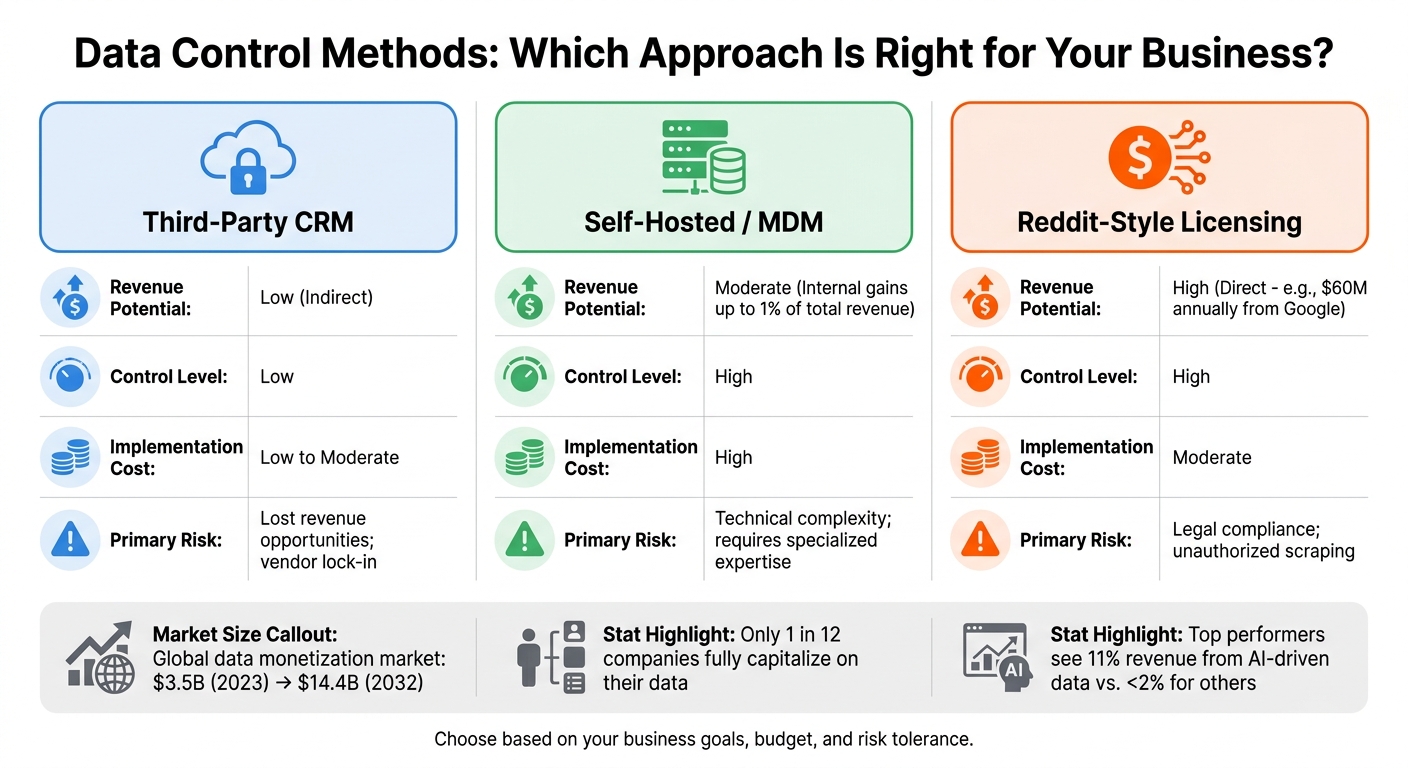
Data Control Methods: Revenue Potential, Costs, and Risks Comparison
Benefits and Drawbacks of Each Approach
The way a company manages its data can have a direct impact on its revenue and operational efficiency. Looking at examples like Reddit and CRM providers, it's clear that different data control methods come with their own set of advantages and challenges.
Third-party CRMs are a popular choice for their ease of setup and relatively low upfront costs. However, they come with limited data control. While you pay subscription fees, the provider may use aggregated insights from your data for their own benefit. This means your revenue gains are indirect - you might see improved sales efficiency, but you're not directly profiting from your data.
Self-hosted solutions, on the other hand, provide full ownership and better security by keeping data in-house. This approach ensures a single source of truth for decision-making. That said, it comes with high implementation costs, requiring investments in infrastructure, skilled personnel, and ongoing maintenance. Companies using this method often see moderate revenue benefits, with efficiency improvements contributing up to 1% of total revenue [14].
Reddit-style data licensing stands out for its high direct revenue potential. Reddit’s model, for instance, generates substantial income, with Google reportedly paying around $60 million annually for API access [1][4]. This method involves restricting access to previously free data and requiring commercial users to sign formal agreements. While the implementation costs are moderate - covering legal frameworks and API management tools - the revenue potential is significant. However, it does carry risks like user backlash and legal challenges.
Here’s a quick comparison of these methods:
| Method | Revenue Potential | Control Level | Implementation Cost | Primary Risk |
|---|---|---|---|---|
| Third-Party CRM | Low (Indirect) | Low | Low to Moderate | Lost revenue opportunities; vendor lock-in |
| Self-Hosted / MDM | Moderate (Internal gains) | High | High | Technical complexity; requires specialized expertise |
| Reddit-Style Licensing | High (Direct) | High | Moderate | Legal compliance; unauthorized scraping |
The global data monetization market was valued at $3.5 billion in 2023 and is projected to grow to $14.4 billion by 2032 [14]. Despite this, only about 1 in 12 companies fully capitalize on their data [13]. Choosing the right approach depends on your business goals, budget, and appetite for risk. Ignoring these opportunities could mean leaving significant revenue on the table. Each method has trade-offs that businesses must carefully weigh to select the best strategy.
Conclusion: Turn Your Business Data into an Asset
Your business data holds immense potential - it’s not just a byproduct of operations but an untapped revenue source. Companies like Reddit have demonstrated how data can evolve into a lucrative asset. The same is true for your business. Every transaction, customer interaction, or engagement generates information that AI companies need to train their models. The key is to recognize and leverage what you already have.
Start by evaluating your data. Conduct a thorough audit to identify unique datasets and secure them with strong contracts and API controls [4][15]. Without these measures, you risk losing out on revenue opportunities while exposing yourself to competitive and regulatory vulnerabilities.
"If you don't own a strategic data asset, you risk becoming a mere feeder - your interactions training the models that will ultimately disintermediate you." - Sriram Parthasarathy, Author [25]
The numbers speak for themselves: top-performing companies attribute 11% of their revenue to AI-driven data initiatives, while others generate less than 2% [12]. Monetization options include licensing agreements, usage-based API billing, or even creating internal AI tools to enhance your platform's value. Acting now ensures you capture these opportunities rather than leaving them untapped.
The global data monetization market is expected to hit $14.4 billion by 2032 [14], yet only a fraction of companies - 1 in 12 - fully capitalize on their data [13]. Don’t let your data’s value slip away. By taking control today, you can turn it into a competitive advantage and a steady revenue stream. The choice is yours: profit from your data or let its potential fade away.
FAQs
Does my business own the data in our CRM?
Understanding who owns the data in your CRM hinges on the specifics of your contracts and data policies. It's a common misconception that your business automatically has full rights to this data. To clarify your level of control and ownership, carefully review the agreements you have with your CRM provider.
How can I stop a CRM from using our data to train AI?
To prevent a CRM from using your data for AI training, start by checking its privacy settings and data usage policies. Look for an option to opt out of data sharing and use that if it's available. Familiarize yourself with your rights under privacy laws that apply to you, and make sure to enable any privacy controls offered by the CRM to safeguard your information. If you're unsure, reach out directly to your CRM provider for detailed advice on limiting how your data is used for AI training.
What’s the simplest way to monetize our customer interaction data?
The easiest way to turn customer interaction data into profit is by pinpointing its specific value and using it to create measurable financial gains. Begin with a thorough audit of your data - such as conversational patterns or behavioral trends - to identify key opportunities. From there, consider options like licensing agreements or forming partnerships to monetize these insights. Always prioritize safeguarding user privacy and adhering to regulations while converting your data into a revenue stream.
Related Blog Posts
- Everyone Wanted to Know How I Find Off-Market Deals. Here’s the Exact Reddit Playbook I Use.
- Reddit Is Quietly the #1 Growth Channel for B2B SaaS in 2026. Here’s the Playbook Nobody Talks About.
- 5. Your SaaS Customers Are Generating Data Worth More Than Your ARR. You Don't Own Any of It.
- 6. Steve Huffman Looked at Google and OpenAI and Said "We're Not Giving Our Data Away for Free Anymore." Every SaaS Founder Should Read That Sentence Again. TechCrunch