Every time your customers use your SaaS platform, they generate data that could be more valuable than your Annual Recurring Revenue (ARR). However, privacy laws and customer agreements mean you don’t actually own most of it. Here’s why this matters and what you can do about it:
- Data is the real competitive edge: Platforms like Reddit and Stack Overflow are licensing user-generated data for millions.
- Legal barriers limit your access: Regulations like GDPR and CCPA classify SaaS companies as "processors", not "owners."
- Competitors are leveraging data better: While you navigate compliance, others use aggregated datasets to outpace you.
- Privacy-focused strategies can help: Techniques like differential privacy and synthetic data allow safe insights without breaking laws.
To stay ahead, focus on ethical data use, transparency, and tools that build customer trust while navigating legal restrictions.
Yes, You Can Sell Customer Data - Here’s When It’s Legal and Ethical
sbb-itb-9cd970b
The Problem: Why Most SaaS Companies Can't Use Their Customer Data
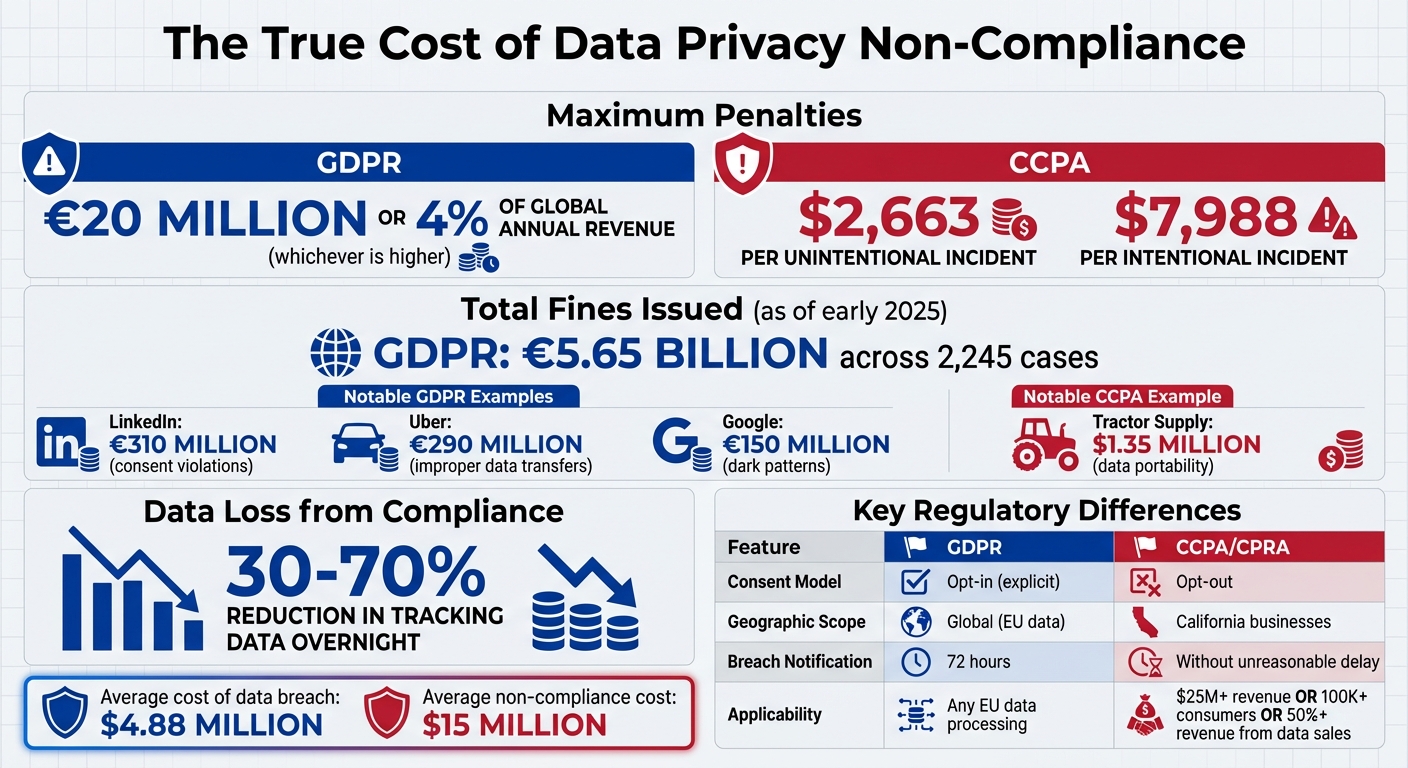
GDPR and CCPA Compliance Costs for SaaS Companies: Fines, Penalties, and Key Differences
SaaS companies generate massive amounts of data every day, but strict privacy regulations often make it nearly impossible to use that data effectively. In most cases, SaaS providers are classified as "data processors", meaning they can't legally access or use raw customer data without explicit consent or another lawful basis [6][8]. Laws like GDPR and CCPA add layers of complexity, making even basic data analysis a risky endeavor.
How GDPR and CCPA Clamp Down on Data Usage
GDPR and CCPA don’t just regulate how you use data - they make it difficult to use it at all. GDPR requires explicit opt-ins, while CCPA uses an opt-out model. Either way, even minor compliance missteps can slash tracking data by as much as 30–70% overnight [7].
The financial risks are staggering. GDPR penalties can reach €20 million or 4% of global annual revenue, whichever is higher [5][8]. By early 2025, fines had already exceeded €5.65 billion across 2,245 cases [5]. In the U.S., CCPA violations cost $2,663 per incident for unintentional breaches and $7,988 for intentional ones [5].
Recent enforcement actions underscore the seriousness of these regulations. For example:
- LinkedIn was fined €310 million for consent violations by the Irish Data Protection Commission in late 2024.
- Uber faced a €290 million fine from Dutch regulators for improper cross-border data transfers.
- California's Privacy Protection Agency issued its first major fine in September 2025, penalizing Tractor Supply $1.35 million for data portability violations [5].
Even seemingly small compliance failures can be costly. For instance, the French regulator CNIL fined Google €150 million for using "dark patterns" that made rejecting cookies more difficult than accepting them [7].
The EU Data Act, effective September 2025, adds even more hurdles. It grants customers the right to switch providers with just two months' notice and mandates data migrations to competitors within 30 days [5]. By 2027, all switching and data transfer fees must be eliminated [5].
"The Data Act effectively gives every customer a termination-for-convenience right with two months' notice, triggered through a switching request."
– Addleshaw Goddard / Latham & Watkins [5]
Understanding data ownership is critical for navigating these challenges. GDPR distinguishes between three types of data: "provided" (e.g., forms, uploads), "observed" (e.g., logs, timestamps), and "derived" (e.g., lead scores, risk ratings). While customers can demand portable copies of the first two types, derived data often remains under the company's ownership [5].
| Data Category | Portable Under GDPR? | Your Ownership Potential |
|---|---|---|
| Actively Provided (Forms, uploads) | Yes | Low (Customer-owned) |
| Observed/Generated (Logs, timestamps) | Yes | Low (Customer-owned) |
| Derived/Inferred (Lead scores, risk ratings) | No | High (Company-owned) |
Compliance challenges don’t stop with data usage. If your SaaS platform serves EU customers, you must comply with the EU-US Data Privacy Framework or use Standard Contractual Clauses for international data transfers. Failure to do so can lead to personal liability for company leadership, as Dutch regulators have warned [5].
"If you cannot find, export, correct, or delete a specific user's data within your system, you are not technically compliant."
– Blake Turley, Technology Counsel [6]
While you're busy navigating these restrictions, your competitors may be finding ways to use data more effectively.
Competitors Are Exploiting Data Better Than You
The regulatory environment doesn’t just limit your use of data - it gives competitors an edge. While you're tied up in compliance, others are leveraging public or aggregated datasets to gain insights and outmaneuver you.
Third-party analytics providers are a prime example. They aggregate and anonymize data from multiple clients to train AI models, fine-tune advertising algorithms, and sell market intelligence [3][10]. Tools like Meta Pixel and Google Analytics may seem helpful, but they also funnel behavioral data into platforms that use it to optimize ads for everyone - including your competitors [3].
The issue of "derived data" compounds the problem. When customers export data from your platform, they typically receive raw files, while you retain the metadata and insights that add real value [2][10]. Savvy competitors are negotiating contracts to access this derived data, while others leave it untapped.
Some dominant players are even using technical barriers like API throttling, high egress fees, and proprietary formats to create "data moats" that block competition. For example, in late 2025, Texas Attorney General Ken Paxton sued Epic Systems for "information blocking", accusing the company of making it difficult for competitors to access patient data [2].
AI training presents another challenge. Some SaaS vendors are using customer data to train AI models, which they then sell back to the market - or even to your competitors [3][9]. A 2025 disclosure revealed that Microsoft Azure OpenAI allowed employees to view prompt and response logs as part of an abuse monitoring system, illustrating how data shared with cloud AI tools may not be as private as expected [9].
"When you rely on third-party tools, you're essentially renting insight... If that third-party changes their policies, prices, or even goes out of business, you could lose critical historical data."
– Onur Alp Soner, CEO, Countly [3]
Here's the kicker: 92% of companies acknowledge that leads won't buy products if their data isn't secure [3]. Yet, the same security concerns are stopping you from fully utilizing the data you already have. The companies that figure out how to balance trust and data utility will gain a massive advantage in the market.
How to Use Customer Data Without Breaking Trust or Laws
You can harness customer data responsibly without running afoul of regulations. Today’s privacy-focused techniques make it possible to gather insights while collecting only the necessary data and safeguarding it from the start.
These strategies not only help you stay compliant but also allow you to tap into the potential of customer data in ways your competitors might already be doing.
Data Analytics Methods That Protect Privacy
Several privacy-focused methods can help you analyze data without compromising individual privacy:
-
Differential privacy: By adding mathematical noise to query results, this method protects individual identities while enabling safe aggregate reporting and public dashboards.
"Differential privacy brings mathematical rigor to privacy protection, enabling customers to leverage previously inaccessible data." - Snowflake [11]
- Synthetic data: This involves creating artificial datasets that replicate the statistical patterns of real data, making it safe for sharing and machine learning (ML) training [13].
- Tokenization: Replacing identifiable information with tokens generated through HMAC ensures secure cohort analysis without linking back to individuals. Additionally, URL scrubbing can remove personally identifiable information from analytics requests [12][15].
| Method | How It Works | Best For |
|---|---|---|
| Differential Privacy | Adds noise to query results or model gradients | Aggregate reporting and public dashboards [11][13] |
| Synthetic Data | Generates artificial records via DP-trained models | Data sharing and ML training [13] |
| Tokenization | Replaces PII with HMAC-based pseudonyms | Cohort analysis and user tracking [12] |
| Sketching | Uses probabilistic data structures (e.g., HyperLogLog) | Real-time approximate counts [12] |
Data minimization is another cornerstone of privacy protection. Collect only the information needed for a specific, well-documented purpose. This approach not only supports compliance but also reduces storage costs and limits the impact of potential breaches [14][16]. Automating retention policies, such as deleting inactive user records after 14 months, can help enforce this practice [16].
Of course, technical safeguards alone aren’t enough. Transparent and user-friendly data policies are equally critical for maintaining trust.
How to Build Customer Trust Through Clear Data Policies
Adopting Privacy by Design ensures that data protection is baked into your product from the outset. For example, default settings should prioritize privacy - data sharing should be off unless users explicitly opt in [14]. Replace lengthy legal jargon with plain-language, layered notices that clearly explain what data is collected and why [14].
Use Consent Management Platforms to allow users to opt into specific data uses. Ensure analytics tags remain inactive until explicit consent is obtained [15].
Providing a centralized control dashboard empowers users to manage their data. This includes viewing their data, adjusting privacy settings, and exercising rights like data portability or deletion. If your system makes it difficult to locate, export, or delete user data, you risk falling short of compliance standards [6]. Keep detailed records of what personal data is collected, where it’s stored, who has access, and the lawful basis for processing [6].
"The biggest risk isn't just the one-time fine. It's the permanent loss of customer trust." - David Pombar, Trackingplan [15]
With the average cost of non-compliance nearing $15 million [17], treating privacy as a competitive advantage - rather than a regulatory checkbox - can set you apart.
Ways to Make Money From Data Without Violating Privacy
There are ethical ways to monetize data while respecting privacy. These include improving internal operations and creating external data-driven products:
- Internal monetization: Use data insights to enhance efficiency, such as through dynamic pricing models or predicting customer churn.
- External monetization: Develop customer-facing products like benchmarking reports or Data-as-a-Service (DaaS) offerings [19].
For example, anonymized benchmarking aggregates performance metrics across your customer base, providing industry comparisons without exposing individual data. Similarly, zero-party data - information customers willingly share - can be used to personalize experiences, offering perks like discounts or early access in exchange [20].
If you’re exploring DaaS, tread carefully. Conduct thorough KYC checks on data buyers to verify their identity and intended use. Cleanse datasets by removing outdated fields, anomalies, and personal identifiers before finalizing contracts that confirm your legal right to sell the data [18].
| Monetization Method | What It Is | Privacy Requirement |
|---|---|---|
| Anonymized Benchmarking | Compare user performance against industry peers | Aggregation to prevent individual identification |
| Zero-Party Data | Use preferences and intentions shared voluntarily | Explicit consent and transparency |
| Data-as-a-Service (DaaS) | Sell raw or processed datasets to third parties | Strict KYC vetting and legal processing agreements |
| Embedded Analytics | Provide data insights as a paid feature | Primarily for internal use with less external compliance |
Before launching any new AI models or data products, conduct Data Privacy Impact Assessments (DPIAs). These assessments help identify risks in high-stakes activities and prevent costly fines [14]. Under GDPR, penalties can reach €20 million or 4% of annual global turnover [14]. Since 2018, GDPR fines have exceeded €7.1 billion, and by early 2025, 144 countries had enacted specific privacy laws [15].
How to Calculate What Your Customer Data Is Actually Worth
Determining the value of your customer data isn’t guesswork - it’s measurable. Three common valuation methods can help you figure out the worth of your data in relation to your Annual Recurring Revenue (ARR): income-based, cost-based, and market-based approaches.
The income-based approach estimates the present value of future benefits by forecasting after-tax cash flows, estimating avoided royalties, or comparing projected performance with and without the data. The cost-based approach calculates the expense of recreating your data from scratch, factoring in costs like engineering, labeling, hosting, governance, and security. The market-based approach compares your data to similar assets sold in recent transactions, adjusting for quality and usage rights.
"The value of data comes from the value of what can be done with it." – Abraham Thomas, Co-founder, Quandl [22]
For SaaS companies, the with-and-without method is particularly practical. By modeling churn and expansion rates with and without specific customer insights, you can estimate the impact of your data. For example, if data-driven retention strategies improve Net Revenue Retention (NRR) by 10 percentage points, that increase directly translates into additional ARR growth.
It’s also important to factor in data debt - expenses like storage, cleanup, compliance, and breach costs. Companies that treat data as an asset and invest in monetization are two to three times more likely to see better ROI on key metrics [21]. To assess this, calculate your data debt leverage ratio (data asset value divided by total data debt costs). A ratio above 1.0 indicates that your data is a net asset rather than a liability.
Methods for Estimating Your Data's Dollar Value
Several frameworks can help calculate the monetary value of your data:
- The marginal lift framework measures the incremental impact of applying new data. For instance, if enhanced customer usage data boosts ad targeting and increases conversion rates, the resulting revenue lift reflects the data's value.
- The relief-from-royalty method estimates what you’d pay to license similar data. For example, if datasets similar to yours typically command royalties of 3–5% of the revenue they enable, applying that rate to your data-driven revenue streams provides a useful valuation. A SaaS company generating $10 million in ARR from customer analytics features might value its data at $300,000 to $500,000 annually.
-
Economic Value to Customer (EVC) is a helpful tool for pricing data products. The formula:
(Next-best alternative price) + (Value of differential advantages) − (Cost of switching).
When creating benchmarking tools or Data-as-a-Service offerings, capturing 30–50% of the differential value ensures customers benefit too, reducing churn.
Keep in mind that data accuracy declines by about 25% annually [21], so you’ll need to account for decay when estimating long-term value. Additionally, proprietary data that hasn’t been used for AI training is especially valuable, as it prevents model overfitting and represents a finite resource.
These methods provide a solid foundation for linking data insights to revenue growth through measurable KPIs.
KPIs That Show How Data Drives Revenue Growth
Once you’ve valued your data, tracking specific KPIs can reveal how it impacts your bottom line.
Net Revenue Retention (NRR) is a key metric for measuring how effectively you use data to grow existing accounts. For public SaaS companies, the median NRR is about 110% [23]. Segmenting NRR by customer group can highlight which data-driven strategies - like upsells or churn prevention - are working best.
Customer Engagement Scores rely on interaction data to predict which accounts are at risk or ready for expansion. Pairing these with Customer Health Scores, which combine usage frequency, support interactions, and Net Promoter Score (NPS), turns raw data into actionable insights.
Expansion ARR tracks revenue from upgrades and add-ons. For example, if customers using a specific analytics dashboard upgrade more frequently, that directly ties data usage to revenue growth.
The CAC-to-LTV ratio measures how efficiently your data-driven strategies convert acquisition costs into long-term value. A healthy SaaS business typically aims for a 1:3 ratio - earning $3 for every $1 spent on customer acquisition [4]. Improvements in targeting that lower Customer Acquisition Cost (CAC) or strategies that boost Lifetime Value (LTV) through better retention should be monitored closely.
While most SaaS companies track between 10 and 24 performance metrics [4], focus on the ones that directly connect data usage to revenue. Companies that score above 40 on the Rule of 40 (Growth % + EBITDA Margin %) often see valuation multiples two to three times higher than those below that threshold [23].
Legal Requirements for Using Customer Data
What GDPR and CCPA Mean for Your SaaS Company
SaaS companies often juggle two roles: acting as controllers for their own data and as processors for customer data. This dual responsibility makes compliance with privacy laws like GDPR and CCPA essential.
GDPR applies to any SaaS company handling personal data of EU residents. As Blake Turley, a business attorney at Turley Law, explains:
"If your SaaS product has even one user in the European Union, GDPR applies to you."
Under GDPR, businesses must obtain explicit opt-in consent before processing personal data. Non-compliance carries hefty penalties, with fines reaching up to €20 million or 4% of global annual turnover - whichever is higher [24].
CCPA and its amendment, CPRA, take a different approach. These California privacy laws apply to for-profit businesses operating in California that meet certain thresholds, such as generating $25 million or more in revenue, handling data for over 100,000 consumers, or deriving at least 50% of revenue from selling consumer data [24]. Unlike GDPR’s opt-in model, CCPA operates on an opt-out basis, requiring businesses to provide a clear "Do Not Sell My Personal Information" link. Violations can result in fines of up to $2,500 per incident, or $7,500 for intentional violations [24].
As of January 1, 2026, 19 U.S. states have implemented comprehensive consumer privacy laws [25]. Without a unified federal privacy law, SaaS companies must navigate a fragmented landscape of state regulations.
| Feature | GDPR | CCPA/CPRA |
|---|---|---|
| Consent Model | Opt-in (Explicit consent required) | Opt-out (For sales/sharing of data) |
| Geographic Scope | Global (Applies to EU data processing) | California-focused for-profit businesses |
| Applicability Thresholds | None | $25M revenue, 100K+ consumers, or 50%+ revenue from data sales |
| Breach Notification | 72 hours to notify regulator | Notify residents without unreasonable delay |
A critical element of GDPR compliance is the Data Processing Agreement (DPA) mandated by Article 28. This legally binding contract outlines how data is handled, specifies security measures, and sets rules for subprocessors. As Secure Privacy emphasizes:
"A data processing agreement for SaaS isn't optional paperwork - it's mandatory infrastructure for enterprise sales."
These regulations make it clear that strong internal controls are non-negotiable for reducing legal risks.
How to Manage Legal Risks When Using Customer Data
Staying compliant requires more than just understanding the law - it involves proactive management to mitigate risks. Even small lapses, like allowing analytics tools such as Google Analytics or Meta Pixel to collect data before users consent via a cookie banner, can lead to violations [8].
Start by mapping your data. Document every type of personal data you collect, where it’s stored, who can access it, and how long it’s retained [26]. This process not only helps manage legal risks but also ensures you can meet Data Subject Access Requests (DSARs) within the required 30-day window [27].
Another essential step is maintaining a subprocessor list. As a SaaS provider, you’re responsible for the data protection practices of third-party vendors like AWS, Stripe, or Zendesk. Keep this list accessible and notify customers at least 30 days before adding new subprocessors [25]. Automating this notification process can save time and ensure smooth legal reviews.
Use runtime audits to catch compliance issues in real-time. Static checks often miss problems like trackers firing before user consent is obtained. Automated scanners can monitor third-party scripts on your live application, helping you identify and fix issues instantly [8].
Adopting a Privacy by Design approach is another key strategy. This means integrating data protection into the development of new features from the start, rather than trying to add it later. For high-risk activities, such as training AI models or automated decision-making, conduct Data Protection Impact Assessments (DPIAs) [14]. With the average cost of a data breach now exceeding $4.88 million [26], prevention is far more cost-effective than remediation.
Under GDPR, you’re required to notify the appropriate supervisory authority within 72 hours of discovering a data breach that poses risks to individuals [24]. Missing this deadline can escalate the situation into a major regulatory issue. Automated breach detection and notification workflows can help ensure you meet this requirement.
Conclusion: How to Use Data While Keeping Customer Trust
Customer data can be incredibly valuable, but its true potential is unlocked only through transparent and trustworthy practices. Companies that thrive in this space aren't those that gather data indiscriminately - they're the ones that treat data as a shared resource, handled with respect and clarity.
To build trust while staying legally compliant, here’s how you can take action:
Start by adopting a first-party data strategy. Managing your analytics internally ensures you're not relying on third-party vendors who might introduce compliance risks or face security breaches. This gives you complete control over your data infrastructure, turning it into a competitive edge.
Prioritize zero-party data. This is data that customers willingly provide, such as through preference centers, onboarding quizzes, or in-app prompts. By creating a clear value exchange, users see immediate benefits like personalized features in return for their information [20]. Always be upfront - explain why you're asking for data and how it will benefit the user.
Show commitment to data portability. Offering tools like "Download My Data" in formats such as JSON or CSV sends a strong trust signal. Test these tools regularly by restoring the exported data in a sandbox environment to ensure everything works as intended [1]. With the EU Data Act mandating the removal of SaaS egress fees by January 2027 [5], making portability a feature now positions you ahead of the curve.
Finally, embed privacy into your product design from the very beginning. Privacy by Design means integrating data protection into your features during the development stage, rather than scrambling to add it after a costly breach (which, on average, could cost $4.88 million [26]). Conduct Data Protection Impact Assessments for high-risk activities like AI training, offer clear and granular consent options, and minimize the data you collect by questioning the necessity of each field. Remember, the safest data is the data you never collect [14]. Companies that demonstrate they only gather what's truly essential are the ones that earn lasting trust.
FAQs
What data can my SaaS legally keep vs. what customers can take back?
Your SaaS can hold onto data specifically outlined as its ownership in the contract - this might include business, customer, or operational data. However, customers maintain the right to reclaim their personal data and any information they’ve provided. This is especially true under laws like GDPR, which ensure the right to data portability. Always stay compliant with relevant regulations and establish clear agreements with customers about data ownership and how it will be used.
How can I get useful analytics without storing personal data?
You can collect useful analytics without holding personal data by adopting privacy-focused techniques that use anonymous, aggregated information. Another option is to utilize zero-party data, which is information customers willingly provide about their preferences and intentions. These methods not only help you stay aligned with privacy laws but also build and maintain trust with your audience.
When does customer data use qualify as 'selling' or 'sharing' under privacy laws?
When customer data is disclosed, transferred, or made available to third parties beyond its original purpose - especially without clear consent or a valid legal reason - it may qualify as "selling" or "sharing" under privacy laws. Regulations like GDPR and the EU Data Act are designed to ensure transparency in these practices and safeguard user privacy.
Related Blog Posts
- I analyzed 50+ SaaS exits from the last 6 months. Companies with AI automation sold for 3.2x higher multiples. Here's the exact playbook
- SaaS Business Models in 2025: How Pricing & Monetization Must Evolve for Maximum Value
- The Hidden Drivers of SaaS Value: Retention, Data Assets & AI Differentiation
- From Subscription to Consumption: How AI Changes the Game for SaaS Valuations