Backlinks are losing their impact. In 2026, 69% of Google searches end without a click, and AI models like ChatGPT now prioritize brands mentioned in trusted communities over traditional SEO signals. The old strategy of creating content and chasing backlinks no longer works as search behavior shifts to AI-driven answers and community-based decision-making.
Here’s what’s changed and what works now:
- Backlinks are less influential: They account for only 45% of off-page ranking weight, while brand mentions and entity signals dominate at 55%.
- AI visibility depends on mentions: AI models prioritize brands frequently mentioned in trusted spaces like Reddit, LinkedIn, and Slack.
- Community engagement is key: Participation in niche forums, social platforms, and directories builds trust and drives conversions.
- Owned, Earned, Paid (OEP) Framework: Focus on owned channels (email, blogs), expand reach through earned mentions (Reddit, directories), and amplify what works with paid ads.
To succeed, shift from traditional SEO tactics to active participation in the spaces where your audience gathers. This approach is more effective for building trust, increasing visibility in AI-generated answers, and driving meaningful business outcomes.
Why Backlinks Don't Work Like They Used To
Backlinks were once the internet’s gold standard. For years, SaaS companies focused on securing high Domain Authority (DA) links, operating under the belief that more backlinks equaled better search rankings. But times have changed. Backlinks now account for just 45% of off-page ranking weight - down from 80% in 2012. Meanwhile, brand mentions and entity signals have taken the lead, making up 55% of off-page influence[8].
The shift is even more pronounced when it comes to AI visibility. A study analyzing 75,000 brands found that brand mentions are about three times more influential than backlinks for AI Overview visibility. The correlation between brand mentions and AI visibility stands at 0.664, compared to a much weaker 0.218 for backlinks[11]. When AI models decide which brands to highlight, they’re not counting links - they’re tracking how often your brand shows up in trusted, relevant contexts.
How Search Algorithms Changed
Search engines have completely redefined how they assess authority. Google, for instance, has transitioned from relying on a link graph (tracking who links to whom) to using a knowledge graph (understanding who knows what about whom)[10]. Modern algorithms now lean on Natural Language Processing (NLP) to identify unlinked brand mentions, which are treated as trust signals based on the credibility of the source and the context in which the brand is mentioned[8].
Google’s SpamBrain AI has made it even harder to game the system. It detects and neutralizes manipulative link-building strategies like private blog networks and guest post farms at scale[9]. The AI evaluates link profiles for unnatural patterns, ignoring links that appear manufactured. As a result, the correlation between Domain Authority and rankings has plummeted - by 2025, it was down to r=0.18. This means a link from a DR 90 generic news site might now hold less value than one from a DR 35 site that’s niche-specific and contextually relevant[12].
Adding to this, Google’s Navboost system processes massive amounts of click-and-query data, making real-time engagement metrics like click-through rate, dwell time, and user satisfaction critical. These factors can now act as a "ranking multiplier", often outweighing traditional backlink signals[13]. AI models like GPT-4, Gemini, and Claude don’t even crawl link graphs. Instead, they focus on text corpora, prioritizing how often a brand is mentioned in authoritative contexts and the sentiment tied to those mentions[8][11].
"Links are definitely not the most important factor. I think that's something that SEOs have kind of focused on for a very long time because it was something that was easy to measure."
- John Mueller, Search Advocate, Google[8]
What Happens When You Rely Only on Backlinks
Relying heavily on backlinks comes with three major drawbacks.
First, it makes your brand invisible to AI-driven search engines. Modern AI models prioritize authority through entity recognition and topical relevance, leaving brands without meaningful mentions out of the picture[10][15].
Second, focusing solely on link-building can harm your site’s performance. Creating content just to generate backlinks can waste crawl budget, which may deprioritize key transactional pages. This often leads to maintenance headaches 18–24 months down the line[16].
Third, in sensitive industries like fintech (Your Money Your Life sectors), low-quality or manipulative links can backfire. These links damage trust signals and invite stricter scrutiny from Google’s quality evaluators[15]. For example, a home retailer shifted their strategy from chasing high-DA (DR 60+) links to targeting niche interior design blogs and communities. Over six months, they earned 23 editorial links from DR 42 sites, resulting in a 127% increase in organic traffic and an extra $43,000 in monthly revenue[12].
"A link embedded in content that no human ever reads is, for all practical purposes, invisible to modern ranking systems."
- Het Balar, Founder, Link Publishers[9]
The brands thriving in 2026 aren’t the ones with the most backlinks - they’re the ones sparking genuine conversations in the spaces where decisions are made. This shift highlights the importance of moving beyond backlinks and embracing strategies rooted in active community engagement.
sbb-itb-9cd970b
How Participation-Based Distribution Works
Instead of obsessing over backlinks, focus on engaging with your audience in the spaces they already frequent. The idea isn’t to drop links but to build trust, positioning yourself as the go-to expert where buying decisions are happening. This approach directly counters the limitations of outdated backlink strategies.
AI now prioritizes community-driven platforms. For example, Reddit accounts for 46.7% of Perplexity's citations and shows up in 68% of AI-generated responses across major platforms. Social platforms, in general, contribute 27.23% of brand-recommendation queries[17][18][24]. A great case study comes from Hamming.ai, a B2B voice AI platform. By scaling Reddit engagement with a focus on being helpful (not spamming links), the company saw 40% of its demos come from Reddit and AI searches. Daily traffic soared from 200 to 1,900 visitors[24].
"We went from 200 visitors/day to 1,900 visitors/day and 40% of the demos we get are from Reddit or AI search." - Sumanyu Sharma, CEO, Hamming.ai[24]
Where to Participate
As traditional SEO becomes less effective, platforms like Reddit and LinkedIn have become essential for staying relevant in today’s AI-driven discovery landscape. However, not all platforms deliver equally. Reddit, for example, now boasts 80 million weekly search users (as of Q4 2025) and is actively developing AI-enhanced search features to function as an answer engine[17]. The key is to target niche subreddits where your ideal customers seek advice, rather than joining spaces already saturated with marketers.
One SaaS founder shared how they grew from $0 to $14,300 in monthly recurring revenue over nine months with just $180 spent. Their strategy? Submitting to 85 directories in the first two months, followed by weekly community content and engagement in 12 subreddits. By month seven, organic content alone was driving daily signups, all without additional ad spend[20].
LinkedIn remains a top platform for B2B SaaS, with 82% of B2B marketers ranking it as their primary channel for reaching decision-makers and building industry authority[21]. Quora also stands out for its structured Q&A format, which aligns well with AI’s question-and-answer citation patterns[17]. Private communities like Slack and Discord (e.g., SaaS Growth, GTM Network) are excellent for peer-to-peer recommendations in trusted environments[21][22].
For real-time updates and technical discussions, X (Twitter) works well, especially for developer tools and productivity-focused SaaS[19]. For complex products, YouTube is invaluable - its long-form tutorials and detailed walkthroughs not only educate users but also rank well with AI engines[19][21]. Finally, platforms like Product Hunt remain effective for generating buzz during product launches and connecting with early adopters[20].
| Platform | Recommended Weekly Cadence | Primary Value for SaaS |
|---|---|---|
| 4-5 posts | Reaching B2B decision-makers & vendor research[19] | |
| X (Twitter) | 5-7 posts | Real-time updates & technical engagement[19] |
| 3-5 contributions | Problem-solving & AI citation sourcing[17][19] | |
| YouTube | 1-2 videos | Product education & SEO/GEO authority[19][21] |
| 1-2 sends | High-conversion direct communication[21][22] |
What You Gain from Community Engagement
Active participation in these communities doesn’t just increase visibility - it delivers measurable business results. By offering genuine value, you build trust with potential customers before they even convert. This often results in higher-quality leads and fewer refunds compared to traditional growth-hacking approaches[23]. For example, customers acquired through Reddit have a lifetime value three times higher than those from paid ads[20], and visitors from AI search convert at 4.4 times the rate of standard organic search visitors[25].
The key is following the 90/10 rule: provide 90% value and limit self-promotion to just 10% over a 6–12 month period[17][26]. Writesonic, an AI writing platform, demonstrated this perfectly. In April 2026, they ran a six-week Reddit campaign focused on authentic engagement. The result? Their brand mentions in AI-generated answers jumped 240%, from around 6,400 to over 22,000, with 41% of relevant AI answers citing their brand[18].
"The mindset that works is: show up to be useful, not to be seen." - AI Search Tools[18]
This approach also creates a feedback loop that traditional SEO methods can’t replicate. By engaging directly with your audience, you uncover the exact questions they’re asking, the language they use, and their core pain points. This information feeds into product development, messaging, and future content strategies. With 93% of B2B website content receiving zero backlinks[21], meaningful participation is becoming one of the few reliable ways to ensure your content reaches the right people.
The OEP Framework: Owned, Earned, and Paid Participation
Many SaaS companies face challenges with content distribution because they treat every channel the same. The OEP Framework - which stands for Owned, Earned, and Paid - provides a clear strategy to organize your distribution efforts and get the most out of your investment. This approach focuses on aligning your content efforts with a community-driven engagement model. Instead of spreading resources thinly across platforms, the framework helps you establish a strong base, grow strategically, and amplify what’s already working[21][3].
The importance of this strategy becomes clear when you consider that 65% of B2B content goes unused and 93% of B2B website content receives no external backlinks[21]. Without a solid distribution plan, even standout content risks being overlooked. The OEP framework ensures your content gets the attention it deserves by guiding it through three clear stages.
Owned Channels: Start Here
Owned channels are the foundation of a participation-first strategy. These include platforms you fully control, such as your blog, email newsletters, social media accounts, and branded podcasts. Here, there’s no algorithm acting as a gatekeeper between you and your audience[21][4]. For instance, email marketing delivers an average ROI of $36 for every $1 spent, making it one of the most dependable channels for SaaS companies[21].
A great example is Morning Brew, which grew its subscriber base significantly between 2018 and 2020 by leveraging a referral program through its owned email newsletter. Subscribers were encouraged to refer others with rewards like stickers and t-shirts. This program accounted for 30-40% of their 4 million subscribers at a cost of under $0.10 per acquisition - far cheaper than the $8-15 cost per acquisition on paid social channels[32]. Owned channels like this grow in value over time with little additional cost.
Similarly, in 2025, Victoria's Secret launched the "What Women Want" campaign using a branded podcast. Distributed on platforms like Spotify and Apple Podcasts, the content tackled societal issues, helping rebuild trust with their audience through media they controlled[4].
Once you’ve established a strong owned media presence, the next step is to expand your reach through earned channels.
Earned Channels: Expand Your Reach
Earned channels refer to third-party platforms where your brand is mentioned, shared, or discussed. These include Reddit threads, guest blog posts, community forums, and media coverage. In 2026, earned channels became even more important for Generative Engine Optimization (GEO), as AI models began prioritizing content cited by trusted third-party sources[21][6].
For example, Reddit plays a significant role, appearing in 40% of analyzed AI citations[21]. Companies like AFFiNE capitalized on this between 2024 and 2026. They engaged authentically in the r/selfhosted subreddit and developer Discord servers, following the 90/10 rule: 90% of their participation focused on offering value, while only 10% involved self-promotion. This approach helped them earn their first 1,000 GitHub stars and led to 30+ Product Hunt launches, all without relying on paid advertising[29][28].
Earned media builds your reputation into a distribution channel. When your brand appears across multiple trusted sources - like Reddit, Wikipedia, or industry publications - AI models recognize you as a credible authority worth citing[21].
With a strong foundation in owned and earned channels, paid strategies can then amplify your most successful content.
Paid Channels: Boost What Works
Paid channels, such as LinkedIn ads, sponsored content, and PPC campaigns, are best used to amplify content that’s already proven its value organically[21][27]. Think of paid distribution as a way to scale success, not as the starting point. For B2B marketers, LinkedIn is a standout option, with 82% ranking it as their most valuable social media platform for paid promotion[21].
The sequence is key here: first, publish your content on owned channels (like your email or blog) to gather initial engagement. Then, leverage earned channels to boost algorithmic reach on social platforms. Finally, use paid campaigns to amplify content that’s already driving high engagement or conversions[30]. This approach minimizes wasted ad spend on content that hasn’t been tested.
Take Zapier as an example. They prioritized distribution infrastructure, allocating 60% of their content resources to distribution and only 40% to content creation. As a result, their top 500 pages generated 78% of their total traffic, helping them reach 6 million monthly organic visitors[32]. While Zapier leaned heavily on owned and earned channels, they demonstrated the importance of focusing on distribution over sheer content volume. When they did invest in paid promotion, they focused on "decision-stage" content like ROI calculators and comparison posts to drive conversions[30][27].
| Channel Type | Primary Goal | Control Level | ROI Characteristic |
|---|---|---|---|
| Owned | Relationship Building | High | Compounding; zero marginal cost per reach[30][32] |
| Earned | Credibility & Reach | Low | High trust; 23x higher conversion from AI-referred visitors[31][32] |
| Paid | Speed & Scaling | High | Immediate results; costs often increase significantly over time[30][28] |
"Content is king, but distribution is queen. And she wears the pants." - Jonathan Perelman, Former VP of Agency Strategy, BuzzFeed[3][4]
How to Implement Participation-Based Distribution
To shift from relying on backlinks to focusing on participation, it’s all about adding value before promoting your product. Companies thriving in 2026 prioritize being present where their audience gathers, collaborating with aligned partners, and using directories to boost visibility across multiple touchpoints. Let’s break down how SaaS and AI companies can make this approach work.
How to Engage in Communities
The key to effective community engagement is building trust first - not jumping straight into promotion. Spend 2–4 weeks actively participating in subreddits, Slack groups, or Discord servers without mentioning your product. This helps establish credibility and avoids the dreaded "spammy" label. Reddit users, in particular, are quick to spot promotional behavior, so focus on contributing value before sharing links [18].
Take a page from Writesonic’s playbook. Between February and April 2026, they engaged authentically in relevant Reddit threads. The result? Their brand mentions in AI-generated answers shot up 240%, with 41% of relevant AI answers citing their brand by the end of the experiment [18].
To stay efficient, use the 70‑20‑10 rule: dedicate 70% of your efforts to proven platforms like LinkedIn and email, 20% to emerging spaces like YouTube and Reddit, and 10% to experimental communities like TikTok or niche forums [21]. Prioritize Q&A threads and comparison posts, which make up nearly 75% of AI-cited content on platforms like Reddit [21]. Once you’ve built a foundation in these communities, you can amplify your impact by partnering with other companies.
Working with Other Companies
After establishing a presence in community spaces, collaborating with trusted partners can help you extend your reach. Co-marketing partnerships are especially powerful for SaaS companies, as they allow you to tap into audiences that already trust your partners. If your product integrates with another software, use that connection to create joint resources like partner directory listings, shared documentation, and co-branded landing pages [33].
For example, if your tool integrates with Salesforce, you could co-create a guide like "How to Automate [Specific Workflow] Using Salesforce and [Your Tool]." This positions both brands as experts while increasing the chances of being cited by AI models [14].
Integration marketplaces such as Zapier, Slack App Directory, and HubSpot Marketplace are also valuable. They not only provide high-authority backlinks but also signal the utility of your product to search engines and AI models [34][35]. Brands with strong mention patterns on these platforms see a 38% AI citation rate, compared to just 12% for those relying solely on backlinks [14]. To maximize visibility, complete all profile fields, include screenshots and videos, and encourage customer reviews [33].
| Marketplace | Domain Rating | Link Type | Primary Benefit |
|---|---|---|---|
| Salesforce AppExchange | Very High | DoFollow | High-intent buyer traffic and enterprise trust [33] |
| HubSpot Marketplace | Very High | DoFollow | Contextual relevance for marketing/sales tools [33] |
| Zapier | Very High | DoFollow | Workflow visibility and automation use cases [33] |
| Slack App Directory | High | NoFollow | Developer community engagement [33] |
Using SaaS Directories for Visibility
SaaS directories are another powerful tool for building authority and credibility. Platforms like G2, Capterra, and Product Hunt aren’t just review sites - they’re trusted sources that AI engines reference when generating recommendations. Social platform mentions (especially from Reddit and LinkedIn) account for 27.23% of all citations in AI brand-recommendation queries [18].
Start with high-domain-rating (DR) directories like G2 (DR 91–93), Product Hunt (DR 91), and Crunchbase (DR 91) for dofollow links and buyer traffic [34][35]. Then, expand to niche directories like AlternativeTo (DR 82) and SaaSHub to attract users searching for competitor alternatives [34]. These listings help create a "citation stack" - a pattern of mentions across trusted sources that signals legitimacy to both people and AI models [21].
AFFiNE provides a great example of this strategy. Between 2024 and 2026, they grew from zero to over 60,000 GitHub stars by engaging in communities like r/selfhosted on Reddit, developer Discord servers, and Hacker News. This community-driven approach also helped them achieve 30 #1 finishes on Product Hunt - without spending on ads [28]. Their success came from consistent engagement across platforms, creating a distributed presence that AI models noticed and referenced.
For newer companies, services like SEOForge.ai offer manual submissions to hand-picked directories for $299 [35]. Alternatively, platforms like BetaList ($129 for priority listing) and Startup Stash ($49 for featured placement) provide affordable options for early-stage businesses [34]. The goal isn’t just to rack up backlinks - it’s about showing up where your audience looks for solutions and where AI models gather consensus for recommendations.
How to Measure Results: Participation vs. Backlinks
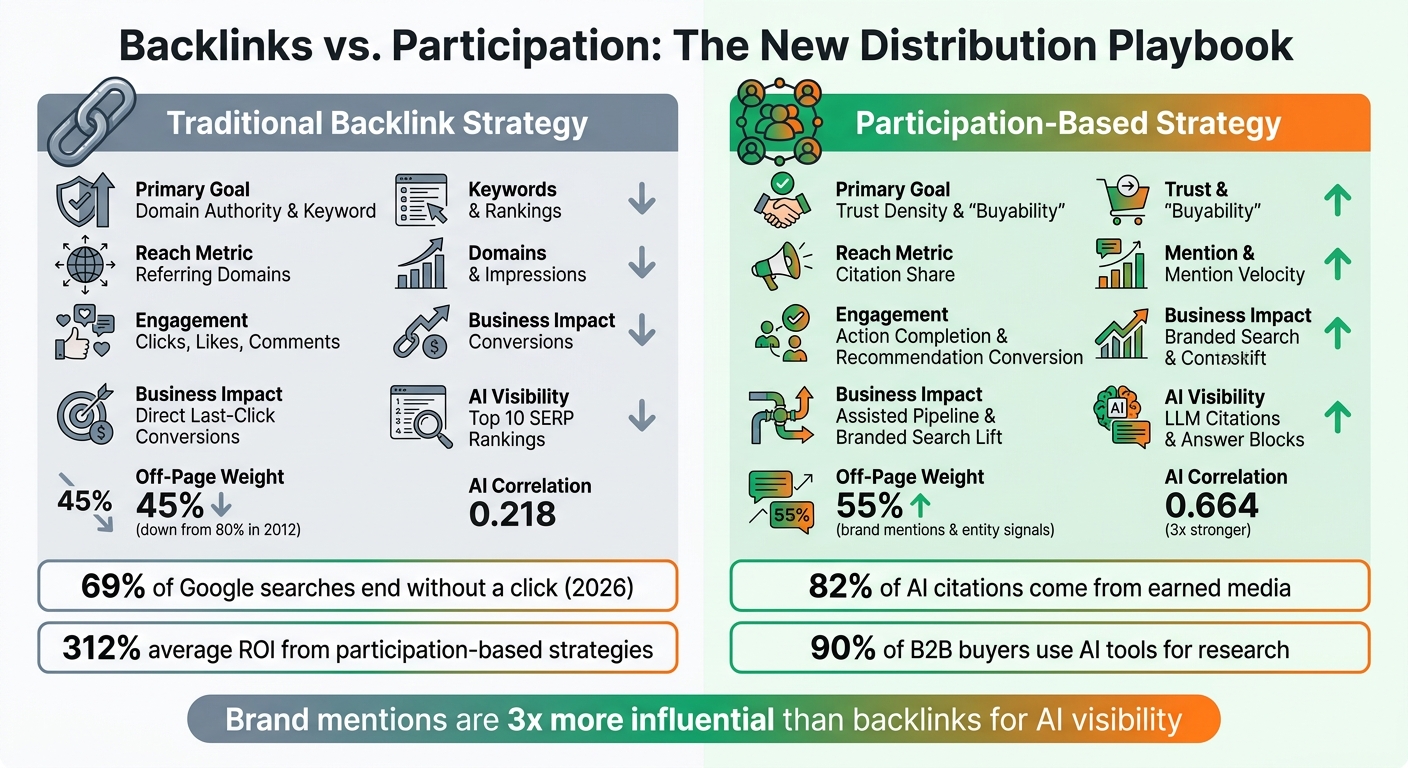
Backlinks vs Participation: 2026 Distribution Strategy Comparison
As digital distribution evolves, the focus has shifted from backlinks to participation, making it crucial to measure real business outcomes. The old way of tracking success relied on counting backlinks and monitoring domain authority. Now, the priority is determining whether your participation drives qualified leads and ultimately leads to purchases [38].
Track Pipeline, Not Vanity Metrics
The key is to measure whether your engagement moves potential buyers from simply being aware of a problem to being ready to make a purchase [38].
One useful indicator is branded search growth. When searches for your company increase, it reflects the market's recognition of your efforts. Tools like Google Search Console can help track monthly branded search growth and assisted conversions - such as trials or demos that stem from community posts, Reddit discussions, or partner listings. These metrics show the tangible results of your community engagement [37][38].
For example, a B2B SaaS company monitored Reddit and Hacker News for mentions of a competitor's service outage. By responding to 12 threads within four hours, they secured 340 signups and generated $28,000 in annual recurring revenue - all for a monitoring cost of under $50 per month [40]. This demonstrates the value of tracking revenue generated per mention, rather than just counting links [40].
"If you are measuring link building only through traditional SEO benchmarks, you are likely undercounting the real impact of your campaigns." - Linqbot [37]
AI citation tracking has also become a vital metric, with 66.2% of digital PR professionals now using it as a KPI [2]. Tools like True Margin's AI Authority Checker can help you see if platforms like ChatGPT, Perplexity, or Google AI cite your brand when users ask related questions. Interestingly, 80% of URLs cited by AI systems don’t rank in Google’s top 100 results, so traditional rankings may not reveal your visibility in AI-generated answers [39][2].
Focusing on these meaningful metrics allows for a better evaluation of ROI when comparing traditional backlink strategies to participation-driven approaches.
ROI Comparison: Backlinks vs. Participation
Participation-driven strategies are proving to have a stronger connection to visibility than backlink-focused ones. Branded web mentions, for instance, show a 3x stronger correlation with AI search visibility (0.664) compared to traditional backlinks (0.218) [2]. This explains why 82% of AI citations come from earned media sources like Reddit discussions or community threads, rather than brand-owned blogs [39].
The table below highlights the differences between these two approaches:
| Metric Category | Backlink-Focused Approach | Participation-Based Strategy |
|---|---|---|
| Primary Goal | Domain Authority & Keyword Rankings | Trust Density & "Buyability" [36][38] |
| Reach Metric | Referring Domains & Impressions | Citation Share & Mention Velocity [37][2] |
| Engagement | Clicks, Likes, and Comments | Action Completion & Recommendation Conversion [36] |
| Business Impact | Direct Last-Click Conversions | Assisted Pipeline & Branded Search Lift [37][38] |
| AI Visibility | Top 10 SERP Rankings | Inclusion in LLM Citations & Answer Blocks [1][39] |
One example of this shift in action comes from a treatment center that secured 39 editorial placements in respected health publications. This effort increased their organic traffic by 352% over nine months [39]. In a sensitive category like YMYL (Your Money Your Life), where AI systems heavily weigh authority, participation-driven strategies proved far more effective than traditional backlink building.
The trend is undeniable: 73% of B2B marketers now prioritize conversions over traffic volume when evaluating content performance [1]. The ultimate goal is to create trust so strong that community members feel confident recommending your brand - not just driving clicks [36]. This approach aligns with today’s AI-driven standards, where genuine engagement consistently outperforms link collection.
Conclusion
By 2026, participation has overtaken backlinks as the foundation of digital distribution. With zero-click searches making up 60%–80% of queries and AI-driven answer engines delivering synthesized responses, traditional SEO has taken a backseat[1]. At the same time, 90% of B2B buyers now rely on generative AI tools during their initial research[5], and about 70% of the B2B buying process happens anonymously - through AI tools, private Slack groups, and Reddit discussions - long before your brand enters the picture[5][7].
The data paints a clear picture: participation-driven strategies outperform traditional backlink approaches in terms of AI visibility and ROI. Digital PR and participation-based methods now deliver an average ROI of 312%[2], while most B2B website content struggles to attract any external links at all[1].
"The uncomfortable truth is simple: In 2026, the best product rarely wins. The best‑distributed one does." - Philip Mordecai, CEO, Florido[41]
From improving AI visibility to fostering community engagement, this article has demonstrated that active participation is the key to thriving in today’s digital landscape. For SaaS and AI brands, distribution has evolved from being a marketing strategy to becoming a critical business challenge[41]. The brands that succeed in 2026 will be those that engage authentically in communities, earn mentions on trusted platforms, and establish mental availability well before potential buyers begin their search.
The rules of the game have shifted. Those who adapt quickly will secure their place in the market. Transitioning to participation-based distribution isn’t just a choice - it’s a necessity. The only question left is: how soon will you make the leap?
FAQs
How do I get more brand mentions in places AI tools trust?
To make an impact, get involved in online communities where people share genuine experiences. Platforms like Reddit and LinkedIn are great places to start. Instead of pushing promotional content, focus on sharing helpful insights and meaningful contributions. When you build trust through authentic engagement and personal input, you increase your chances of being referenced by AI models. These models often prioritize credibility and community-driven validation when determining visibility in AI-powered search results.
Which communities should I participate in first for my niche?
To connect with your audience on a deeper level, focus on the spaces where they naturally gather and interact. Start with niche subreddits that align with your industry. These smaller, topic-focused communities are excellent for building trust and increasing visibility. Jump into discussions where people are asking for advice or sharing their experiences - this is your chance to provide value and make a genuine connection.
Beyond Reddit, explore forums, LinkedIn groups, and specialized industry platforms. These spaces often host meaningful conversations and provide opportunities to establish your expertise. By contributing thoughtfully and authentically, you can position yourself as a credible voice in your field.
What should I track to prove participation drives revenue?
To demonstrate how participation boosts revenue, zero in on metrics that highlight trust and genuine engagement. Keep an eye on qualified leads generated through online communities, referral traffic from platforms such as LinkedIn or Reddit, and increases in brand searches - all of which signal growing authority and trust. Also, track natural backlinks and improvements in content visibility that result from active involvement. These often go hand-in-hand with higher conversion rates and a noticeable impact on revenue.
Related Blog Posts
- Generative Engine Optimization GEO The Future of SaaS Discovery
- 9. Reddit Is Cited in 46.7% of Perplexity Answers and 21% of Google AI Answers. Your Blog Gets Zero. Here's the Mathematical Reason Why That Gap Is Going to Widen. WorkfxAI Blogs
- 19. People Don't Trust AI. They Trust Reddit. That's Why Reddit Is Worth $43 Billion and Your Blog Is Worth Zero. The Gap Is Called Distribution Authority. The Motley Fool
- A Single Well-Crafted Answer in the Right Reddit Thread Can Influence Thousands of AI Responses About Your Brand. Your Competitors Figured This Out. You're Still Running LinkedIn Ads. Substack