Here’s the big takeaway: The most successful SaaS founders prioritize distribution over product development. Why? A great product without distribution is invisible. After analyzing 19 interviews, it’s clear that 70% of a founder's focus should be on distribution strategies, not building features.
Here’s why distribution matters:
- Replicable products: AI and no-code tools make it easy to copy features within days.
- Startup failures: 42% of startups fail due to "no market need" - not because the product is bad, but because no one knows it exists.
- Winning examples: Dropbox doubled its users in 10 days with a referral program. Microsoft Teams beat Slack by bundling with Office 365.
Key strategies from top SaaS founders:
- Referrals & Virality: Programs like Dropbox’s offer rewards tied to product value, driving sustained growth.
- Built-in Virality: Features like "Powered by Clickfunnels" badges turn users into marketers, generating $12M ARR.
- SEO & Communities: Free tools and user-generated content boost visibility (e.g., Webflow’s Showcase).
- Partnerships: Integrations and affiliate programs expand reach (e.g., Slack’s App Directory).
- Content Flywheels: Embed your brand into user content for compounding growth.
Pro Tip: Test distribution early. Pause product development for two weeks to focus solely on growth. Secure pre-orders or referrals before scaling.
Conclusion: In today’s crowded SaaS market, distribution is your edge. Build it into your product from day one. As Reid Hoffman said, “A good product with great distribution will almost always beat a great product with poor distribution.”
How the Analysis Was Conducted
How Interviews Were Selected
To ensure meaningful insights, founders were chosen based on hitting key revenue milestones: either achieving $50 million ARR within 18 months or operating companies with revenue between $10–70 million ARR [8][9]. Interviews were drawn from trusted sources like the Nathan Latka podcast, "Invest Like the Best", Startup Archive on YouTube, and well-known SaaS newsletters [7][4][9]. The study included a mix of bootstrapped founders (like the 19-year-old behind Cal AI) and venture-backed entrepreneurs to identify patterns that cut across different funding approaches. A critical selection criterion was their focus on "distribution-first" strategies. Founders needed to share detailed playbooks on tactics like influencer marketing, SEO backlink strategies, or viral referral loops [4][8]. This approach ensured the analysis centered on actionable distribution methods. For those looking to scale, our B2B SaaS newsletter provides a framework to move from $500K to $5M+ ARR.
How Patterns Were Identified
Once the interviews were compiled, the next step was to uncover recurring themes. Analysts meticulously tracked how often founders emphasized distribution tactics compared to product development [10][2][6]. Each interview was categorized based on factors like format, timing, and outcomes, allowing for a clear picture of what drove success [12]. The AARRR framework - Acquisition, Activation, Retention, Revenue, Referral - was used to organize founder actions and pinpoint which stages of growth were most impactful [2].
To validate these patterns, analysts leaned on metrics. They measured "K-factor" components, such as invite rates and conversion percentages, to identify which strategies delivered the highest viral growth [6]. One founder likened the process to "detective work", citing examples like a single viral tweet that led to 200 downloads and 50–200 direct messages. These small wins were then scaled up tenfold to amplify results [5][4]. This combination of anecdotal insights and data-driven validation helped solidify the findings.
sbb-itb-9cd970b
How this $1M+ SaaS Founder made LinkedIn her Biggest Lead Channel
The Main Finding: Distribution Drives Growth Faster Than Product
Our research reveals a clear trend: startups that focused on distribution outpaced those prioritizing product features. This difference often separated rapid-growth companies from those that struggled to keep up.
Consider this: Microsoft Teams amassed over 320 million monthly active users, dwarfing Slack's 80 million, largely because it was bundled with Office 365 [7]. Similarly, ChatGPT reached 100 million users in just two months, thanks to the social media influence of its founders and viral "prompt" threads [7]. Another striking example is Dropbox, which doubled its user base from 100,000 to 200,000 in just ten days after launching a referral program that rewarded users for inviting friends [13].
What Founders Said About Distribution vs. Product
This distribution-first mindset is echoed by prominent industry leaders, who stress its importance in scaling a business:
Reid Hoffman, Co-founder of LinkedIn, summed it up perfectly:
"A good product with great distribution will almost always beat a great product with poor distribution." [13]
David Sacks, Founder of Yammer, highlighted the need to prioritize distribution from the start:
"Distribution has to be baked into the product from the beginning, it's not something you tack on later." [7]
Andrew Gazdecki, a startup founder, urged entrepreneurs to rethink their approach:
"Your job as a startup founder is to find ways to innovate on distribution strategy as much as you innovate on product strategy." [7]
These insights underline the value of treating distribution as a core strategy rather than an afterthought.
Examples of Distribution-Driven Success
The power of strong distribution channels is evident in several standout examples, even when products themselves were relatively simple.
Take Hotmail, for instance. Founders Sabeer Bhatia and Jack Smith added a clickable signature to every outgoing email: "PS. I Love You. Get your free email at HoTMaiL." This small tweak helped Hotmail grow to 12 million users within a year, ultimately leading to a $400 million acquisition by Microsoft [7].
Facebook offers another compelling case. When Mark Zuckerberg launched the Facebook Developer Platform in May 2007, it allowed third-party companies to create apps integrated with Facebook's Social Graph. This move propelled Facebook from 25 million users to 250 million in just two years [7].
Even in hyper-competitive markets, the lesson remains clear. In the AI era, software features can be replicated within hours or days, making distribution networks the only lasting edge for many businesses [7]. With millions of apps and websites vying for attention, success often hinges on reaching customers effectively - not just building great technology [4].
Top Distribution Strategies from 19 SaaS Founders
From 19 interviews with SaaS founders, five standout distribution strategies emerged. Each one integrates distribution into the product's DNA.
Owned Channels: Referrals, SEO, and Social Media
Referral programs thrive when the rewards directly enhance the user experience. For example, Dropbox offered 500MB of free storage to both the referrer and the referred user, boosting product value instead of offering unrelated perks like gift cards. This approach drove 35% of their daily signups at its peak, with users sending a staggering 2.8 million invites in April 2010 alone [14][15][16][17].
Referred customers tend to stick around longer and spend more, showing a 16% higher lifetime value compared to other channels. Referrals also boast the highest B2B conversion rates at 3.63% [14]. Timing matters too - prompt users to refer others during onboarding or after achieving key milestones [15][16][17].
Another effective owned channel is community-driven SEO. Take Webflow, for instance: their "Showcase" feature allows users to share templates and designs, creating a wealth of user-generated content that boosts long-tail SEO. Similarly, Instantly.ai founder Raul Kaevand launched a Facebook group called "Cold Email Masterclass", which grew to over 6,000 members and helped the company hit a $2.4 million run rate in just nine months [6].
Free tools can also act as powerful lead magnets. Surfer SEO’s free "Keyword Surfer" Chrome extension attracted over 500,000 active users, serving as a brand awareness engine that funneled users into their paid SaaS product [6]. Hiten Shah, Co-founder of Crazy Egg and KISSmetrics, advises:
"My big piece of advice for founders is to spend your time figuring out the words your customers and people in your space use to describe their problems" [11].
Virality is another key driver when baked into the product itself.
Built-In Product Features for Viral Growth
Some of the most effective viral strategies are those seamlessly integrated into the product's core functionality, turning everyday use into a distribution opportunity.
Clickfunnels exemplifies this with their "Powered by Clickfunnels" badge, which appears on every user-created landing page. Co-founder Todd Dickerson highlights its impact:
"The badge drives $1M+ in monthly recurring revenue, roughly 20% of total MRR. That's ≥$12M ARR attributable to the badge" [6].
Another example of viral growth is collaboration virality, where a product becomes more valuable as team members join. Loom leveraged this by unlocking advanced features when users invited coworkers, boosting weekly active users by 1.8x and signups by 2.6x [6]. The secret lies in optimizing three metrics: the Invite Rate (invites sent per user), the Conversion Rate (percentage of invites accepted), and the Loop Speed (time between sending an invite and acceptance). Cutting the Loop Speed from two weeks to one can quadruple growth in just 30 days [6].
Pre-launch campaigns can also generate buzz. Harry’s used tiered rewards - like free shaving cream for five referrals and a year of free blades for 50 referrals - to drive 100,000 email signups in a single week, with 77% coming from referrals [18]. Similarly, Robinhood’s gamified waitlist, which allowed users to move up by sharing referral links, grew their user base from 10,000 to 3 million before launch [18].
Partnerships and Platform Integrations
Platform integrations turn third-party apps into distribution channels. For example, Slack’s App Directory, with over 2,000 integrations, has transformed its ecosystem into a robust distribution network [17]. Building an API-first architecture from the start ensures your product can plug into other platforms seamlessly [17].
Affiliate partnerships are another effective strategy, especially in niche markets. Expandi scaled to $7 million ARR in just 20 months by building a network of affiliates, offering aggressive recurring commissions of 30-50% [6]. This strategy works by leveraging the trust influencers and micro-influencers have with their audiences [19][6].
| Strategy | Primary Driver | Key Metric | Best For |
|---|---|---|---|
| Partnerships | Borrowed Trust | Affiliate Revenue | Niche communities |
| Integrations | Ecosystem Value | Marketplace Installs | API-first products |
| Enterprise | Team Efficiency | LTV / ACV | High-touch B2B |
| Powered-By | Brand Exposure | Badge Click-through | Tools with public output |
While partnerships and integrations expand reach, content and media assets can amplify growth even further.
Content and Media Flywheels
Embedding your brand into user-generated content can create a self-sustaining growth loop. For example, Tally Forms generated $4 million in revenue by having users embed branded forms on their websites [6]. Similarly, Turtl’s branded "powered by" placements consistently drive 30% to 50% of new leads [6].
The beauty of content flywheels is their compounding nature. Every user-generated piece of content, embedded widget, or shared template becomes a permanent asset, working around the clock without requiring additional ad spend.
Enterprise-Focused Distribution Tactics
When targeting enterprise clients, the approach shifts significantly. Messaging should focus on team efficiency and organizational ROI to appeal to decision-makers [19].
Speed is critical in enterprise sales. Reducing response times from three days to one hour can increase deal closures by 20% [19]. As David Hauser, CEO and Co-founder of Grasshopper, puts it:
"Marketing is about focusing on where your target market actually is, and not the stuff that makes you feel good" [11].
Pricing strategy also plays a crucial role. For instance, Unbounce discovered that their $25/month plan wasn’t sustainable, as it cost $150 to acquire a customer who only stayed for four months. Targeting enterprise customers with higher budgets and lower support needs can be far more profitable, even with higher acquisition costs [11].
Rather than building custom features for individual clients early on, focus on a well-defined segment with budgets that align with your high-touch sales process [11]. This ensures long-term scalability while avoiding distractions.
Case Studies: SaaS Companies That Won with Distribution
Dropbox: Referral Program Mastery
Back in 2008, Dropbox faced a big challenge: acquiring customers through Google AdWords was incredibly expensive, costing between $233 and $388 per customer for a product priced at $99 per year [15]. To solve this, founder Drew Houston and growth expert Sean Ellis created a referral program that transformed users into Dropbox's most effective marketers.
The program was simple but brilliant. It offered 500MB of free storage to both the referrer and the referred user. Dropbox made it easy to invite others by integrating "Thank You" emails, syncing with Gmail or Outlook for bulk invitations, and providing a dashboard so users could track their earned storage. This approach not only encouraged referrals but also highlighted the product's core value - extra storage. The results were staggering: between September 2008 and January 2010, Dropbox grew its user base from 100,000 to 4 million - a jaw-dropping 3,900% increase in just 15 months [15]. By April 2010, users were sending 2.8 million invites monthly, and referrals accounted for 35% of daily signups. Over time, this program permanently boosted signups by 60%.
As Megan Mosley from Referral Rock noted:
"The referral program drew inspiration from the Paypal viral referral program... PayPal gave cash as a reward – as they are in the business of money. Dropbox chose to go a similar route and give away their primary product (storage space) as well." [15]
Next, let’s look at how Airbnb tapped into existing online communities to fuel its growth.
Airbnb: Using Craigslist for Rapid Growth
In August 2008, Airbnb was struggling. With only two users and nearly no funds left [20], the founders - Brian Chesky, Joe Gebbia, and Nathan Blecharczyk - decided to focus on finding their audience where it already existed: Craigslist. At the time, Craigslist had millions of users looking for short-term rentals, but it lacked polished features like professional photos, secure payments, and a user-friendly booking system.
Airbnb seized this opportunity by making it easy for hosts to cross-post their Airbnb listings to Craigslist. They automated the process with tools that bypassed CAPTCHAs and pre-filled listing details, making it seamless for hosts to reach Craigslist’s massive audience [22]. Additionally, the team scraped Craigslist for "Looking for a place to stay" ads, gathered email addresses, and sent personalized invitations to join Airbnb. What started as manual outreach quickly evolved into an automated system [21]. This strategy funneled high-intent users from Craigslist’s basic interface to Airbnb’s visually appealing platform, solving the classic "chicken-and-egg" problem of building a marketplace - all without a marketing budget. Fast forward, Airbnb grew into a company valued at over $35 billion [21].
Now, let’s explore how Dresma leveraged partnerships to achieve success.
Dresma: Studio Partnerships Driving Revenue
Dresma took a different route compared to Dropbox and Airbnb. Instead of relying on viral growth or tapping into existing communities, Dresma pursued strategic partnerships. By working with 3–5 pilot studio partners during 60-day trial periods, Dresma gained testimonials and social proof that propelled its revenue growth [23]. These partnerships allowed the company to reach its target audience through trusted, established relationships.
This example highlights that distribution doesn’t always require viral campaigns or clever hacks. Sometimes, aligning with the right partners can be just as impactful.
How to Build Distribution from Day One
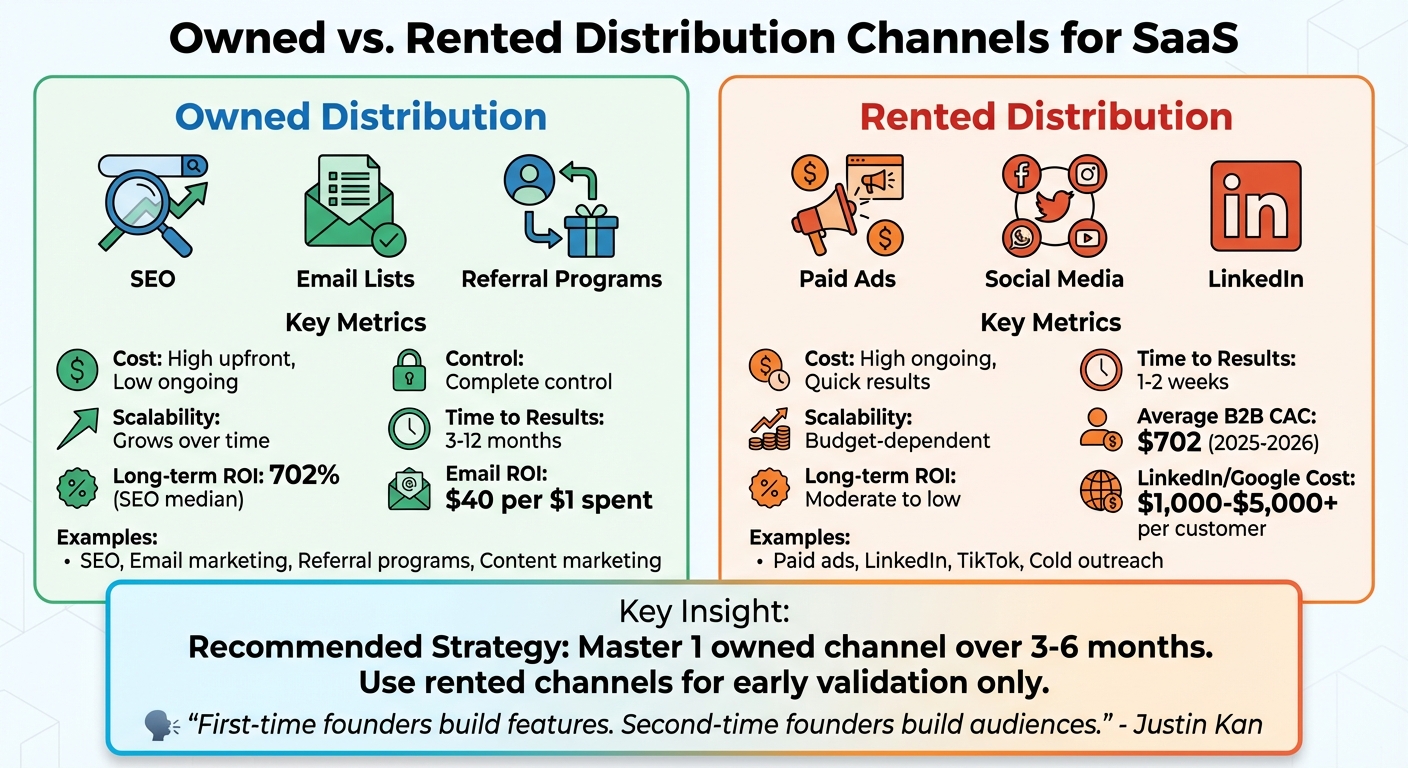
Owned vs Rented Distribution Channels: ROI and Cost Comparison for SaaS
Step-by-Step Playbook for Prioritizing Distribution
These steps integrate distribution into your launch strategy, ensuring that reaching your audience takes precedence over perfecting the product.
SaaS founders often make the mistake of focusing entirely on their product while neglecting distribution. The 2-Week Distribution Rule offers a solution: once you have a concept or prototype, pause development for 14 days to focus solely on growth [5]. This period is your chance to test market demand. Secure letters of intent (LOIs) or pre-orders before committing to full-scale development. For example, in 2020–2021, Sarah Ahmad’s team at Stable proved demand for their AI-powered virtual mailbox by signing 100 paying customers using just a landing page, Google Drive, and a Stripe link - without building the software first [27].
Next, bake virality into your product from the beginning. Consider adding "Powered By" badges, embeddable widgets, or features that require users to invite others for the product to work (like Loom or DocuSign) [6][2]. Tally Forms is an excellent case study: they grew from $0 to $4 million in revenue by using embeddable forms hosted on user subdomains, exposing their brand to every form respondent [6].
Once virality is in place, focus on building trust through transparency. Share your progress publicly - weekly metrics, challenges, and wins - on platforms like LinkedIn or X. This "build in public" approach helps establish credibility and reinforces your outreach efforts [2]. It’s a smart strategy since 67% of prospects research a company after a cold outreach, and organic content acts as a trust signal [24]. Additionally, 82% of B2B buyers check a founder’s LinkedIn profile before agreeing to a meeting [24].
For immediate results, target bottom-funnel SEO. Keywords like "Competitor A vs. B" and "Alternative to X" attract high-intent buyers [2]. Organic search leads close at a rate of 14.6%, far outperforming the 1.7% rate for cold outbound leads [24]. Pair this with one fast channel (like cold outreach) using the 30-Day Test Framework: pick two channels - one for quick results, one for long-term growth - and stick with them for 30 days to collect meaningful data [26].
Finally, refine your "Magic Moment" - the time it takes for a user to experience your product’s core value, such as creating their first AI report. Afterward, prompt them for referrals [5]. A referral waitlist can also work wonders: users move up the queue by referring friends [2]. In 2024, Jungle founder Julian Alvarez used a viral tweet to generate 200 downloads and 200 DMs before the product was even finished. Later, a partnership with a niche medical school influencer (Agogo) boosted the company’s revenue from $2,000 to $15,000 MRR in just two weeks [5].
As Justin Kan, Co-Founder of Twitch, wisely said:
"First-time founders build features. Second-time founders build audiences." [3]
Owned vs. Rented Distribution Channels: A Comparison
Once your distribution tools are in motion, it’s essential to understand how different channels measure up in terms of control and return on investment (ROI).
Owned channels - like SEO, email lists, and referral programs - offer full control over your audience and data but require time to establish. On the other hand, rented channels - such as paid ads, social media, and cold outreach - provide instant exposure but come with risks like algorithm changes and escalating costs.
Case studies show that owned channels drive sustained growth, while rented channels deliver short-term gains. Consider these stats: B2B SaaS SEO yields a median ROI of 702% over 1–3 years, with a break-even point around 7 months [24][29]. Email marketing generates $40 for every $1 spent [29]. Meanwhile, rising costs in paid channels have pushed the average B2B SaaS Customer Acquisition Cost (CAC) to $702 in 2025–2026, with platforms like LinkedIn and Google charging between $1,000 and $5,000+ per customer [29].
Here’s a quick comparison:
| Feature | Owned Distribution | Rented Distribution |
|---|---|---|
| Cost | High upfront; low ongoing cost [29] | High ongoing cost; quick results [29] |
| Scalability | Grows over time [26] | Budget-dependent [25] |
| Long-term ROI | Very high (e.g., SEO at 702%) [29] | Moderate to low [29] |
| Control | Complete control [26] | Platform-dependent [28] |
| Time to Results | Slower (3–12 months) [29] | Faster (1–2 weeks) [26] |
| Examples | SEO, email lists, referral programs [24] | Paid ads, LinkedIn, TikTok [2] |
The smart move? Start by mastering one owned channel over 3–6 months before branching out [25]. For example, Joel Griffith at Browserless scaled a $4 million ARR SaaS with a small team by leveraging an 8-year content strategy (blog posts, GitHub answers, and Stack Overflow) that outperformed VC-backed competitors [27]. Use rented channels for early validation and quick wins, but don’t depend on them as your only growth strategy.
Rick Koleta, Founder of GTM Vault, summed it up best:
"In 2025, the best product no one sees is the same as no product at all." [3]
Conclusion
After diving into 19 interviews with viral SaaS founders, one thing stands out: distribution always outperforms product. With 300,000 new SaaS tools hitting the market each year[3], and AI capable of replicating most applications in just 72 hours[3], the real edge lies in being seen.
It's worth remembering that startups fail more often due to a lack of market demand than because of product flaws.
The most successful founders embrace the 70/30 Rule: dedicating 70% of their time to distribution and 30% to product[1]. They validate demand early - whether through preselling, securing Letters of Intent, or building viral features into their product from the start. For them, distribution isn't a single campaign but an ongoing effort that builds momentum over time.
Yes, product quality matters, but it’s not the whole story. A well-crafted product amplifies distribution efforts, driving virality and retention naturally[5].
"In 2025, the best product no one sees is the same as no product at all." - Rick Koleta, Founder, GTM Vault[3]
In today’s fast-paced market, time is of the essence. Pick two distribution channels, commit to them for 30 days, and start measuring your progress immediately. In the age of AI, visibility is your strongest competitive edge[1][30].
FAQs
How do I pick the best first distribution channel for my SaaS?
To select your first distribution channel, begin by figuring out where your target audience spends most of their time. Run focused campaigns on two potential channels over a 30-day period, tracking real results like sign-ups or sales. Eliminate channels that don’t perform well and concentrate your efforts on the ones that deliver results. This trial-and-error method helps you zero in on the best channels to drive your SaaS growth.
What should I build into my product to make it naturally viral?
To help your product spread organically, build viral loops right into its design. Make sharing effortless by weaving it into the product's experience. Even better, ensure the product becomes more valuable when users invite others. The key is to create a setup where users gain something tangible by bringing in new people - this way, growth becomes a natural result of their interaction with your product.
How can I test demand before I finish building the product?
To gauge demand before diving into full development, start by testing market interest with minimal effort. A simple way to do this is by creating landing pages or educational content that explains your product idea. Then, track engagement through sign-ups, waitlists, or even pre-sales.
Another effective approach? Share your concept on platforms like LinkedIn or in relevant online communities. Organic outreach can give you valuable feedback and help measure genuine interest. These strategies let you confirm demand and commitment without requiring a significant upfront investment.