Silver Lake’s $56.5 billion acquisition of Electronic Arts (EA) in December 2025 wasn’t about selling more video games. Instead, it was a bet on EA’s technology, AI capabilities, and massive user data. Here’s why this deal stands out:
- Tech Platform: EA’s Frostbite engine and cloud infrastructure are more than gaming tools - they’re scalable systems with potential in other industries like virtual events and enterprise software.
- Recurring Revenue: EA’s live-services model, including subscriptions and in-game purchases, provides predictable income streams, reducing reliance on hit-driven sales.
- AI Potential: EA’s AI systems analyze user behavior, cut development costs, and have applications in industries like retail and finance.
- Data Powerhouse: With data from 700 million users, EA offers insights valuable for targeted advertising, customer analytics, and even sports betting.
This deal highlights how companies with strong tech assets, recurring revenue, and data strategies can attract massive valuations - even outside their core industries.
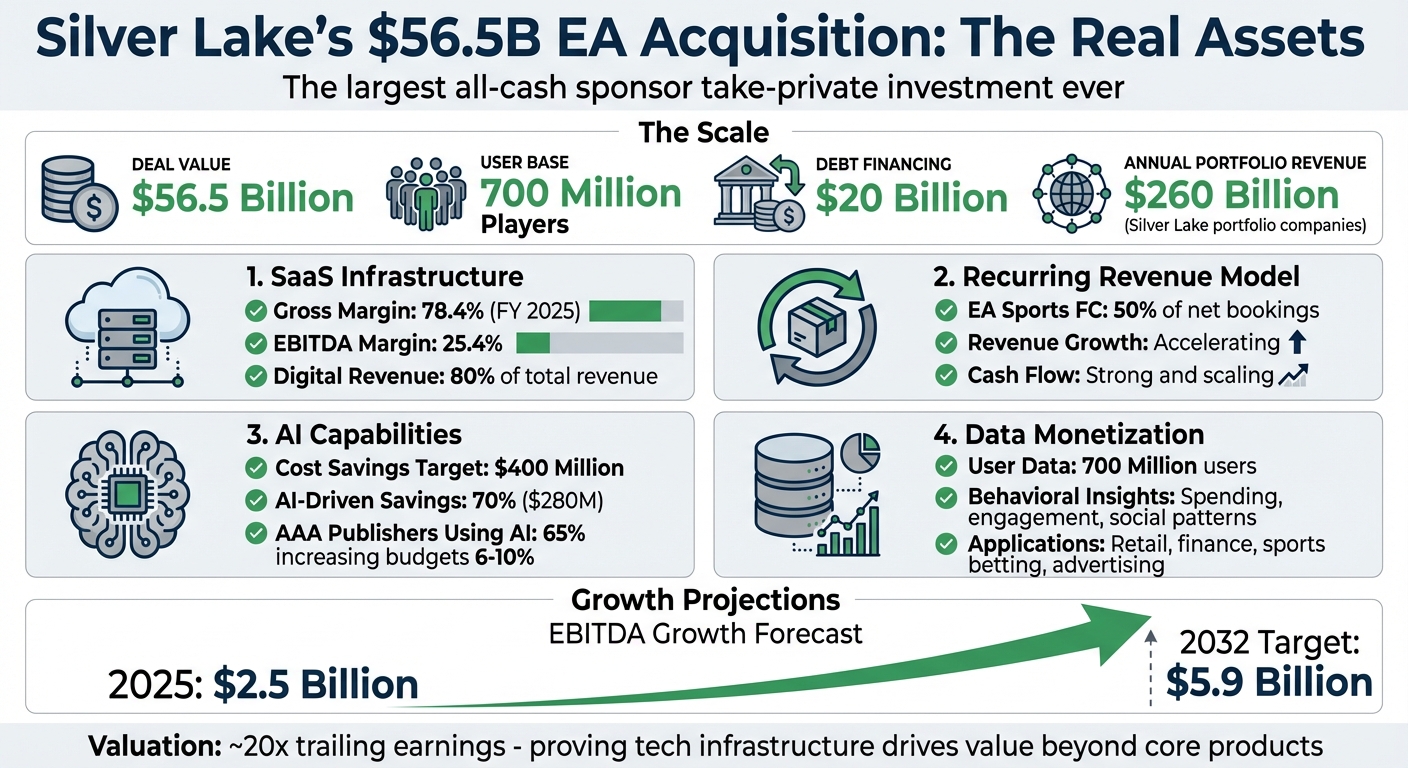
Silver Lake's $56.5B EA Acquisition: Key Assets and Financial Metrics
SaaS Infrastructure: The Core Asset Behind the Deal
Cloud-Based Platforms for Enterprise Use
EA's Frostbite engine isn't just a game development tool - it's a robust, enterprise-level cloud infrastructure. Silver Lake plans to overhaul and optimize this proprietary software, drawing inspiration from Dell's 2013 transformation. The goal? To make Frostbite more efficient and adaptable for a wider range of digital entertainment applications [1].
This infrastructure is no small operation. It supports over 700 million active players [1], handling vast amounts of data, transactions, and user interactions seamlessly. With digital transactions and in-game spending on consoles accounting for nearly 80% of EA's total revenue [5], the platform fuels key elements like EA Play subscriptions, continuous content updates, and millions of daily microtransactions. These features are the backbone of a mature SaaS ecosystem.
But there's more to this than gaming. By repositioning EA's infrastructure, the consortium sees opportunities to venture into areas like virtual events and enterprise-level content delivery. EA's extensive global networks in gaming, entertainment, and sports can be used to merge physical and digital experiences, unlocking new growth areas in adjacent markets [2]. Combined with its scalable infrastructure, these efforts highlight EA's evolution into a tech-driven enterprise.
Recurring Revenue Models
EA's infrastructure doesn't just power its operations - it also supports its transition to a reliable, tech-focused revenue model. By adopting a live-services approach, EA has created a steady, subscription-like cash flow. Evergreen sports franchises like EA Sports FC and Madden NFL consistently generate revenue through downloadable content, in-game purchases, and subscription services. These titles help reduce the unpredictability often associated with hit-driven entertainment.
The financials back this up. In fiscal year 2025, EA achieved a gross margin of 78.4%, up from 76.3% the previous year, while maintaining an EBITDA margin of 25.4% [5]. These figures rival top vertical SaaS companies. The $20 billion debt package funding the acquisition is expected to be serviced through these recurring revenue streams [1] [2], showcasing EA's subscription-based model as a dependable cash generator, far beyond the scope of a traditional gaming company.
sbb-itb-9cd970b
AI Capabilities: Technology That Extends Beyond Gaming
AI for Personalization and Customer Data Analysis
EA's AI systems go far beyond enhancing gameplay. They analyze user behavior on a massive scale, using this data to train models that predict decision-making patterns, understand engagement triggers, and even anticipate spending habits. This isn't just about gaming - it’s about creating insights that can transform other industries. Silver Lake, for instance, sees a clear opportunity to apply these capabilities to areas like retail customer journey mapping and personalized financial advice [1][8].
What sets EA apart is its live-services model. Instead of relying on one-off data snapshots, this model continuously gathers user data over months, even years. This approach generates deep behavioral insights that are invaluable across industries like retail and financial services, where companies are willing to invest heavily for such advanced analytics. The importance of these capabilities is underscored by the scrutiny from the Committee on Foreign Investment in the United States, which is investigating the acquisition due to concerns about foreign access to personal data from millions of Americans [1].
Silver Lake's fintech portfolio, which includes companies like Klarna and SoFi, provides a direct route to leverage EA's predictive AI models for tasks like financial risk assessment and consumer behavior modeling [1]. The consortium has already identified $400 million in potential cost savings, with 70% of those savings expected to come from AI-driven R&D efficiencies [8]. This demonstrates how EA's AI expertise extends far beyond gaming, aligning perfectly with Silver Lake's broader acquisition objectives.
Automation Tools for Operational Efficiency
EA’s AI capabilities also shine in the realm of operational efficiency. Tools powered by AI are used for tasks like playtesting, quality assurance, localization, and procedural asset design [5]. These same tools can be repurposed for enterprise software testing or creating industrial digital twins. As Brandon Sutton from MIDiA Research puts it:
"Even if specific titles fail, the creation of successful AI tools for optimising development would create immense value for the new owners beyond individual title success" [6].
The push for Generative AI in gaming is evident, with 65% of AAA game publishers increasing development budgets by 6% to 10% to integrate these tools [5]. EA has become a proving ground for large-scale AI applications [6]. Tools that reduce costs in areas like localization and quality assurance could even be packaged as standalone enterprise products. Silver Lake plans to apply its restructuring expertise, much like it did with Dell, to maximize the potential of proprietary technologies like the Frostbite engine. This approach underscores its strategy of repurposing advanced tech assets for use across multiple industries [1].
Data Monetization: The Hidden Asset
User Data as a Business Asset
EA's user data is a powerhouse for its business. With a dataset covering over 700 million users, EA gathers much more than just basic contact information. Thanks to its live-services model, the company collects detailed behavioral insights - tracking how players spend money, engage with games, and interact socially within its gaming ecosystems.
A major driver of EA's success is EA Sports FC, which makes up about 50% of EA's net bookings [8]. Silver Lake plans to amplify in-game advertising [8], using EA's extensive data to fuel highly targeted marketing campaigns. As SiliconValley.com put it, "Gaming is now viewed through the same lens as social media - a platform for data harvesting and soft-power influence" [1]. However, this massive trove of user data has attracted scrutiny. The Committee on Foreign Investment in the United States is currently investigating the deal, raising concerns about the potential national security risks of giving a foreign entity access to such sensitive data [1].
The potential for this data extends far beyond gaming itself.
Opportunities in Adjacent Markets
EA's rich data offers opportunities to tap into entirely new industries. Silver Lake's diverse portfolio creates a unique chance to integrate EA's data into other sectors. The firm owns a range of assets, including sports properties like City Football Group and UFC (via Endeavor), travel platforms such as Airbnb and Expedia, and entertainment ventures [7]. In March 2025, Silver Lake finalized a $13 billion deal to take Endeavor private, which includes UFC and WWE [7]. This blend of media, sports, and entertainment assets sets the stage for EA's sports data to play a key role in optimizing operations across multiple industries. Together, the companies in Silver Lake's portfolio generate around $260 billion in annual revenue [2].
Beyond the usual applications, EA's player data could drive innovation in transmedia opportunities. Insights into player preferences and engagement patterns could inform the expansion of gaming franchises into film, TV, and other media. Additionally, this data could fuel ventures in sports betting or partnerships in lifestyle retail. By taking this approach, EA aims to transform its gaming data into a dynamic tool for generating revenue across industries.
Private Equity in 2025: Market Shifts, Strategy, and the Rise of AI with Hugh MacArthur
What SaaS and AI Entrepreneurs Can Learn
Silver Lake's acquisition of EA offers valuable insights into building tech assets that deliver value far beyond traditional gaming.
Build Scalable Cloud Infrastructure
One key takeaway from Silver Lake's acquisition of EA is the emphasis on recurring revenue models, which are highly attractive to private equity firms. To finance the deal, the consortium took on $20 billion in debt [1]. This underscores the importance of steady, predictable cash flow. For SaaS entrepreneurs, this means moving away from one-time sales and focusing on subscription-based revenue streams.
Silver Lake has ambitious plans to increase EA's adjusted EBITDA from $2.5 billion in 2025 to $5.9 billion by 2032 [3]. Additionally, the consortium is targeting $400 million in cost savings, with 70% expected to come from optimizing R&D [3]. This demonstrates that operational efficiency is just as critical as revenue growth. Companies that can balance growth with profitability - ideally maintaining an EBIT margin of around 20% [5] - are more likely to attract acquisition interest. As Egon Durban, Co-CEO and Managing Partner of Silver Lake, remarked:
"EA is a special company... anchored by its premier sports franchise, with accelerating revenue growth and strong and scaling free cash flow" [2].
Develop AI for Multiple Industries
EA's use of AI extends well beyond gaming, offering lessons for AI entrepreneurs. The company leverages AI to cut production times, automate quality assurance processes, and streamline asset creation [6]. As Brandon Sutton from MIDiA Research pointed out:
"Video game development shows how AI tools can cut production time, streamline asset creation, and enhance storytelling" [6].
The takeaway? Build AI solutions that can address challenges across various industries. EA's AI-driven personalization engines and customer data analysis tools, for example, have potential applications in sports betting, entertainment, and retail. With 65% of AAA publishers planning to increase development budgets by 6%–10% to integrate generative AI tools [5], the demand for versatile AI solutions is clear.
To capitalize on this trend, pair advanced AI capabilities with a robust data strategy to unlock diversified revenue streams.
Create a Data Collection and Monetization Strategy
The real strategic asset behind Silver Lake's acquisition wasn’t just EA's gaming software - it was the behavioral data from over 700 million users [1]. EA's live-services model collects detailed insights into user behavior, including spending habits, content engagement, and social interactions [8]. This creates a "data moat", a competitive edge that is hard to duplicate.
A diversified approach to monetization is equally important. EA generates revenue through subscriptions, in-game purchases, and advertising [8]. The EA Sports FC franchise alone accounts for about 50% of EA's net bookings [8]. In the console gaming market, digital transactions and in-game spending now make up nearly 80% of total revenue [5]. For SaaS entrepreneurs, this highlights the importance of exploring various revenue channels, such as advertising or packaging data insights for use in adjacent markets. As the Bocconi Students M&A Circle noted:
"the take-private deal will allow the firm to reorient its attention towards its core business and reposition itself in the market" [5].
To succeed, ensure your data governance policies are solid to address potential regulatory challenges.
These insights reinforce the idea that strong SaaS models, advanced AI capabilities, and data-driven strategies are the cornerstones of modern tech valuations.
Conclusion: Tech Assets Drive Value in Modern Acquisitions
Silver Lake's $56.5 billion acquisition of EA wasn’t just about video games - it was about leveraging a tech platform built on recurring revenue, advanced AI, and data from 700 million players [4]. This historic deal, the largest all-cash sponsor take-private investment ever [2], highlights a major shift in how investors assess the value of tech companies across industries. It’s a textbook example of what drives value in today’s market.
The consortium focused on three key tech assets: EA’s live-services model, which ensures steady subscription-based revenue; AI tools that slashed R&D costs by $280 million, achieving 70% of the targeted $400 million savings [8]; and user data networks that function much like social media platforms. Silver Lake identified EA as a global leader in interactive entertainment, with accelerating revenue and impressive free cash flow growth [2].
For SaaS and AI entrepreneurs, the takeaway is straightforward: prioritize building tech infrastructure over just delivering products. Create predictable revenue streams, develop versatile AI capabilities, and harness strategic data assets. This deal underscores that companies with strong SaaS frameworks, smart AI integration, and effective data strategies can achieve valuations approaching 20x trailing earnings [4], even in industries traditionally seen as creative rather than technical.
FAQs
How can EA’s Frostbite engine be used outside gaming?
The EA Frostbite engine, widely recognized for its role in video game development, has found uses far beyond gaming. Its cutting-edge graphics, physics capabilities, and real-time rendering make it a powerful tool for various industries. It's particularly well-suited for virtual production, architectural visualization, and simulation training in areas like real estate, aerospace, and military operations.
Additionally, the engine's flexibility extends to AI-driven applications, such as creating digital twins or interactive models. These features allow for the development of immersive environments and support better decision-making across a range of professional fields.
What makes EA’s revenue “recurring” enough for private equity?
EA’s revenue is often referred to as "recurring" because a significant portion comes from digital sales, subscriptions, and live services. These sources create steady and predictable cash flows, making them particularly attractive to private equity firms that prioritize long-term, stable investments.
What privacy or national security risks are associated with EA’s user data?
The search results do not provide any details regarding privacy or national security risks associated with EA's user data. No further information on this subject is available.
Related Blog Posts
- Musk’s “Inside Game”: How xAI Buying X Rewrote a ‘Bad LBO’ Narrative
- From Hype to High-Value Exits: AI's Role in Private Equity's Future
- Why Buying a Business Beats Starting One in 2025
- 3. From 2015 to 2025, PE Acquired 1,900 Software Companies for $440 Billion. AI Is Now Dismantling the Thesis Behind Every Single One. Nobody on Wall Street Wants to Say It First. SaaStr