How did I grow a bootstrapped SaaS to $25k MRR with 67% profit margins? By focusing on smart go-to-market (GTM) strategies, targeting a niche, and keeping costs lean. Here’s the quick breakdown:
- Idea Validation: Started with a $200 landing page test in March 2023, confirming demand with 47 signups.
- Target Audience: Focused on mid-market B2B firms (50-200 employees) with clear buying signals.
- GTM Strategy: Combined product-led growth for small businesses with inside sales for larger accounts.
- Pricing: Used a 3-tier structure ($49, $149, $299/month) to align value with customer needs.
- Retention: Achieved 125% net revenue retention through proactive health scoring and upsells.
- Efficiency: Automated workflows and kept operating costs at 33% of revenue.
This approach turned $25k MRR into $16,750 in monthly profit without external funding. Below, I’ll explain the exact strategies, tools, and metrics that made it happen.
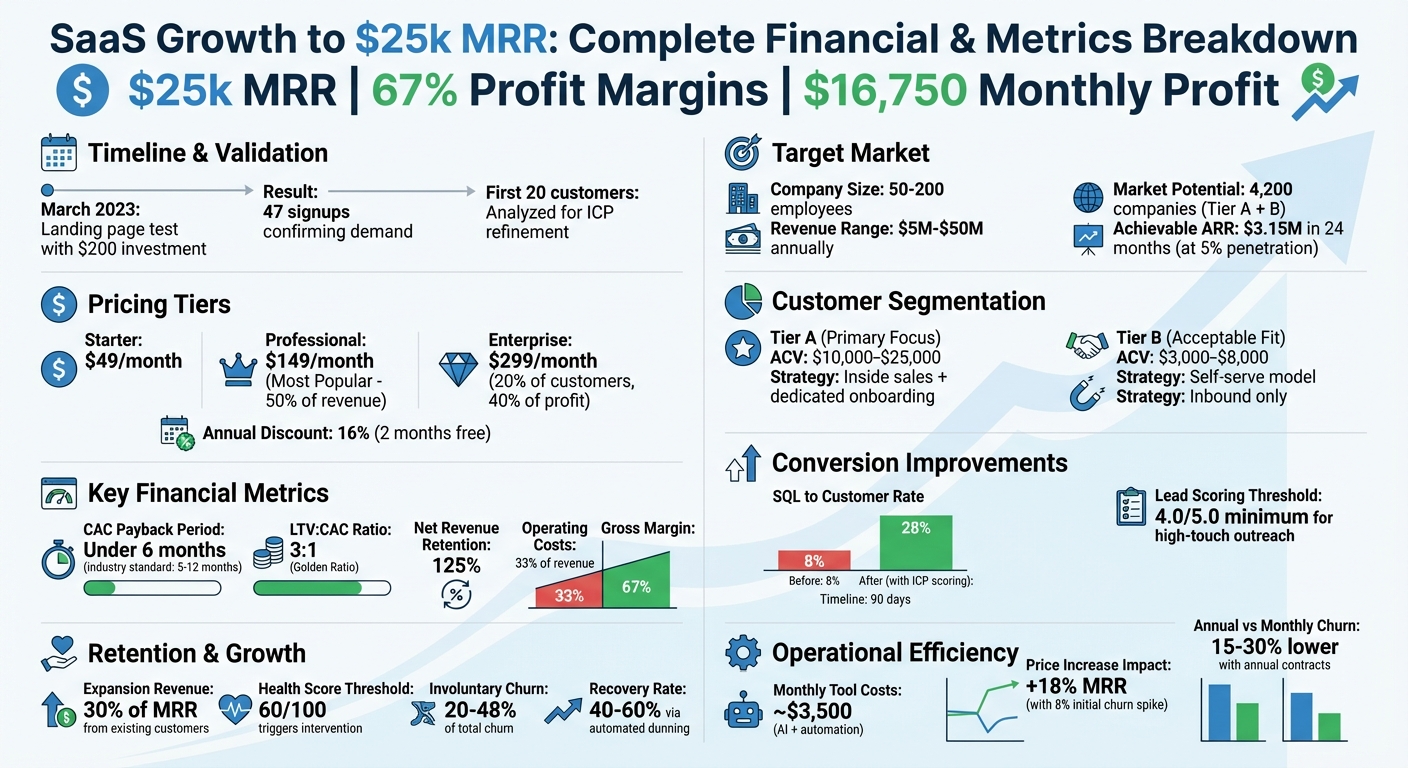
SaaS Growth to $25k MRR: Key Metrics and Financial Breakdown
What’s a Good SaaS Profit Margin? (How to Calculate & Improve It)
sbb-itb-9cd970b
Finding Your Ideal Customer and Segmenting the Market
Before diving into marketing or building a sales team, I focused on defining my ideal customer: those who would benefit the most, stick around longer, and cost less to support. This clarity became the backbone of everything else - pricing strategies, channel selection, and even product development. Analyzing customer data was the first step in creating my Ideal Customer Profile (ICP) and identifying market segments.
I started with the data from 47 landing page signups, examining details like company size, industry, job roles, and the problems they described. Then, as I onboarded my first 20 paying customers, I paid close attention to who adopted the product quickly, needed minimal support, and expanded their usage within the first 60 days. The results were clear: mid-market professional services firms with 50-200 employees had the shortest sales cycles, the highest retention rates, and the lowest support demands.
These patterns helped me refine and define my target customer profile.
Building Your ICP
To create my ICP, I combined firmographics, technographics, and behavioral data. The ideal customer for my SaaS product turned out to be firms earning $5M-$50M annually, already using cloud-based tools like Salesforce or HubSpot, and showing signs of rapid growth - such as recent job postings for roles in sales or operations.
I also identified an "Anti-ICP" - profiles of companies I wanted to avoid. These included businesses with fewer than 25 employees (too price-sensitive and prone to churn), industries where my tool wasn't essential (leading to low engagement), and companies requiring heavy customization (expensive to support). By clearly documenting these disqualifiers, I saved my sales team from chasing leads that were unlikely to convert or would churn quickly after signing up [6][7].
To make this process actionable, I built a weighted scoring model into my CRM. Each lead was scored based on factors like industry fit (25% weight), company size (20%), tech stack compatibility (15%), and buying signals (15%). Only prospects scoring 4.0 or higher (out of 5.0) received high-touch outreach. This system boosted my SQL-to-customer conversion rate from 8% to 28% within just 90 days [8].
Segmenting Your Market for Better Focus
With a clear ICP in place, I divided the market into three tiers:
- Tier A (Primary Focus): Mid-market accounts with annual contract values (ACVs) between $10,000 and $25,000. These accounts were managed through inside sales and received dedicated onboarding.
- Tier B (Acceptable Fit): Smaller businesses with ACVs of $3,000 to $8,000, served through a self-serve model with minimal support.
- Tier C (Opportunistic): Strategic accounts or edge cases pursued only if they came inbound [5].
Using LinkedIn Sales Navigator, I calculated my Serviceable Obtainable Market (SOM) and identified 4,200 potential Tier A and B companies in the U.S. At a 5% market penetration rate and an average ACV of $15,000, this translated to $3.15M in achievable annual recurring revenue (ARR) within 24 months [9].
This segmentation allowed me to align my go-to-market (GTM) strategy with the economics of each customer group. Tier A accounts received personalized demos and dedicated customer success managers, while Tier B accounts were funneled into an automated onboarding process with in-app support. By tailoring the sales approach to each segment, I kept my cost-to-serve at just 33% of revenue while maintaining high satisfaction levels across the board. These clearly defined segments became the backbone of my GTM strategy, which I’ll detail further in the next section.
The GTM Strategy: Combining Product-Led and Sales-Led Approaches
I developed a hybrid go-to-market (GTM) strategy that combined self-serve, product-led growth for smaller businesses with a sales-led approach for mid-market accounts. The idea was simple: Tier B customers (smaller businesses with annual contract values of $3,000–$8,000) preferred to explore the product independently, while Tier A customers (mid-market accounts with annual contract values of $10,000–$25,000) needed personalized support to navigate buying committees and implementation challenges.
This dual approach created a data feedback loop. Insights from product usage in self-serve accounts helped the sales team better understand customer needs. This loop informed both sales strategies and product improvements, making each decision more precise.
The financial logic was clear. By 2025, 91% of SaaS companies planned to increase investment in product-led growth [10]. However, relying solely on product-led growth wouldn’t have been enough to hit $25,000 in monthly recurring revenue (MRR) while maintaining healthy margins. The hybrid model allowed me to keep acquisition costs low for small businesses while securing larger, high-value deals that required a sales touch.
"The choice between product-led growth and sales-led growth is not philosophical. It is determined by your average contract value, product complexity, and buyer profile."
- Semir Jahic, CEO of Salesmotion [10]
Product-Led Growth for SMB Customers
For Tier B accounts, I crafted a seamless self-serve experience from sign-up to payment. The product itself had to do the selling, so I focused on removing every possible barrier. Using session recording tools, I watched real users navigate the onboarding process and identified where they struggled. Then, I rewrote error messages and quickstart guides to address those pain points. These user experience tweaks can increase activation rates by almost threefold [3].
I also created a library of use-case–specific content targeting high-intent search terms. Instead of generic blog posts like "productivity tips", I published actionable guides like "How to Import Salesforce Data to [My Tool]" or "Automate Weekly Reports in Under 5 Minutes." This strategy was inspired by Andy Cloke, who scaled Data Fetcher to $23,000 MRR with an 85% profit margin. By building integrations for Airtable and publishing repeatable content for searches like "Import Facebook Ads to Airtable", Cloke attracted consistent, qualified leads without relying on paid ads [1].
To make the product more accessible, I introduced no-code interfaces that masked the technical complexity. Initially, the product required users to understand API headers and endpoints, which limited adoption to tech-savvy power users. By creating visual configuration screens, I opened the product to general managers and operations teams. Andy Cloke used a similar strategy to grow Data Fetcher from $3,000 to $10,000 MRR in just one year [1].
While this product-led approach drove early adoption, mid-market clients required a more personalized sales process.
Inside Sales for Mid-Market Accounts
For Tier A accounts, I brought on a part-time inside sales rep who focused on Product Qualified Leads (PQLs) - self-serve users showing strong buying signals. These triggers included accounts with five or more active users, high product usage, or requests for enterprise features like SSO or advanced permissions. When a Tier B account hit these thresholds or expanded its team, the sales rep reached out with a personalized message. The message acknowledged their current engagement and offered a tailored demo designed for teams of their size. This approach, driven by product usage data, eliminated the need for cold outreach by giving sales teams a warm entry point [10].
To meet mid-market expectations, I raised prices from $150/month to $800/month and introduced structured digital sales rooms. These rooms allowed prospects to explore case studies, security documentation, and implementation timelines at their own pace. This strategy mirrored Harris Kenny’s approach with OutboundSync, where he transitioned from low-touch $150/month deals to sales-assisted $800/month contracts, scaling to $20,000 MRR in early 2026 [11].
I also prioritized SOC 2 compliance early in the process. Mid-market buyers often require vendors to complete security questionnaires before signing contracts. Having SOC 2 certification ready helped speed up sales cycles and close deals that might have otherwise been delayed in procurement [11].
As these sales efforts matured, aligning marketing channels and lead nurturing became critical for sustained growth.
Marketing Channels and Lead Nurturing
Rather than spreading resources thin, I concentrated on a few high-impact marketing channels: SEO-driven content, founder-led LinkedIn posts, and a weekly email newsletter for trial users. Paid ads, while effective in the short term, didn’t create lasting value. In contrast, organic channels built enduring assets. For example, a well-ranking blog post from six months ago could still generate 40–50 qualified signups per month at no additional cost. This approach aligns with industry trends showing that companies are spending $2 in sales and marketing for every $1 of new ARR, a ratio that has risen by 14% since 2024 [10].
For lead nurturing, I designed a reactivation email sequence targeting users who signed up but didn’t convert. Instead of offering blanket discounts, I segmented users based on the features they engaged with most during their trial and sent tutorials tailored to their interests. Hendrik-André Rootering used a similar strategy to revive Kissmetrics. After acquiring it for $1 in April 2024, his team rewrote onboarding flows and updated documentation, converting 108 new paying customers from a “dead list” of 3,219 users in just 30 days [3].
Pricing Strategy: How I Achieved 67% Margins
To boost profitability, I zeroed in on pricing - a tool that delivers results quickly. I revamped the pricing model, shifting from a flat-rate plan to a three-tier, usage-based structure. This change not only increased revenue but also helped filter out lower-value customers.
The reasoning was simple: adjusting pricing is the fastest way to grow revenue without building anything new. A 20% price increase with 90% retention outperforms doubling your customer base - MaxVerdic Team [13]. By raising prices for new signups while grandfathering existing customers, I achieved an 18% increase in monthly recurring revenue (MRR), even with an initial 8% churn spike, which stabilized within three months [16].
3-Tier Usage-Based Pricing Structure
I introduced three pricing tiers: Starter ($49/month), Professional ($149/month), and Enterprise ($299/month). Each tier was tailored to a specific audience:
- Starter: Designed for solopreneurs and small teams, offering limited API calls and basic integrations.
- Professional: Targeted at growing teams, this tier included priority support and advanced workflows. It was labeled "Most Popular" to guide customers toward it.
- Enterprise: Built for heavy users, this tier offered custom integrations, single sign-on (SSO), and dedicated account management.
The pricing gaps between tiers were intentional. For example, the Professional tier cost three times more than Starter, and Enterprise was six times higher. This created a psychological anchor, making the mid-tier option appear like the best deal [13][15]. The results? The Professional tier brought in 50% of revenue, while the Enterprise tier, though chosen by only 20% of customers, contributed 40% of total profit due to its higher margins and lower support costs [13].
This model naturally encouraged customers to upgrade as their businesses scaled. More API calls, team members, and integrations meant they moved into higher-margin tiers without the need for aggressive upselling. The pricing structure aligned costs with the value customers received, driving expansion revenue organically [13][14][15].
But pricing alone wasn’t enough. Contract structure also played a critical role in stabilizing revenue.
Using Annual Contracts to Reduce Churn
Switching to annual contracts, with a 16% discount (equivalent to two months free), improved both cash flow and customer retention. Annual churn rates are typically 15% to 30% lower than monthly churn rates [2]. By locking customers in for a year, the "monthly re-purchase" decision was eliminated, giving users more time to see the product’s value.
Collecting full annual payments up front also shortened the customer acquisition cost (CAC) payback period, providing more operational flexibility. This extra capital was reinvested into product development and marketing, creating a positive growth cycle. For B2B SaaS, a CAC payback period under 12 months is ideal, and annual contracts significantly accelerated this timeline [2].
To maximize adoption, I made annual pricing the default option on the pricing page. The "monthly equivalent" cost was displayed alongside the annual price to highlight the savings. For instance, the Professional tier was shown as "$149/month or $1,499/year (save $289)" [14][15]. This presentation made the discount feel more compelling and encouraged customers to commit long-term.
Financial Metrics Behind 67% Profit Margins
Achieving a 67% profit margin wasn’t a stroke of luck - it was the result of carefully monitoring and refining three key financial metrics: Customer Acquisition Cost (CAC) payback period, Lifetime Value to CAC ratio (LTV:CAC), and Net Revenue Retention (NRR). For a SaaS business, profitability hinges on ensuring recurring revenue from existing customers can cover the cost of acquiring new ones [17]. By recovering CAC quickly and ensuring each customer generated at least three times their acquisition cost, I freed up cash to reinvest in growth. Let’s unpack how each metric contributed to this success.
CAC Payback Period and LTV:CAC Ratio
Keeping the CAC payback period under six months was a game-changer - especially when the industry standard ranges from 5 to 12 months for SaaS companies [17]. A shorter payback period meant the business could shift from operating at a loss to profitability much faster. This also ensured that more revenue could be retained as profit, rather than being funneled back into acquisition costs.
One effective tactic was offering discounted annual contracts. These deals not only shortened the payback period but also boosted immediate cash flow. With this influx of capital, I reinvested in product development and marketing, creating a growth cycle that didn’t rely on external funding.
On top of that, maintaining an LTV:CAC ratio above 3:1 - the so-called "Golden Ratio" for SaaS growth - was critical [17][18]. For every $1 spent on acquiring a customer, I generated $3 in lifetime gross profit. This margin wasn’t just a safety net; it covered essential expenses like payroll, infrastructure, and development [19]. Without this buffer, hitting a 67% profit margin would have been far more difficult.
Net Revenue Retention (NRR) of 125%
With an NRR of 125%, existing customers were delivering 25% more revenue year-over-year, without any additional acquisition costs. This was a massive driver of profitability, as it created “free” expansion revenue through a usage-based pricing model. As customers grew their businesses, they naturally consumed more resources and upgraded to higher-priced plans, increasing revenue without requiring heavy sales efforts.
"NRR above 120% can add 2-3x to your multiple." - Khaled Azar, M&A Advisor [21]
This high retention rate wasn’t just about the numbers; it reflected a strong product-market fit and showed that customers found increasing value over time.
Keeping Operational Costs at 33% of Revenue
Operational efficiency was the backbone of this success. By keeping operational costs - like hosting, support, tools, and contractor fees - at just 33% of revenue, I ensured that 67% could go directly to gross profit. This lean approach made the impressive profit margin possible.
Automation played a central role in keeping costs low. AI tools handled tasks like lead generation, email campaigns, and customer onboarding, reducing the need for a large full-time team. Specialized tasks, such as design and development, were outsourced to contractors, keeping fixed costs manageable while maintaining scalability.
Hosting costs stayed predictable thanks to scalable infrastructure and serverless functions. Support expenses were also minimized by implementing a robust knowledge base and deploying chatbots for routine inquiries. Human support was reserved for premium customers, ensuring resources were used efficiently.
This streamlined approach supported $25,000 in MRR without draining capital. Every dollar saved on operational costs went straight to the bottom line, reinforcing the 67% profit margin. Together, these metrics offer a clear roadmap for achieving profitability in the SaaS world.
Retaining Customers and Driving Expansion Revenue
Retention became a powerful growth driver, accounting for 30% of my monthly recurring revenue (MRR) through existing customers. This transformation happened because I began treating customer success as a revenue-generating function rather than a cost center. By proactively identifying at-risk accounts and implementing structured upsell playbooks, I turned retention into a systematic process that directly boosted revenue. This approach worked hand-in-hand with earlier go-to-market (GTM) and pricing strategies, fueling organic and cost-effective growth. Let’s dive into the health scoring system that made these retention efforts possible.
Health Scoring and Early Intervention
I developed a health scoring system that monitored five key indicators: usage trends, onboarding friction, feature adoption, support ticket sentiment, and billing anomalies [22][24]. The system prioritized tracking critical "value milestones", like inviting a teammate or integrating a tool, assigning these actions greater weight in the overall score [26].
When a customer's score dipped below 60 out of 100, an automated alert triggered a 30-day intervention plan. Here's how it worked:
- Days 1-3: The customer success manager reached out with a personalized check-in.
- Days 4-14: Customers received tailored educational content, such as ROI insights or tutorials for underused features.
- Days 15-30: Escalation involved executive engagement and final retention offers.
This structured process allowed us to address issues before customers reached the point of cancellation - a common pitfall for many businesses.
One game-changing insight? Involuntary churn from failed payments made up 20-48% of total churn, but 40-60% of this could be recovered using automated dunning workflows [23][24]. By introducing smart retry mechanisms and in-app grace periods, I reclaimed revenue that would have otherwise been lost, with minimal additional effort.
Upsell Playbooks That Generated 30% of Growth
Building on the foundation of proactive retention, I leveraged customer engagement to drive expansion revenue through strategic upsell initiatives. The key was treating upsells as a service, not a sales pitch. For example, when customers reached 80% of their plan limits, an automated alert prompted a personal check-in to discuss upgrading before they encountered any frustration [25]. This advisory approach made the transition to a higher plan feel natural and aligned with their needs.
"Acquiring a new customer costs five times more than growing an existing one. Five times." - Mamta Tainwala, Sybill.ai [25]
I also adopted a "Renewal-Plus" strategy: before sending a renewal invoice, I identified a relevant upgrade or add-on that aligned with the customer’s goals and pitched it as the next step in their journey [25]. This simple tactic turned renewals into opportunities for growth. The results? A net revenue retention (NRR) rate of 125%, meaning existing customers generated 25% more revenue year-over-year - with zero additional acquisition costs. This directly contributed to an impressive 67% profit margin.
Tools and Processes That Enabled Scalable Operations
Efficient operations, driven by automation, were the backbone of our growth strategy. By automating repetitive tasks, I kept overhead low and achieved $25,000 MRR with a 67% profit margin. The secret? Treating the tech stack as a profit center - every tool had to either bring in revenue, save time, or cut costs.
Using AI for Lead Generation and Automation
AI completely transformed how I handled lead generation. Instead of relying on costly sales teams, I turned to AI-powered tools. Clay became my go-to for automating prospect research, combining sales and marketing data into a single workflow. Meanwhile, Stormy AI handled autonomous lead discovery and sent personalized emails 24/7, eliminating the need for manual prospecting.
The results were striking. For example, Andy Cloke of Data Fetcher used Stormy AI for influencer outreach, keeping costs fixed at about $3,500 monthly. On my end, customer support was streamlined with Help Scout, while ChartMogul took care of MRR tracking. This freed up my time to focus entirely on scaling the business.
"Growth often comes from doing the boring stuff 1% better every single day." - Andy Cloke [1]
This automation-first mindset also laid the groundwork for optimizing internal processes. For founders looking to scale B2B SaaS beyond initial milestones, focusing on these high-leverage systems is critical.
Automating Internal Workflows
To streamline internal operations, I utilized platforms like n8n and Zapier. These tools connected my tech stack, automating tasks like syncing customer data and sending internal notifications. Manual data entry became a thing of the past.
For centralized operations, I turned to Airtable and Notion, ditching outdated systems. Airtable's AI-driven features significantly improved data analysis, with 66% of its users reporting better insights. On the analytics side, tools like PostHog and Amplitude tracked user behavior, delivering actionable insights that shaped upsell strategies and retention plans. These automated workflows were key to maintaining lean operational costs, aligning perfectly with our broader goals.
| Tool Category | Specific Platforms | Cost Impact |
|---|---|---|
| Lead Gen AI | Clay, Stormy AI | Reduced sales labor costs to under $1,000/month [27] |
| Automation | n8n, Zapier | Eliminated manual data entry [12] |
| Internal Ops | Airtable, Notion | Unified fragmented systems [12] |
| Analytics | PostHog, Amplitude | Delivered automated behavioral insights [12] |
| Support & Billing | Help Scout, ChartMogul | Simplified solo management of a large customer base [1] |
Conclusion: How to Replicate This Success
Main Lessons from This Breakdown
Reaching $25,000 MRR with 67% profit margins isn’t about reinventing the wheel - it’s about executing proven strategies with precision. The key takeaway? Distribution outperforms innovation. Instead of obsessing over creating the "perfect" product, focus on connecting with your audience through platform distribution, tutorial-driven marketing, and AI tools. Keeping operational costs low is equally crucial. This can be achieved by self-hosting tools, leveraging AI for development and content creation, and targeting a specific niche rather than competing with broad-market leaders.
Your pricing strategy plays a massive role in both profitability and customer retention. A three-tier pricing model, paired with annual contracts, encourages upfront payments and reduces churn compared to monthly billing cycles [2]. Avoid the temptation to underprice. Silent customers often mean untapped revenue potential. Higher prices tend to attract more committed users who stick around longer.
"You don't need $2M when $20K gets you to $20K MRR." - George Pu, Founder, SimpleDirect [4]
Financial discipline is another cornerstone of success. Aim for gross margins above 80%, keep your customer acquisition cost (CAC) payback period under 12 months, and target a Net Revenue Retention rate between 110% and 130% [28][2]. These metrics create a strong foundation, allowing you to scale sustainably without relying on outside funding or constant problem-solving.
These lessons provide a clear roadmap for success and naturally lead into actionable steps for your SaaS journey.
Next Steps for Your SaaS Business
Start with validation before writing a single line of code. Use a 14-day loop: build a landing page, share demos on platforms like X (Twitter) or LinkedIn, and aim to gather over 1,000 waitlist emails before committing to development. For example, in 2024, Sajila Mazafir scaled Code Guide to $42,000 MRR in just 90 days using this approach. She started with nothing more than a screen recording shared on X, which generated 1,800 signups [20].
Take advantage of established platforms to leverage their built-in trust and audience. Andy Cloke, a solo founder, reached $23,000 MRR with 85% profit margins by building an Airtable extension and promoting it through tutorial marketing. His targeted YouTube videos and blog posts, like "Import Facebook Ads to Airtable", drove qualified traffic and conversions [1].
Document your sales process, automate repetitive tasks with AI, and don’t shy away from raising prices periodically to test how much value your market is willing to pay for.
FAQs
How do I find my ICP fast?
To pinpoint your Ideal Customer Profile (ICP) efficiently, start by diving into your current customer data, examining market segments, and studying buyer behavior. Pay attention to the characteristics of your most loyal and engaged customers - they often hold the key to understanding your target audience. Additionally, leverage feedback from early adopters to confirm demand and fine-tune your focus. This data-driven strategy eliminates much of the guesswork, helping you aim your marketing and sales efforts at the right audience for quicker and more effective outcomes.
When should I add inside sales?
Once your SaaS business hits a predictable and scalable customer acquisition channel - usually around the $20K MRR mark - it might be time to consider adding inside sales to your strategy. By this point, your marketing efforts should be consistent and repeatable, and your positioning should be clear enough for prospects to determine if your solution fits their needs.
Inside sales can play a crucial role in driving growth. It can help boost conversion rates, handle more complex sales processes, or even speed up the sales cycle. This approach becomes especially valuable when your inbound leads are consistently filling your pipeline, ensuring a steady flow of prospects ready to engage.
What metrics prove 67% margins?
A profit margin of 67% is backed by an impressive gross margin of around 73%. This aligns closely with industry standards for high-performing AI SaaS companies, which often achieve comparable gross margins. These figures reinforce the credibility of the reported profitability.