Private equity (PE) firms are acquiring SaaS companies not for their software but for their customer data and distribution networks. These assets are the real drivers of value, enabling predictable revenue, price increases, and AI-driven innovations. Check out our latest blog posts for more insights on scaling your business. Here's what you need to know:
- Customer Data: PE firms use it to validate growth, optimize pricing, and fuel AI upgrades. Clean, accessible data with high Net Revenue Retention (NRR) is critical.
- Distribution Lists: Email and SEO offer cost-effective customer acquisition. PE buyers value engaged, accurate, and segmented lists.
- Focus Areas: Companies with strong retention, scalable distribution, and AI readiness command higher valuations (8x–12x EV/Revenue vs. 2x–3.5x for others).
To maximize your SaaS valuation, prioritize clean data, efficient distribution, and AI integration. PE firms are buying your customer relationships, not just your code.
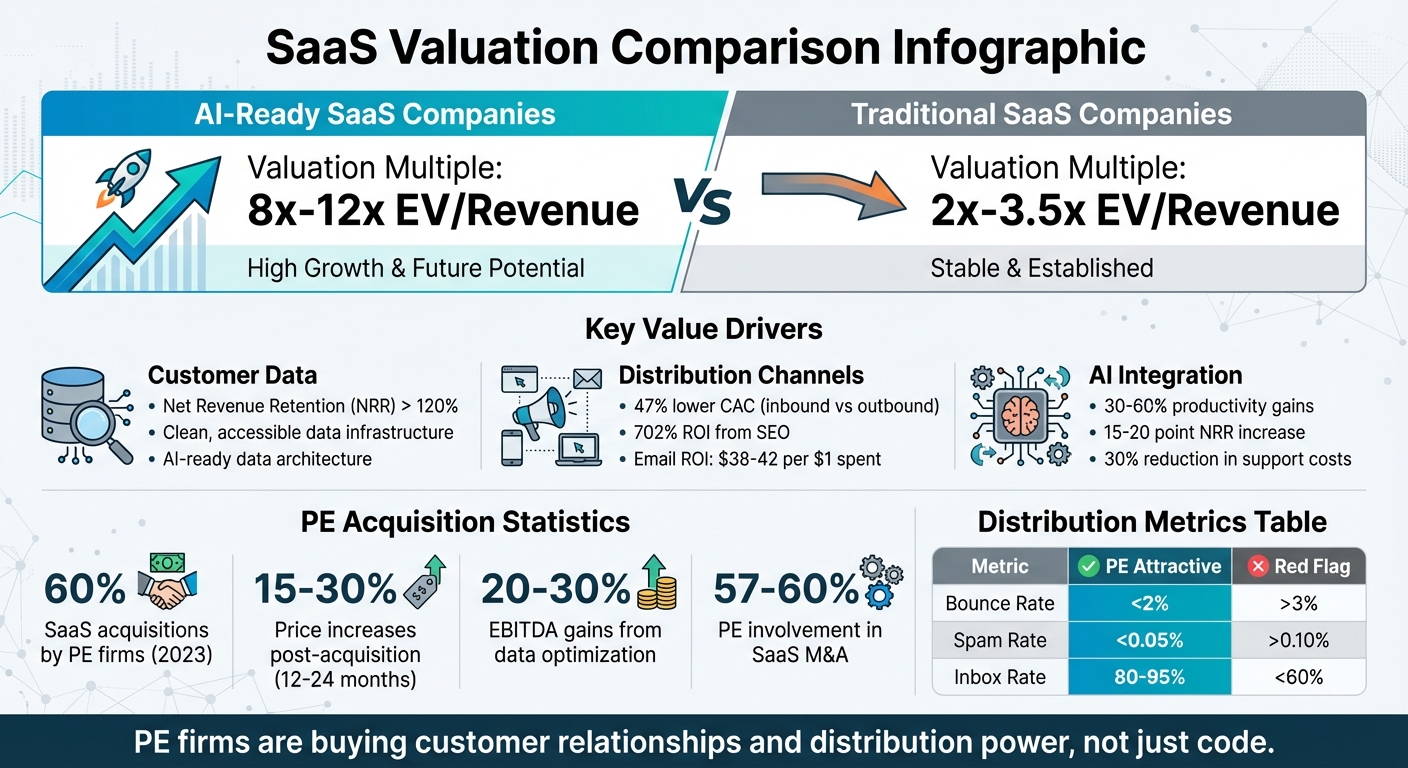
SaaS Valuation Multiples: AI-Ready vs Traditional Companies
How Private Equity Firms Can Drive Value Through SaaS Retention and Pricing
sbb-itb-9cd970b
Why Customer Data Matters in SaaS Acquisitions
Customer data is more than just a valuable asset - it's the backbone of how private equity (PE) firms plan to generate returns from a SaaS business. When PE firms evaluate a company, they rely on customer data to validate growth projections and assess whether the management team’s performance claims align with reality. If your data infrastructure is fragmented, difficult to access, or overly dependent on manual processes, it can trigger concerns that could lower your valuation and lead to deeper scrutiny during due diligence.
One of the most impactful ways customer data drives value is through what PE firms call "cross-sell optionality." When a PE firm acquires a SaaS company, it often intends to add complementary products from future acquisitions. Your current customer base becomes a ready-made channel to distribute these new offerings, reducing the complexity of integration. This approach is particularly effective in vertical roll-ups, where firms consolidate specialized tools serving the same industry. The payoff? Price increases of 15–30% within 12 to 24 months of acquisition [2].
Customer data also supports what buyers refer to as "embedded operational integration." If your software is deeply embedded in critical processes - like healthcare systems or payroll functions - it creates high switching costs for customers. This makes your customer relationships more secure and ensures predictable cash flow, which significantly boosts your company’s appeal to buyers.
How PE Firms Use Customer Data to Generate Revenue
Private equity firms use customer data in several ways to drive revenue growth:
- Optimize sales and marketing: This can lead to EBITDA gains of 20–30% [7].
- Support price increases: Annual price hikes of 5–10% can be achieved without causing proportional churn [1].
- Fuel AI-driven product upgrades: These enhancements can command valuations of 10–15x ARR [4].
As Luciano Colos, CEO of PitchGrade, explains:
"The ability to raise prices 5–10% annually without proportional churn - the most powerful lever in the PE playbook" [1].
Effective use of customer data also allows firms to identify which customers are most likely to pay for premium features or higher pricing tiers. However, as Ankit Sud, Partner at NewView Capital, points out:
"Without modern data management, they won't be able to meet the moment on AI. Their infrastructure, as designed today, is not capable of AI innovation." [5].
PE firms like Vista Equity Partners have made this approach systematic. Through teams like the Vista Consulting Group, they implement proven strategies for pricing, go-to-market execution, and customer success across their portfolio companies. These initiatives, often powered by digital tools and analytics, have been shown to increase EBITDA by 20% in just six months [7].
Case Studies: Data-Driven SaaS Acquisitions
The importance of customer data is evident in real-world examples. Companies with high Net Revenue Retention (NRR) - typically above 120% - show their ability to grow revenue from existing customers through effective upselling and cross-selling. This metric signals long-term value and makes such companies attractive acquisition targets.
In 2023, private equity-backed strategics and PE firms accounted for 60% of all SaaS acquisitions [4]. These buyers sought companies with well-maintained datasets that could support AI-driven transformations. Notably, nearly 20% of firms that adopted generative AI reported productivity gains of 30–60% [7]. These examples demonstrate how a focus on customer data can unlock pricing power, operational efficiencies, and higher valuations. By managing customer data effectively, companies position themselves as attractive assets while also driving measurable improvements in performance.
Why Distribution Lists Drive SaaS Valuations
A strong distribution list can be a goldmine for SaaS companies. Unlike paid advertising, which constantly demands more budget, owned channels like email and SEO offer a cost-effective way to reach customers. The stats back this up: inbound leads from these channels come with a 47% lower customer acquisition cost (CAC) compared to outbound strategies. Plus, SEO can deliver a whopping 702% return on investment (ROI) compared to paid acquisition methods [8].
This efficiency has a direct impact on how private equity (PE) firms evaluate SaaS businesses. With industry CACs averaging $702 - and climbing to $1,200 for enterprise-level customers - a well-maintained distribution list is a critical tool for balancing costs and growth [8]. Companies that excel in content marketing report a 400% boost in lead generation, and with 81% of SaaS businesses relying on email as a primary acquisition channel, your distribution list becomes a key driver of future valuation [8]. This is especially true for AI-native SaaS companies, which often command higher valuation multiples due to their ability to combine large datasets with effective distribution strategies.
How much higher? AI-native SaaS companies with strong distribution channels can achieve 8x-12x EV/Revenue multiples, compared to just 2x-3.5x for less-developed SaaS deals [6]. As Ray Rike, Founder of SaaS Barometer, puts it:
"Companies with large amounts of customer data that can leverage the power of AI and strong distribution will be attractive acquisition targets." [6]
PE firms also see distribution lists as a strategic asset for consolidation plays. When acquiring a SaaS company, they often plan to add complementary products from future acquisitions. This means your distribution list becomes a ready-made platform for cross-selling additional solutions. In vertical roll-ups, where firms merge 3-5 related SaaS tools, combining distribution lists can lead to 15–30% price increases within 12–24 months [2].
It’s no wonder PE firms have been involved in 57% to 60% of SaaS mergers and acquisitions (M&A) in recent years, with a clear focus on companies that have scalable, efficient distribution engines [6][9].
How to Build and Grow Your Distribution Channels
To maximize the value of your distribution list, treat it as a living, evolving asset. Email lists naturally degrade - 23% of contacts become outdated each year due to job changes, disabled accounts, and other factors [10]. Companies that refresh their data weekly, instead of every 4-6 weeks, see better engagement and deliverability rates.
Capture leads when they’re most engaged. Instead of relying on static website forms, use dynamic tools like feature announcement modals, demo request forms, and product-triggered popups. Pair these with irresistible lead magnets - think pricing calculators or downloadable templates - to boost conversion rates by up to 50% [15].
Protect your list with a verification gate. By filtering out invalid emails and retesting uncertain ones, you safeguard your sender reputation and ensure your list remains a long-term asset. Focus on organic channels like content marketing and SEO, which provide consistent returns over time. Considering that the average B2B sales cycle now stretches to 134 days, these channels help nurture leads and reduce churn during the process [8]. Offering a freemium tier can also grow your list - 48% of SaaS companies now use this strategy to attract users and lower initial friction [8].
Finally, move beyond basic demographic segmentation. Instead of grouping contacts by job title or company size, use behavioral segmentation. For example, identify trial users who haven’t reached an "aha" moment, customers who haven’t logged in for 30 days, or power users ready for an upsell. Proper segmentation can increase revenue by up to 760%, with segmented campaigns generating 30% more opens and 50% more click-throughs [14][13].
What Makes Distribution Lists Attractive to PE Buyers
PE firms evaluate distribution lists with a sharp focus on quality over quantity. They’re not just looking at subscriber counts - they’re assessing data freshness and accuracy. Lists that are refreshed every 7 days, rather than the typical 4-6 weeks, are far more appealing. A stale, unengaged list can actually hurt your sender reputation and signal poor operational practices.
Compliance is another major factor. For companies with EU or UK customers, GDPR compliance is essential. PE firms will require detailed documentation of consent, including the source URL, collection method, timestamp, and lawful basis for every contact. Similarly, under CAN-SPAM, opt-out requests must be honored within 10 business days, and maintaining a suppression list is critical for legal protection [10].
Alignment with your Ideal Customer Profile (ICP) is also key. PE firms value lists that are tightly filtered by criteria like industry, company size, and growth signals (e.g., recent funding or hiring). Instead of broad categories like "SaaS", they prefer specific targeting, such as "VP Sales at Series B-funded companies." This kind of precision shows that your list can support targeted cross-sell and upsell strategies post-acquisition.
Deliverability metrics are equally important. PE buyers want proof that your emails actually reach inboxes. This includes established SPF, DKIM, and DMARC authentication, as well as spam complaint rates below 0.05%. High open rates - 51% to over 80% for welcome emails - indicate an engaged and responsive audience [12][13].
| Metric | Attractive to PE | Red Flag |
|---|---|---|
| Total Bounce Rate | <1-2% | >3% |
| Hard Bounces | <0.5% | >1% |
| Spam Complaints | <0.05% | >0.10% |
| Inbox Placement | 80-95% | <60% |
Unlike social media followers, who are at the mercy of algorithm changes, an email list is an owned asset. It provides a direct, stable connection to customers and serves as a reliable revenue engine. With email marketing delivering an average ROI of $38 to $42 for every $1 spent, it’s no surprise that PE firms see distribution lists as a cornerstone of predictable, recurring revenue [11][12].
How to Increase the Value of Your Data and Distribution Assets
To boost Private Equity (PE) valuations, it's crucial to treat your data and distribution channels as essential revenue drivers. The market already rewards companies that prioritize these areas, especially those prepared for AI-driven growth. For instance, AI-native SaaS companies are projected to command 8x–12x EV/Revenue multiples by 2025, while traditional SaaS companies lag behind at 2x–3.5x [6]. Firms that have laid the groundwork for AI transformation often see valuations in the low-to-mid teens, compared to legacy platforms trading at 3–6x revenue [18].
This valuation gap stems from investments in data infrastructure and optimized distribution, which directly enhance AI capabilities. As Faraaz Khan from The Inorganic Edge explains:
"The market is paying for automation, agent-led workflows, stronger NRR, better unit economics, and lower cost-to-serve." [18]
Here’s how to strengthen and protect the value of your data and distribution assets.
How to Collect and Manage Customer Data Effectively
Start by thoroughly assessing and integrating your sales, customer, and product data to eliminate silos [7]. During due diligence, buyers will scrutinize your data sources, processes, and systems to understand how data is generated, moved, and utilized. Implementing a Data Operating Model can help establish clear ownership, reporting lines, and decision-making authority [7]. This approach enables data-driven transformations, potentially increasing EBITDA by 20–30% by equipping sales and marketing teams with sharper insights.
Data minimization is another key focus. With stricter privacy regulations like GDPR and CCPA, collecting only essential data - an approach known as "Privacy by Design" - builds trust and ensures compliance [4]. Simultaneously, prioritize gathering domain-specific, proprietary data that’s difficult for competitors or foundation models to replicate. This creates a protective moat around your platform [16].
Accurate financials are equally important. Clear GAAP compliance and solid revenue recognition practices demonstrate robust MRR. Buyers look for Net Revenue Retention (NRR) above 120%, as it signals strong upselling and cross-selling potential [4]. Falling short here could result in valuation discounts or even disinterest from buyers.
| Factor | Impact on Multiple | Buyer Perception |
|---|---|---|
| NRR > 120% | Premium (High) | Strong upsell/cross-sell potential [4] |
| High Tech Debt | 30–50% Discount | Hidden costs for backend rewrites [16] |
| Siloed Data | Discount (Medium) | Risk to value creation and reporting [7] |
| Vertical Focus | 6x–10x ARR | High barriers to entry and loyalty [4] |
Finally, enhance your workflow integrations. Embed your product into widely used platforms like Salesforce, Slack, or Shopify. Seamless integration increases switching costs for customers and boosts the value of your data [16].
Using AI and Automation to Scale Your Distribution
AI can significantly amplify the value of your distribution channels. By 2026, 80% of PE and strategic buyers will pay a premium for AI-native SaaS companies, with 87% expecting this premium to grow through 2027 [17]. The focus is on improving key metrics such as NRR, CAC, and EBITDA.
Begin with predictive lead scoring. AI can process vast amounts of data - customer reviews, social media content, and product usage patterns - and feed it into your lead scoring models [7]. This can reduce Customer Acquisition Cost (CAC) by up to 50% and speed up customer acquisition by 3 to 5 times compared to traditional SaaS competitors [8]. Highlight your distribution engine’s ability to improve as your dataset expands. As Khaled Azar, CEO of Livmo, notes:
"The multiple moves when AI shows up in your retention and expansion numbers - not when it shows up in your product roadmap slides." [17]
Focus on retention workflows. Use AI to automate onboarding, predict customer health, and streamline support, boosting both NRR and Gross Revenue Retention (GRR). AI-powered triggers for expansion can increase NRR by 15–20 points, directly enhancing valuation multiples. Additionally, redesigning workflows with AI can cut support costs by 30%, improving EBITDA margins [17].
During due diligence, demonstrate a "data flywheel" - a system where customer interactions continuously improve your AI’s performance. This creates a self-reinforcing loop that strengthens your competitive edge over time [17]. As Ray Rike, author of SaaS Barometer, puts it:
"Companies with large amounts of customer data that can leverage the power of AI and strong distribution will be attractive acquisition targets." [6]
Timing is critical. As Khaled Azar warns:
"The premium is for being ahead of your category - not ahead of the world." [17]
To stay competitive, integrate AI into your workflows now and ensure your data infrastructure can support it. The difference between a 3× multiple and a 12× multiple often boils down to whether your data and distribution assets are prepared for AI-driven growth.
Conclusion: Preparing Your SaaS Company for PE Acquisition
What to Remember
Here’s a quick recap of the key points we’ve covered about data and distribution:
PE firms are looking for more than just a solid product or flashy branding - they want proven revenue streams supported by strong customer data and reliable distribution channels. Companies that are AI-ready can fetch EV/Revenue multiples of 8×–12×, while older platforms typically trade at much lower multiples of 2×–3.5× [6]. Metrics like net revenue retention (NRR), customer health, and how deeply your product is embedded in workflows will determine whether you're seen as a valuable, scalable business or a risky turnaround project [1].
The market has shifted its focus from prioritizing growth at all costs to demanding profitable growth. PE buyers now expect companies to meet benchmarks like the Rule of 40, maintain high gross retention rates, and achieve fast CAC payback periods [8]. To stand out, your customer data needs to be clean, well-structured, and AI-ready, while your distribution channels must offer clear advantages - whether through vertical specialization, integration into critical workflows, or ownership of proprietary audiences.
Action Steps for SaaS Founders
To position your SaaS company as a prime target for PE acquisition, consider these steps:
- Audit and improve retention metrics: If your NRR is below 110%, or your product isn’t deeply embedded in essential workflows, your valuation will take a hit [1]. Work on embedding your product into mission-critical processes to boost retention. Also, reduce customer concentration - no single customer should account for more than 10% of your ARR [1][3].
- Optimize your customer data: Ensure your customer data is clean, integrated, and accessible across sales, product, and customer success teams. Use tools like engagement scoring and customer health metrics to showcase predictable retention and expansion opportunities. PE firms will closely analyze your LTV:CAC ratio (aim for 3:1) and CAC payback periods [8].
- Expand cross-sell and upsell opportunities: Organize your data to identify pricing power and upsell potential. Show that you can raise prices by 5–10% annually without causing significant churn [1]. Diversify your acquisition channels beyond paid ads (where CAC now averages $702) by investing in SEO, content marketing, and owned distribution assets like newsletters or niche communities [8][19].
As Orlando Bravo from Thoma Bravo aptly puts it:
"At the end of the day, profitability and growth have to go together" [3].
FAQs
What customer data do PE buyers care about most?
Private equity buyers zero in on customer metrics that highlight stable, predictable, and easily transferable recurring revenue. Some of the key metrics they prioritize include:
- Net revenue retention: A rate above 110% is ideal, showing customers are not only staying but also spending more over time.
- Churn rates: Keeping this under 5% indicates a loyal customer base with minimal losses.
- Gross margins: High margins, typically 80% or more, reflect strong profitability.
- LTV:CAC ratio: A minimum of 3:1 suggests the long-term value of customers significantly outweighs the cost of acquiring them.
- Customer concentration: Ensuring no single customer accounts for more than 10-20% of revenue reduces dependency and risk.
These metrics collectively point to a business that’s both healthy and built for growth.
How can I prove my email list is valuable in due diligence?
Your email list is more than just a collection of contacts - it's a powerful asset that can demonstrate quality, engagement, and growth potential. To highlight its importance, focus on these key areas:
- Consistent Growth: Share data that illustrates steady growth in your subscriber base over time. This shows that your list is not only expanding but also attracting interest from your target audience.
- Strong Engagement Metrics: Highlight metrics like open rates and click-through rates to prove that your subscribers are actively engaging with your content. High engagement signals that your list is filled with relevant, interested individuals.
- Low Churn Rate: A low unsubscribe rate indicates that your audience finds consistent value in your emails, reinforcing the quality of your list.
- Retention and Sales Impact: Provide data on how well your list supports customer retention and contributes to sales. For example, you can showcase how email campaigns have driven repeat purchases or nurtured leads into conversions.
By presenting these trends and performance indicators, you can position your email list as a critical resource that private equity firms will see as a valuable asset during due diligence. It’s not just about the numbers - it’s about how those numbers translate into meaningful business outcomes.
What steps make my SaaS “AI-ready” to earn a higher multiple?
Integrating AI into your SaaS product and operations isn't just about keeping up with trends - it’s about standing out in the market and boosting your company’s value. By weaving AI into your offerings, you can set yourself apart from competitors while staying in step with what customers and investors are looking for.
To make this work, you’ll need a solid AI infrastructure. This means minimizing risks tied to dependencies, keeping costs under control, and staying on top of data compliance. These steps help ensure your AI implementation is both effective and sustainable.
Equally important is focusing on the financial health of your SaaS business. Private equity investors are drawn to companies with durable, measurable revenue streams, strong customer retention, and high gross margins (80% or more). These elements not only make your business more appealing but also position you for higher valuation multiples.