Predictable growth isn’t luck - it’s about using proven strategies that build revenue consistently over time. If your growth feels inconsistent, you're likely missing one of these five approaches:
- Product-Led Growth (PLG): Letting the product sell itself through self-serve models, free trials, or freemium plans. Examples like Cursor ($1M to $100M ARR in 12 months) prove its efficiency.
- Customer Success & Expansion Revenue: Retain and grow existing customers. A 5% increase in retention can boost profits by 25-95%.
- Usage-Based Pricing: Aligning revenue with customer usage. Companies using this model report 22% lower churn and 1.5x faster growth.
- Partnerships & Integrations: Collaborate with other tools or platforms to expand your reach and embed your product into workflows.
- Community Building: Create a loyal user base that advocates for your product. Engaged communities can double revenue growth rates.
Quick Tip: If you’re losing customers quickly, focus on retention strategies. If growth is slow, explore PLG or partnerships. Tight margins? Usage-based pricing might help. Each strategy has unique strengths - find the one that fits your current challenges.
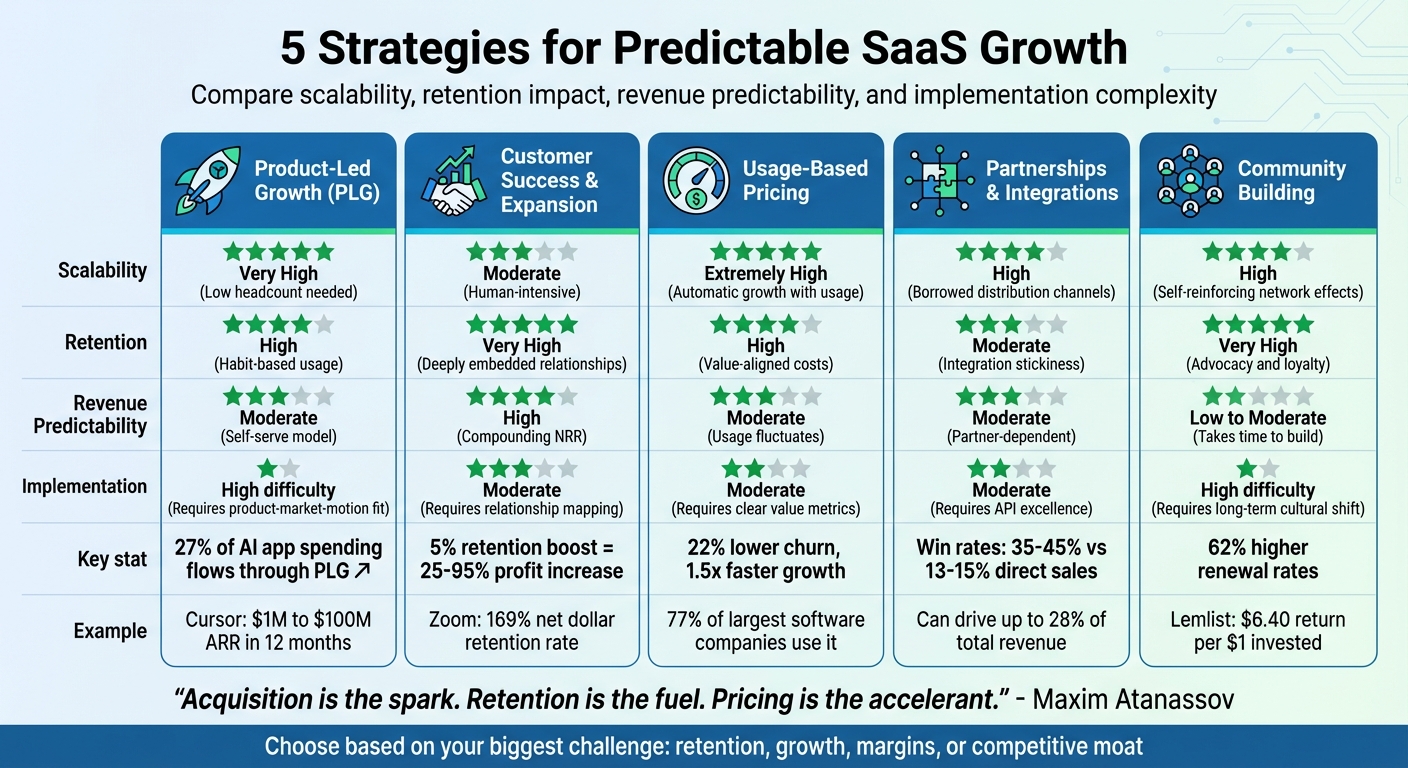
5 SaaS Growth Strategies Comparison: Scalability, Retention & Implementation
10 Steps to Product Market Fit & Predictable Growth (Brass Tacks Tactics to Grow Your SaaS Business)
sbb-itb-9cd970b
1. Product-Led Growth (PLG)
Product-Led Growth (PLG) shifts the focus from traditional sales tactics to letting the product itself take center stage. Instead of relying on sales representatives to close deals, the product becomes the engine for acquisition, activation, and expansion [10]. Users can discover, try, and purchase the software at their own pace - no need for demo calls or follow-ups from sales reps.
A striking example of PLG success is how it has powered growth for the fastest-growing software companies. In 2025, all of Brex's top 50 fastest-growing software companies embraced PLG [8]. These companies not only grew faster but also operated more efficiently, achieving a median customer acquisition cost (CAC) payback period of 10 months, compared to 18 months for sales-led companies [10].
Take Cursor, an AI code editor. By December 2025, the company skyrocketed from $1 million to $100 million in ARR within just 12 months. They reached $200 million ARR without hiring a single enterprise sales rep, relying solely on a frictionless, product-focused strategy [8][9]. Similarly, Lovable, a Swedish AI company, hit $100 million ARR in just 8 months through self-serve adoption, making it one of the fastest companies to reach that milestone [8][9].
Scalability Potential
PLG offers immense scalability because the product itself drives both adoption and conversion [12][10]. When users invite colleagues, it creates an organic growth loop, reducing the need for additional marketing spend. This viral effect allows companies to grow without proportional increases in headcount or advertising budgets.
AI is amplifying this scalability even further. Today, 27% of all AI application spending flows through PLG strategies, a figure nearly four times higher than the 7% found in traditional SaaS [8]. AI simplifies onboarding to the point where users can start seeing value in under 60 seconds, thanks to features like auto-configured workspaces tailored to a single intent question [8][9].
This approach doesn’t just expand reach - it also strengthens customer retention.
Impact on Customer Retention
PLG leads to stickier customers by embedding the product into their daily routines [10]. Companies leveraging PLG often achieve Net Revenue Retention (NRR) rates between 120% and 140%, meaning they grow revenue from existing customers by 20-40% annually, even without acquiring new ones [10][11].
The secret lies in getting users to their "aha moment" as quickly as possible. Every 10-minute delay in time-to-value can reduce conversions by about 8% [12]. For Slack, the "aha moment" is the first reply to a message. For Dropbox, it’s the first file sync. Identifying and streamlining this moment for your product is critical.
When customers quickly see the value, they’re more likely to stick around, which fuels predictable revenue growth.
Revenue Growth Predictability
PLG creates a steady revenue stream by expanding usage within existing accounts [10][11]. Users often start with free plans and naturally upgrade when they hit usage limits - like Slack’s 10,000-message history or Zoom’s 40-minute meeting cap - because the product becomes essential to their workflow [13][14].
This model builds a self-sustaining revenue engine. By analyzing user behavior, companies can identify Product Qualified Leads (PQLs) - users who show strong intent signals, such as hitting usage caps or inviting teammates. This allows sales teams to focus on warm leads rather than cold outreach [10][11]. While the average trial-to-paid conversion rate in B2B SaaS is 18.5%, top PLG performers achieve rates between 35% and 45% [12].
Implementation Complexity
Adopting PLG requires more than just adding a free plan to your pricing page. It involves a company-wide realignment where engineering, marketing, and sales all prioritize the product experience [12][10]. Around 20-30% of engineering resources should be dedicated to improving the signup flow, onboarding experience, and conversion triggers, rather than focusing solely on core product features [15].
"In a product-led company, the product is the primary driver of acquisition, activation, retention, and expansion. Marketing and sales do not disappear, but they amplify the product instead of replacing it." - KISSmetrics Editorial [10]
Start by using person-level analytics to track individual user behavior instead of relying on aggregate data [10]. This helps pinpoint where users drop off and which actions correlate with retention. Next, decide on your free offering strategy. Freemium models typically convert visitors at a median rate of 12%, which is 140% higher than conversion rates for free trials [12]. Alternatively, consider a reverse trial, where users start with premium features for 7-14 days before moving to a free tier. This combines the urgency of a trial with the accessibility of freemium [12][9].
When implemented effectively, PLG transforms every interaction with your product into an opportunity for growth, creating a reliable framework for sustained success.
2. Customer Success and Expansion Revenue
Customer success turns your existing customers into a powerful engine for growth. Research shows that even a modest 5% boost in customer retention can increase profits by 25% to 95% [17].
Top SaaS companies often achieve net revenue retention (NRR) of 120% or more, driving over 20% annual growth from their current customer base [17]. A standout example is Zoom, which in 2022 reached a 169% net dollar retention rate by combining a freemium model with smart upsell strategies. By setting usage caps - like limits on meeting duration and participant numbers - Zoom naturally guided users toward upgrading to enterprise plans [17].
"Net revenue retention is the most important single metric in SaaS growth. Not new ARR. Not MRR growth rate. Not pipeline coverage. NRR." - Robert Moment, SaaS Advisor [1]
Scalability Potential
Customer success scales differently than traditional sales efforts. By segmenting customers based on revenue potential, companies can manage accounts more efficiently:
- Enterprise accounts ($100K+): Assigned dedicated Customer Success Managers (CSMs) with quarterly business reviews.
- Mid-market customers ($10K-$100K): Supported by pooled CSMs with monthly check-ins.
- SMB accounts (under $10K): Managed through automated "tech-touch" workflows [18].
This tiered system enables revenue growth without requiring a proportional increase in headcount. For instance, a business with 115% NRR can double its ARR within five years without acquiring new customers [1]. HubX demonstrated this in late 2025 by introducing automated salvage offers for users attempting to cancel. This initiative retained 63% of at-risk customers and recovered $106,000 in potential lost revenue in just three months [3].
Impact on Customer Retention
Effective segmentation supports proactive retention strategies. In today’s competitive landscape, retention isn’t about waiting for problems to arise - it’s about addressing issues before customers even consider leaving. This involves using health scoring systems that analyze factors like usage frequency, feature adoption, spikes in support tickets, and decision-maker engagement to predict churn [18].
AI-focused businesses face unique challenges, with median gross retention for AI-native B2B SaaS hovering around 40%. This is often due to "Experimental Run Rate Revenue", where initial enthusiasm hides poor product fit over time [19]. SocialPost.ai tackled this issue in 2026 by reducing decision fatigue instead of adding features. By leveraging customer insights to set optimal defaults, they increased user activation from 23% to 42% and cut churn by 20% [6].
"Delight gets users to try. Reliability gets them to stay." - Gaurav Vohra, Head of Growth, Superhuman [16]
To avoid churn, keep an eye on key red flags: a 50%+ drop in login frequency, a 3x spike in support tickets, inactivity from decision-makers for over 30 days, or failed payments on renewal [18].
Revenue Growth Predictability
Customer success doesn’t just protect revenue - it drives expansion. For many SaaS companies, 40% of new ARR comes from expansion revenue [20]. This is achieved through strategic pricing models and well-timed in-app triggers. For example, prompts tied to resource limits or premium feature usage convert at 60% higher rates than email campaigns [20].
Slack achieved 140% NRR by bundling advanced features into premium tiers, while HubSpot increased NRR to 125% by creating personalized upsell paths based on real-time user behavior. This strategy alone added over $50 million in ARR without acquiring new customers [23].
Adjusting pricing models also plays a key role. Offering productized add-ons - like SSO/SAML (15-25% price increase), custom branding (10-15%), or advanced analytics (20%) - lets companies capture more value from enterprise clients without overhauling their core product [20].
Implementation Complexity
Building a strong customer success function requires integrated systems that connect success platforms, product analytics, and CRM data into a unified customer view [22][18]. Start by tracking key metrics like NRR, Gross Revenue Retention (GRR), and expansion revenue percentage on a weekly basis [22][23].
Automate health scoring using a formula such as:
(Usage Frequency × 0.3) + (Feature Adoption × 0.2) + (Support Tickets × −0.1) + (Engagement Score × 0.2) + (Invoice Status × 0.2) [18].
This composite score helps predict churn before it happens.
For AI products, focus on North Star usage metrics during the first 7-30 days - like completed integrations or automated workflows - as these are strong indicators of long-term success [19]. Companies that revise their pricing or packaging every three months see 103% higher average revenue per user compared to those that don’t [21].
"Revenue retention is not built by the customer success team. It is built by every function in the company, starting with the precision of the ICP definition." - Robert Moment, SaaS Advisor [1]
The rewards are clear: companies with predictable revenue models are valued 2-3x higher than those with inconsistent growth [17]. When customer success is done right, expansion revenue becomes the most efficient path to growth - no cold calls, no lengthy sales cycles, just steady value from the relationships you’ve already established.
3. Usage-Based Pricing
Usage-based pricing takes customer value and ties it directly to revenue. Instead of charging a flat subscription fee, this model bills customers based on how much they actually use - whether that's API calls, tokens processed, messages sent, or data analyzed. This shift has gained traction, with 77% of the largest software companies now incorporating consumption-based pricing into their strategies [29].
Why does it work? Because it aligns your revenue with the value customers receive. When customers grow and use more of your product, you earn more. During slower periods, they pay less - without canceling. This flexibility leads to 22% lower churn rates compared to traditional flat-rate pricing [28]. For instance, Intercom Fin charges $0.99 per resolution delivered by its AI agent, directly linking spending to real-time value [28][29].
"Usage-based pricing represents a fundamental shift from selling software access to selling business outcomes." - Katerina Tomislav, Author [29]
Hybrid Models for Stability
While usage-based pricing can seem unpredictable, hybrid models offer a solution. 83% of public SaaS companies using this approach include minimum commitments to ensure a steady revenue base [24]. For example, companies might charge a $500 monthly subscription fee as a baseline, with additional charges for usage beyond included limits. This hybrid strategy has proven effective, delivering a 21% median growth rate, outperforming pure subscription models [29]. Snowflake, for instance, achieved an impressive 158% net dollar retention using this method [29].
Scalability and AI Integration
One of the biggest advantages of usage-based pricing is its scalability. As customers grow and use more of your product, your revenue grows automatically - no extra sales effort required. Companies using this model see 38% higher revenue growth compared to those sticking to subscriptions [24].
AI products make this approach even more effective. Traditional seat-based pricing struggles when AI replaces human labor. Instead, companies like OpenAI charge based on computational work, such as $1.75 per million input tokens for GPT-5.2 [28]. This ensures fair compensation regardless of how many "seats" a customer needs.
Another option is credit-based systems. Customers pre-purchase credits (e.g., $10,000 worth) and draw them down as they use the service. Snowflake has successfully implemented this approach for compute usage and storage, balancing flexibility with upfront cash flow [27].
"AI breaks traditional pricing because value is wildly uneven across customers, seat-based models collapse, and every AI interaction carries real compute costs." - Chargebee [32]
Customer Retention Benefits
Usage-based pricing also strengthens customer retention. Unlike traditional subscriptions, it eliminates the all-or-nothing decision. During economic uncertainty, this flexibility becomes even more appealing. For example, when SaaS prices rose by 11.4% in 2025, CFOs began scrutinizing fixed costs and preferred usage-based models [31]. Customers appreciate paying only for what they use, especially when they have real-time visibility into their consumption and costs.
Transparency is key. Provide dashboards showing current usage, historical trends, and forecasted spending. Automated alerts at 50%, 75%, and 90% of usage thresholds help prevent "bill shock", which can harm customer relationships and drive churn [28][26].
The numbers back this up: companies using usage-based pricing grow revenue 1.5x faster than those relying solely on subscriptions [26]. Over time, the retention benefits compound as customers integrate more deeply with your product.
Predictable Revenue Growth
Critics often point to revenue volatility as a downside of usage-based pricing, but smart contract structures can address this. Minimum commitments create a revenue floor, while high-usage customers provide additional upside. Nearly 39% of SaaS companies now rely primarily on usage-based models and have developed advanced forecasting methods to manage variability [27].
Top performers use historical data, customer segmentation, and leading indicators like API call volume to achieve a Mean Absolute Percentage Error (MAPE) of 15% or lower for 90-day revenue forecasts [25]. Twilio, for example, invested heavily in data infrastructure to process billions of API calls and extract meaningful usage patterns, enabling accurate forecasting [25].
"Investment in data infrastructure was crucial for enabling accurate usage-based forecasting, allowing them to process billions of API calls while extracting meaningful usage patterns." - Jeff Lawson, CEO, Twilio [25]
Multi-year contracts add another layer of predictability. These agreements now account for 40% of SaaS contracts, up from 14% in 2022 [29]. By combining annual minimums with multi-year commitments, companies create a stable revenue base while retaining the growth potential of usage-based pricing.
Implementation Challenges
The transition to usage-based pricing isn't easy. It requires four key systems: real-time usage tracking, billing platforms capable of handling complex calculations, customer dashboards, and clear communication with sales teams [28]. For example, Stripe Billing charges 0.7% of revenue billed to manage complex rating logic and integrate multiple systems [30].
Sales teams need to shift their focus to metrics tied to consumption, while finance teams require new forecasting models. Customer success teams also play a critical role, helping clients optimize usage rather than simply preventing cancellations [30][26].
Choosing the right usage metric is crucial. It should directly correlate with customer value - what OpenView Partners calls "celebration metrics." For instance, leads generated is a better metric than page views because it ties directly to business outcomes [29][24].
To avoid revenue leakage, store contracts as structured data rather than PDFs. Start with a pilot program for new customers before rolling out the model to your entire customer base. Monitor infrastructure costs closely to ensure high-usage customers remain profitable [29].
Despite the technical hurdles, the benefits are clear. 60% of SaaS companies are now using or testing usage-based pricing, proving its potential for growth and scalability [30].
4. Partnership and Integration Strategy
Partnerships can embed your product into the everyday workflows of your customers. When paired with strong product and customer success strategies, they can expand your market reach and improve retention. Done right, partnerships can boost customer acquisition, increase deal closure rates, and improve retention. In fact, over 90% of tech industry leaders see partnerships as critical to driving innovation, and well-designed programs can account for up to 28% of total revenue [39].
The secret is to treat partnerships as an ongoing operational strategy, not a side project. This requires clear workflows, shared metrics, and team alignment. Companies that master this approach often see win rates jump to 35% to 45%, compared to the 13% to 15% win rates typically achieved through direct sales alone [36].
Scalability Potential
Unlike traditional sales, partnerships offer a different path to scalability. Instead of adding more sales reps, you tap into the customer bases and distribution channels of your partners. Building API-first, self-serve integrations can save engineering resources while scaling effectively. For example, MainStreet, a tax credit platform, used Finch's unified API to connect with payroll and HR systems. This streamlined their processes, cutting manual support calls and pulling data in seconds rather than days, making their product more valuable instantly [37].
Integrations like these not only drive customer acquisition but also create stable recurring revenue. With 97% of HR professionals emphasizing the importance of system integrations [37], seamless connections can significantly boost conversion rates. Strategic alliances with partners who share your Ideal Customer Profile (ICP) and offer complementary products can increase revenue by up to 20% [36][37].
"Software companies only get a few of what I call 'innovation tokens' a year and need to use them wisely. Integration partners extend the value of your product without wasting one of your precious tokens." - Sean Harris, Senior Director of Product Management, PartnerStack [38]
Impact on Customer Retention
Integrations can make your product indispensable, much like the retention benefits seen in product-led growth. When your product integrates with essential systems like payroll, CRM, or data warehouses, switching becomes a hassle for customers. These partnership-driven integrations create a "lock-in" effect, reducing churn. Tracking the "churn delta" - the difference in retention rates between customers with integrations and those without - can reveal the impact of these efforts [38].
For instance, Laura Elizabeth, creator of the Client Portal WordPress plugin, collaborated with partners on joint webinars in 2024. By focusing on educational content about client onboarding instead of direct selling, her first promotional partnership generated $10,000 in revenue - well above her $3,000 target. More importantly, it fostered long-term customer relationships [39]. Similarly, Poper, an AI-powered popup tool, partnered with GenAI Works to offer exclusive discounts, leading to a 35% increase in signups during their campaign [39].
Revenue Growth Predictability
Partnerships can also speed up the sales pipeline, much like usage-based pricing adds predictability to revenue. Deals sourced through partners tend to close faster because they come with built-in trust and context. To maintain predictable revenue, track both partner-sourced revenue (deals initiated by the partner) and partner-influenced revenue (deals where the partner played a role in the outcome, speed, or deal size) [36][38].
Tools like Crossbeam and Reveal are helpful for identifying customer and prospect overlaps before investing in a technical integration. To maximize impact, align incentives with specific actions, such as co-selling activities, rather than focusing solely on acquiring logos [38][33].
"Win rates... Direct sellers typically are stuck in this 13 to 15 percent win rate. Partnerships if you're doing it right you're in that 35 to 45 percent win rate." - Rob Moyer, Expert [36]
Implementation Complexity
Building successful partnerships requires a CEO-level mindset that brings together sales, product, marketing, and services teams [36]. Standardized workflows, reusable components, and self-serve partner onboarding processes can help avoid bottlenecks [35][37].
Start with a clear business objective - like entering a new vertical or reducing churn in mid-market accounts. This focus helps streamline partner selection and prevents resource dilution [34]. Automate repetitive tasks with partner portals that generate joint value propositions, landing pages, and outreach templates [34]. Beyond the initial setup, establish a maintenance plan with regular check-ins and dedicated contacts to manage API updates, bug fixes, and user migrations [37].
One common pitfall is entering partnerships where only one side contributes effort.
"Partnerships should be avoided where only one of the parties would work on promoting the partnership and synchronizing users. The involvement of both parties in this process is very important." - Lazar Krstic, founder of Detachless [39]
To ensure long-term success, integrate partner data into your core revenue metrics so leadership can see the program's value and continue investing in it [33][38].
5. Community Building
Building a strong community is becoming just as crucial as product-led growth and customer success for achieving steady growth in SaaS. A well-established community transforms users into advocates and creates a barrier that’s hard for competitors to breach. When customers connect not just with your product but also with each other, they form bonds that make switching to another service less appealing. In fact, SaaS customers who actively participate in product communities have 62% higher renewal rates, and companies with active communities see their revenue grow 2.1 times faster than those without one [41].
The difference between an audience and a community is simple: an audience listens to you, but a community supports each other. Between 2020 and 2023, Supabase grew a Discord community of more than 200,000 members, helping it reach a valuation of over $500 million through initiatives like quarterly "Launch Week" events and an open-source model. Similarly, Notion achieved a $2 billion valuation, with 95% of its traffic coming from organic sources. This success was fueled by a 226,000-member Reddit community and the "Notion Pros" ambassador program [42].
Scalability Potential
Communities scale differently than traditional sales teams. Take Notion’s ambassador program, for example. It started with just 20 ambassadors and grew to 60, creating a ripple effect as each ambassador built their own network. This decentralized approach allows communities to grow while staying relevant to local audiences [40][42].
Scaling also requires a shift in leadership style - from a founder-driven "guru" model to a member-led "platform" model. Hiring a Platform Manager who focuses on creating self-sustaining systems, rather than just planning events, is essential. A good example is Build Club, founded by Annie Liao. Using a "City Lead" model supported by standardized playbooks, the community grew to over 50,000 members across 60+ cities in just one year [40].
"Online reach is rented but IRL trust compounds." - Annie Liao, Founder of Build Club [40]
Impact on Customer Retention
Engaged community members form stronger, more diverse relationships, which significantly reduce churn. In 2025, Max Rofagha, CEO of Finimize, shared that subscribers involved in their community experienced 50% lower churn rates. Gainsight also reported that active community members had 30% higher retention rates and were twice as likely to engage in upsell conversations [41][43]. On top of this, active community support can lower support inquiries by up to 45% [41].
These connections don’t just keep customers around - they also drive revenue growth faster.
Revenue Growth Predictability
Although building a community takes time - typically 6 to 18 months to see results - it fosters predictable growth through shorter deal cycles and improved conversion rates [45]. For instance, 72% of community-influenced deals close within 90 days, compared to just 42% for sales-led deals. Additionally, Community-Qualified Leads convert at 4.8 times the rate of traditional Marketing-Qualified Leads [41][46].
A great example is Lemlist. In 2021, CEO Guillaume Moubeche launched "The Sales Automation Family" Facebook group, which grew to nearly 10,000 members. This initiative helped scale the company from $600,000 to over $2 million in ARR. For every dollar invested in the community, they saw a return of $6.40, while also reducing customer acquisition costs by 32% [41][43].
Implementation Complexity
Despite its advantages, building a thriving community requires careful planning and consistent effort. The early stages demand daily engagement and hands-on involvement from founders for at least 6 to 12 months. Many SaaS startups - about 90% - fail at community building because they treat it as a one-way broadcast channel instead of a space for relationships [42].
To succeed, start by personally recruiting your first 50 key members, focusing the community on solving a shared problem (like SaaS product management) rather than centering it around your product name [40][42]. Aim for an 80/20 balance: 80% of the content should provide value through education and peer support, while only 20% should focus on your product [41].
"The less you talk about your product, the more community members advocate for it." - Finder Launch [42]
Choose platforms like Discord, Slack, or Reddit - places where your users already spend time. Establish rituals like weekly discussion threads or feature request roundups to keep members engaged. And remember, a great community can amplify a good product, but it can’t save a bad one [44].
Strategy Comparison Table
The five strategies outlined here offer different avenues for achieving predictable growth. Each varies in terms of scalability, retention, revenue consistency, and the effort required to implement. Understanding these differences can help you determine which approach aligns best with your current resources and business stage.
The table below evaluates each strategy against four key metrics:
- Scalability potential: How efficiently the strategy can grow without requiring proportional increases in costs or headcount.
- Retention impact: How effectively the strategy keeps customers engaged and minimizes churn.
- Revenue predictability: How consistently future revenue can be forecasted.
- Implementation difficulty: The level of effort, time, and resources needed to execute successfully.
| Strategy | Scalability Potential | Retention Impact | Revenue Predictability | Implementation Difficulty |
|---|---|---|---|---|
| Product-Led Growth | Very High (Low headcount needed) [3] | High (Habit-based usage) [18] | Moderate (Self-serve model) [2] | High (Requires product-market-motion fit) [5] |
| Customer Success/Expansion | Moderate (Human-intensive) [5] | Very High (Deeply embedded relationships) [7] | High (Compounding NRR) [18] | Moderate (Requires relationship mapping) [5] |
| Usage-Based Pricing | Extremely High (Automatic growth with usage) [5] | High (Value-aligned costs) [5] | Moderate (Usage fluctuates) [5] | Moderate (Requires clear value metrics) [5] |
| Partnerships/Integrations | High (Borrowed distribution channels) [7] | Moderate (Integration stickiness) [5] | Moderate (Partner-dependent) [5] | Moderate (Requires API excellence) [5] |
| Community Building | High (Self-reinforcing network effects) [7] | Very High (Advocacy and loyalty) [5] | Low to Moderate (Takes time to build) [2] | High (Requires long-term cultural shift) [5] |
These metrics provide a practical framework to align your growth strategy with your operational capabilities. For example, modern AI-native companies like Cursor demonstrate the power of efficiency, achieving $100 million in revenue with just 30 employees - far surpassing traditional benchmarks.
"Acquisition is the spark. Retention is the fuel. Pricing is the accelerant." - Maxim Atanassov, Future Ventures [18]
Each strategy has its strengths, making it essential to choose based on your product and team's expertise. Opt for Product-Led Growth if you can deliver immediate "aha moments", Customer Success for complex enterprise needs, Usage-Based Pricing when value is easy to measure, Partnerships for deep integrations, or Community Building to create a lasting competitive edge.
Conclusion
We’ve covered five key strategies that separate founders who achieve consistent growth from those stuck in a revenue rollercoaster. The real question isn’t whether these strategies work - it’s which one you’re overlooking.
Take a closer look at where your biggest challenges lie. If you’re bringing in users but losing them quickly, your focus should be on Customer Success. Strong retention but weak user growth? It might be time to explore Product-Led Growth or Partnerships. Struggling with tight margins due to high AI feature costs? Usage-Based Pricing could help. And if your product is easily copied, building a strong Community could give you the edge you need.
"Product-market fit is not a permanent state of being. It's a dynamic relationship between your product and a market that is constantly evolving." - Robert Moment, SaaS Advisor [4]
To accelerate progress, consider running a quarterly audit of your growth strategies. Ask yourself: Does your time-to-value exceed 5–10 minutes (a common Product-Led Growth metric)? Have you gone more than six months without revisiting your pricing - potentially leaving 20–40% of revenue untapped? Are 70% of your resources tied up in building rather than distribution [3]? Companies that adjust pricing every three months often outperform others by 103% in ARPU [3].
If you’re feeling stuck, tools like Agile Growth Labs can provide structured diagnostics to identify exactly where your growth is stalling. Whether it’s a misaligned ICP, broken conversion mechanics, or outdated pricing, knowing the root cause can make all the difference. The gap between guessing and truly understanding is often the gap between stagnation and the growth you’ve been striving for.
FAQs
How do I choose which growth strategy to start with?
Start by evaluating where your business stands and what it needs most right now. If you're in the early stages, your priority should be achieving product-market fit and bringing in customers. For businesses that are further along, strategies that can scale - like partnerships or content marketing - might be more effective.
Focus on building a single, well-structured growth engine that you can refine on a weekly basis. Regularly analyze your metrics to pinpoint the factors that lead to consistent and reliable growth.
What metrics should I track to know it’s working?
To determine if your growth strategies are working, keep a close eye on key SaaS metrics. Start with Monthly Recurring Revenue (MRR) and Annual Recurring Revenue (ARR) - aim for around 26% growth in these areas. Check your Net Revenue Retention (NRR), which should ideally exceed 106%, and keep your churn rate under 1% per month.
For efficiency, focus on metrics like Customer Acquisition Cost (CAC), ensuring the CAC payback period stays between 12-15 months. Also, aim for an LTV-to-CAC ratio of 4:1. Reviewing these regularly helps maintain steady and predictable growth.
Can I combine multiple strategies without losing focus?
Yes, you can combine different growth strategies, but it requires a thoughtful and well-coordinated approach. Successful founders often bring together methods like Product-Led Growth (PLG), in-depth customer research, and strategic partnerships to form a unified system. The trick is to ensure these strategies align with your business model and work together seamlessly. By maintaining clear priorities and integrating these tactics into a single, cohesive growth plan, you can avoid spreading your efforts too thin and set the stage for long-term success.