Your company's data is more than just numbers - it's a source of influence. Without a clear plan for how it's used, you're handing over your competitive edge to AI, competitors, and the market.
Key Takeaways:
- Data as Power: Data shapes decisions, trains AI, and gives insights that can drive your business forward.
- Quality Over Quantity: Collecting more data isn’t the goal - using it effectively is. Companies with clear strategies outperform those that hoard data aimlessly.
- Risks of Poor Management: Mismanaged data leads to inefficiency, security risks, and lost opportunities. Shadow AI tools, present in 77% of organizations, can exploit your data against you.
- Winning Strategies: Define clear objectives, centralize your data, and use tools that align with your goals. Protect sensitive information with strict governance and access controls.
Companies like Renaissance Technologies, Adobe, and Salesforce have turned data into a competitive advantage by focusing on actionable insights, operational efficiency, and long-term strategies. If you’re not intentional about how you manage and use your data, you risk losing control of your influence.
Let’s explore how to turn your data into a tool for success.
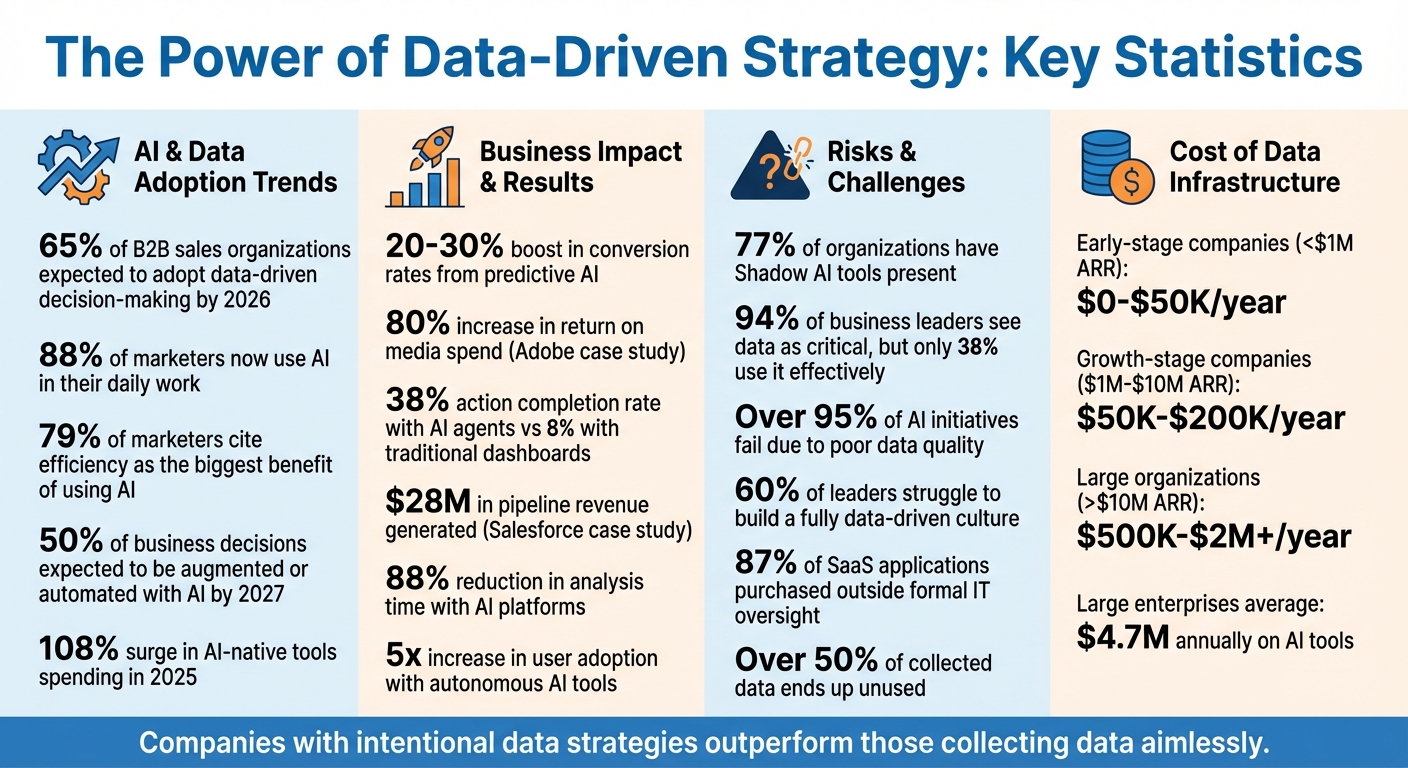
Data Strategy Impact: Key Statistics on AI Adoption and Business Outcomes
Your proprietary data is your competitive advantage | Accenture
sbb-itb-9cd970b
Section 1: Why Data Matters for Your Business
Data isn’t just about recording what’s already happened - it’s about shaping what comes next. Businesses that embrace data-driven strategies can make quicker, smarter decisions than competitors who focus only on gathering more information. In fact, by 2026, 65% of B2B sales organizations are expected to adopt data-driven decision-making practices [9].
When you design systems that learn from every customer interaction and piece of feedback, you create a self-reinforcing advantage. This is why 88% of marketers now use AI in their daily work [10], and why predictive AI has been shown to boost conversion rates by 20% to 30% [10]. The key takeaway? Businesses that treat their data as a strategic asset are the ones leading the pack.
Using Data to Beat Your Competition
Data becomes a competitive edge when it uncovers patterns your rivals can’t see. The real power lies not in raw data, but in interactional data (like user preferences) and learning data (feedback that refines your systems). These insights are deeply embedded in your operations, making them tough for competitors to duplicate.
Take Spotify, for example. By analyzing user listening habits, the company powers AI-driven recommendations that keep users engaged and reduce churn, directly boosting customer lifetime value [8]. Similarly, AWS leverages usage-based pricing data to ensure customers only pay for what they use, creating high switching costs that make it hard for them to leave [8]. Both companies have turned their operational data into a strategic advantage.
Speed matters more than sheer volume. As Alex Pawlowski from The Strategy Stack puts it:
"Advantage no longer comes from having data. It comes from turning data into intelligence faster than rivals can copy." [3]
For instance, Uber uses a Data Quality Monitor to analyze at least two months of historical telemetry. This system flags anomalies early, catching pipeline issues before they affect downstream teams [1]. Such systems show how quickly transforming data into action can give businesses a critical edge.
How Data Improves Decision-Making
Data takes the guesswork out of decisions by spotlighting what truly drives success. By 2027, 50% of business decisions are expected to be augmented or automated with AI-powered decision intelligence [11].
Here’s the difference: Traditional analytics focus on looking backward - figuring out what happened. Modern data systems, on the other hand, predict future trends and adjust operations in real time. For example, Samuel J. Woods’ e-commerce client used predictive modeling to identify users likely to abandon their carts. By offering personalized discounts in real time, the client reduced cart abandonment by 12% and increased overall revenue by 7% in just 60 days [10].
Real-time data also enables businesses to act fast. Whether it’s doubling down on a successful campaign, shifting inventory to meet sudden demand, or detecting fraud before it escalates, the agility data provides is invaluable. It’s no surprise that 79% of marketers cite efficiency as the biggest benefit of using AI [10].
Real Examples: Companies Winning with Data
Let’s look at how some companies have turned data into a game-changer.
Adobe Inc. offers a standout example of data-driven transformation. Between 2019 and 2024, Matt Scharf (VP of Growth Marketing Performance) spearheaded the rollout of Adobe Mix Modeler. By unifying marketing data and moving away from cookie-based attribution, Adobe boosted its return on media spend by 80% and grew digital subscriptions by 75% [13]. Scharf explained:
"Mix Modeler helped us take the guesswork out of channel measurement, allowing us to explore new channels like connected TV and influencer marketing with greater confidence and accuracy." [13]
This shows how data can directly strengthen competitive positioning.
Salesforce took a different route by focusing on making AI insights actionable. In early 2025, a team led by Ali Nahvi and Laura Skelly piloted a system using Data Cloud and Agentforce. The result? They achieved a 38% action completion rate - compared to just 8% with traditional dashboards - and generated $28M in pipeline revenue, with $9M in closed annual contract value (ACV) [14]. Nahvi emphasized:
"Insight doesn't equal impact. Our challenge wasn't to build more models - it was to operationalize the ones we already had." [14]
This highlights the importance of turning insights into action.
Mercado Libre tackled a logistics issue using data. In 2025, Matias Caratti (Product Shipping Supervisor) used Amplitude's AI Agents to optimize the "Flex Shipments" program. By identifying courier coverage gaps, they reduced searches for unavailable couriers by 10% and improved their Service Level Agreement (SLA) rate by 2.5% [12]. As Caratti put it:
"Instead of expanding capacity reactively, we started doing so with concrete data." [12]
This example demonstrates how data can enhance operational efficiency and provide a competitive edge.
These companies didn’t just collect data - they built systems that turned information into influence. The result? Advantages that grow over time and become increasingly difficult for competitors to match.
Section 2: Creating Your Data Strategy
Building a solid data strategy isn't about collecting as much data as possible - it's about focusing on the data that drives meaningful business outcomes. Without a clear plan, over half of all collected data ends up unused [17]. The companies that succeed with data are those that approach it with purpose and clarity.
Setting Clear Data Goals
Start by identifying your top 3–5 objectives for the next quarter or year. These could include goals like boosting market share, lowering churn rates, or entering new markets. For each goal, craft specific business questions that the data must answer [15][16].
For instance, instead of a broad goal like "improve marketing", ask something actionable like: "Which counties have the highest concentration of our target audience?" [15]. This approach forces you to pinpoint the exact data you need and plan the steps you'll take once you have it. Use a decision-action map to connect each business question to the necessary data, potential actions, and measurable success indicators [15].
A great example of this is RSG Group, the parent company of Gold's Gym and McFIT. In 2025, they standardized definitions for terms like "active member" and "revenue" across their 900+ locations in 30 countries. By embedding these definitions into their data processes, they eliminated duplicate SQL queries and aligned their finance and operations teams. This reduced data preparation time and created a single, consistent view of their business [18].
To stay focused, organize your goals using a metrics hierarchy:
- North Star metric: Your primary driver of value.
- Input metrics: Leading indicators that predict success.
- Guardrail metrics: Metrics that ensure long-term health.
This structure helps teams prioritize what truly matters and avoid wasting time on vanity metrics.
"Data strategy isn't a technical problem, it's a business strategy problem that happens to involve technology." - Tom Tunguz [19]
Once your goals are clear, the next step is selecting the tools that align with your objectives.
Selecting Data Management and Analysis Tools
The tools you choose depend on your company's size and needs. Here's a general breakdown of costs based on annual recurring revenue (ARR):
- Early-stage companies (under $1M ARR): SaaS analytics tools costing $0–$50,000 per year [19].
- Growth-stage companies ($1M–$10M ARR): Data stack budgets of $50,000–$200,000 annually, often including their first data hire [19].
- Large-scale organizations (over $10M ARR): Costs exceeding $500,000 to $2M+ per year [19].
Your data stack should cover four categories:
- Acquire: Tools like Google Analytics or Intercom to collect data.
- Consolidate: Platforms like Twilio Segment to unify data sources.
- Store: Warehouses like Snowflake or BigQuery.
- Analyze: Tools like Mixpanel or Tableau.
Assign an internal owner to each tool - someone responsible for becoming the expert and ensuring the tool is fully utilized [17].
| Factor | Data Warehouse | Data Lake | Lakehouse |
|---|---|---|---|
| Best For | SaaS, BI, Financial Analysis | ML, IoT, Experimentation | Unified BI & ML Platform |
| Data Type | Structured | Raw, Unstructured | Both |
| Query Language | SQL | Spark, Hadoop | SQL + Advanced Analytics |
| Examples | Snowflake, BigQuery, Redshift | S3 + Spark, Azure Data Lake | Databricks, Delta Lake |
Before committing to tools, create a tracking plan that documents each event, its location, and its purpose. This will help maintain data integrity and avoid future headaches [17].
A great case study is Doctolib, a healthcare platform. In 2025, they implemented a "living catalog" with natural-language search and clear ownership visibility. This allowed over 900 users across various departments to easily access and contribute to governed knowledge. The result? A 6x increase in data asset adoption and fewer "where is the data?" inquiries [18].
"AI is the shiny object that gets the pill swallowed. The 'pill' is data governance - and for the first time, executives are willing to take it." - Pierre Cliche, CEO, Infostrux [18]
Protecting Data While Using It
Data protection is about more than compliance; it's about trust and staying competitive. Start by categorizing your data into tiered sensitivity levels:
- High: Financial data, personally identifiable information (PII).
- Medium: Customer analytics, sales data.
- Low: Public datasets, general reports.
This approach allows strict controls for sensitive data while keeping less critical data accessible for innovation.
Adopt policy-as-code, where rules are versioned, tested, and enforced automatically at runtime [7]. This ensures that policies around consent, data residency, and retention are actively followed. When evaluating AI tools, prioritize features like no-train zones, decision traceability, and granular access controls [7][20].
To maintain security without creating bottlenecks, use Role-Based Access Control (RBAC) and Attribute-Based Access Control (ABAC), along with "just-in-time" or "break-glass" access. Protect sensitive data through tokenization, pseudonymization, and encryption both in transit and at rest [7].
Another key step is creating a use-case and model registry. This is a formal inventory that tracks AI models, their datasets, purposes, and ownership. It helps monitor for unauthorized AI tools ("Shadow AI") that could bypass governance and risk exposing sensitive information [7].
"You can't trust your AI answers if you don't trust your data. Governance isn't optional anymore - it's the cost of accurate AI." - Armon Petrossian, CEO & Co-founder, Coalesce [18]
Although 94% of business leaders see data as critical for decision-making, only 38% feel their organization uses it effectively to create value [15]. The problem isn't technical - it's strategic. By setting clear goals, choosing the right tools, and protecting your data, you can transform raw information into a true competitive advantage.
Section 3: Common Data Mistakes to Avoid
Even with the best tools and strategies, many companies still struggle to use data effectively. The gap between data that drives results and data that drains resources often boils down to a few key missteps. Avoiding these pitfalls can be the difference between staying ahead in the market and falling behind competitors.
Collecting Too Much Data Without Purpose
The urge to collect as much data as possible is a costly habit. Gathering excessive data without a clear purpose creates unnecessary noise, reduces forecasting accuracy, and increases legal risks [2]. Treating data as a passive byproduct instead of a strategic tool can weaken your competitive edge. To fix this, start by auditing your data collection practices. Identify which data points are essential for your operations and which are collected out of habit. For every piece of data, ask, What business question does this answer? If it doesn’t align with your priorities, it’s just clutter [2].
| Common Data Mistake | Business Impact | Prevention Strategy |
|---|---|---|
| Collecting without purpose | Noise, legal risks, reduced forecasting accuracy | Audit collection practices; focus on operational needs |
| Fragmented ownership | Inconsistent quality, lack of strategic direction | Assign business owners for specific data domains |
| Analyzing without action | Wasted investment, stalled AI projects | Redesign processes to ensure actionable outcomes |
| Passive data sharing | Competitors gain leverage through shared AI training | Define sharing boundaries and track data lineage |
Passive data sharing is another serious error. Companies often share data with partners, not realizing it could be used to train AI models that eventually benefit competitors. Once your competitive edge is lost, recovering it is incredibly difficult [2]. And even when insights are generated, they’re meaningless without action.
Analyzing Data But Not Taking Action
Failing to act on insights is just as damaging as collecting unnecessary data. Many organizations sit on promising insights that never get used - 60% of leaders admit they’ve struggled to build a fully data-driven culture [22]. As Ganes Kesari, Cofounder and Chief Decision Scientist at Gramener, explains:
"The graveyard of data science initiatives is filled with solutions that are advanced, accurate, and well-meaning yet unused" [22]
The problem? Data projects are often treated as technical exercises rather than business-led initiatives. To avoid this, focus on solving your most pressing challenges first. Define clear success metrics and expected ROI before starting any project [22]. Additionally, techniques like storytelling and gamification - using internal data ambassadors, leaderboards, or quizzes - can help foster a culture where insights are put into action. These tactics have contributed to an increase in successful data-driven cultures, from 28.3% in 2019 to 42% by 2024 [22].
Losing Market Position Through Poor Data Management
Weak data management can erode your competitive position. Over 95% of AI initiatives fail due to poor data quality and inconsistent governance [21]. As Bain & Company points out:
"The basic rule of 'garbage in, garbage out' remains a feature of AI as much as any other digital solution" [21]
For example, one company improved its data tracking and recovered $10 million from billing errors. Strengthening data foundations also led to efficiency gains of 20% to 25% within a year [21]. A common issue is fragmented data ownership - when data management is left solely to IT, governance often fails to align with business needs. Assigning specific business owners ensures accountability for data quality. Introducing data contracts and validation SLAs for critical data flows can also prevent problems as you scale [7].
Section 4: Tools and Methods for Data-Driven Results
Modern AI-powered platforms have redefined how businesses handle data, shifting from passive analysis to autonomous decision-making. In 2025, spending on AI-native tools surged by 108%, with large enterprises investing an average of $4.7 million annually [5]. These tools don't just simplify analysis - they help organizations turn data into a strategic advantage. Choosing the right platform, however, requires a clear understanding of what makes a tool effective versus a costly misstep.
AI and SaaS Tools for Data Analysis
Today's data platforms allow users to interact with data in plain English, making complex analysis accessible to everyone. Tools like Secoda, Genloop, and Basedash enable users to ask straightforward questions - e.g., "What caused last week's revenue drop?" or "Which product has the highest margin?" - and receive optimized queries, visualizations, and insights instantly [23][24][28]. Nathan Baschez, Founder of Lex, highlights Basedash's capabilities:
"the first tool that writes and runs SQL, catches its own errors, self-corrects, and genuinely nails it" [28]
The shift from static dashboards to autonomous AI represents a major leap forward. Platforms like Tellius and Amplitude use AI to investigate anomalies, identify trends, and execute workflows without human input [25][26]. For example, a global commercial team using Tellius achieved an 88% reduction in analysis time and saw a 5x increase in user adoption, empowering non-technical staff with direct access to data insights [25].
Meanwhile, proactive monitoring tools like Kyomi and Sapien keep an eye on metrics around the clock. They alert teams to potential issues - like revenue dips or cost spikes - before they escalate. In one case, Carlex, a manufacturing company, used Sapien to uncover $12 million in hidden profit potential by analyzing 800% more data than previous manual methods [29]. Similarly, &pizza saved over 30 hours per week by automating variance analysis across 46 locations [29].
Advanced platforms now incorporate "business memory", learning your organization's specific metrics, formulas, and structures. This ensures consistent insights and reduces errors like AI "hallucinations." Security is also a top priority, with features like SOC 2 compliance, PII masking, and role-based access controls to safeguard sensitive data [23][5][28]. With 93% of IT leaders concerned about data exposure, these governance tools are critical [5].
| Feature | Traditional BI Tools | AI-Native Platforms |
|---|---|---|
| Query Method | Manual SQL / Drag-and-drop | Natural Language / Plain English |
| Setup Time | Weeks/Months (Data Engineering) | Hours/Days (Direct Connection) |
| Analysis Type | Descriptive (What happened?) | Diagnostic & Proactive (Why? & What's next?) |
| Maintenance | High (Brittle dashboards) | Low (Self-correcting queries) |
These advancements signal a shift toward automation that actively drives business outcomes.
Using Automation and Predictive Analytics
Building on autonomous querying, automation transforms data into a forward-thinking engine. AI agents monitor metrics continuously, sending alerts when thresholds are breached - whether it's a sudden jump in customer acquisition costs or a dip in conversion rates [32][27][26]. This proactive approach ensures teams can address issues before they impact customers.
A semantic model is essential for reliable automation. By standardizing business logic and metric definitions, it prevents AI from generating inconsistent or misleading results. Priya Gupta, Head of Data at Cribl, explains:
"Our big lesson with AI is that it's about control. When you constrain it and give it context, like Omni's semantic layer does, you get predictable, reliable results that drive action" [30]
Organizations adopting AI-native platforms have seen dramatic improvements, cutting analysis times by 70% and saving over 9,000 hours annually by automating data collection [31]. Stephen Flood, CEO of GoldCore, describes the impact:
"It's like having a supercharged data analyst who never sleeps. What used to take weeks of manual data gathering now gets done in a couple of hours, with greater accuracy" [31]
Predictive analytics takes things further by forecasting future trends and opportunities. AI agents can even design and analyze experiments, turning data into a continuous optimization engine [26]. Rakib Azad, CFO of Alkira, Inc., highlights its importance:
"Oraion's insights are now a fundamental part of our day-to-day financial planning and decision-making, allowing us to be proactive rather than reactive" [31]
As automation scales, maintaining security and governance becomes even more critical. With 87% of SaaS applications purchased outside formal IT oversight, regular audits are essential to prevent data leaks [5].
Embedding Data Insights Into Daily Operations
For data to drive action, insights must reach decision-makers where they work. Embedding intelligence into tools like Slack, Microsoft Teams, or developer environments ensures that insights are immediately accessible. Platforms using the Model Context Protocol (MCP) allow data to flow seamlessly across different tools [27][33][26].
Natural language interfaces also empower employees to access complex insights without relying on technical teams, reducing bottlenecks and speeding up decisions [23][25]. Jesu Joseph, Global Head of Data and Advanced Analytics, explains:
"We're training the company to rely on dashboards for basic things. But for anything more sophisticated, use Secoda AI" [23]
Moving from "what happened" to "why it happened" requires decision intelligence - tools that can simulate scenarios, test strategies, and offer actionable recommendations [34][35]. Companies using causal analysis have seen a 60–80% reduction in decision-making time and a 5–30% improvement in resource efficiency [35].
To stay in control as AI tools multiply, organizations must set clear standards for transparency, encryption, and data access. Restricting the types of data AI tools can process based on user roles prevents sensitive information from being misused [5]. Doug Poppen, SVP of Strategy and Analytics at &pizza, underscores the value:
"Sapien has clearly helped us take a very different look at how we evaluate the business" [29]
Conclusion: Control Your Data to Build Influence
Data is the backbone of competitive power. Every interaction shapes outcomes and feeds AI systems. When data is treated as a byproduct instead of a valuable asset, you risk training systems that benefit your competitors. As Paul Garny aptly puts it, "Influence, once surrendered, is extremely difficult to reclaim" [2]. This highlights the need for a deliberate and controlled data strategy.
Key Elements of a Strong Data Strategy
A successful data strategy begins with identifying a clear source of power. For example, Dbt Labs has shown that solving a single critical data bottleneck can unlock immense value [6]. By 2026, the most resilient competitive advantages won’t rely on static databases but on learning loops - systems that improve over time, attract more users, and enhance their intelligence. Renaissance Technologies exemplifies this approach by building proprietary datasets from unconventional sources, meticulously refining and testing them in secrecy for over three decades [6]. Every decision about data use strengthens influence and solidifies a competitive edge.
Data governance is not a barrier - it’s the foundation of scalable, reliable AI. With 77% of IT leaders reporting unauthorized AI tools in their organizations and 87% of SaaS applications being purchased outside IT oversight, regular audits are crucial [5]. Establishing an AI risk council, with members from Product, Security, and Legal teams, can help review ethical considerations, assess risks, and approve high-stakes deployments [7].
Steps to Drive Growth Using Data
Move beyond basic reporting to actionable insights. For instance, Intent Amplify processes over 5 billion interactions across various channels, converting them into actionable signals. This enables dynamic prioritization of accounts and real-time campaign triggers based on user behavior [11]. The distinction is clear: AI confined to dashboards offers optional insights, while AI embedded in workflows becomes indispensable. By 2027, 50% of business decisions are expected to be augmented or automated by AI powered by decision intelligence [11].
Audit your data flows and keep only what’s essential. Reducing unnecessary data not only improves forecasting accuracy but also builds customer trust [2][4]. Implementing validation and standardization processes before data enters your CRM or AI systems is vital. As Francisca Poh, Technical Product Marketing Manager at Amplitude, points out, "garbage in, garbage out doesn't change because AI is in the loop" [7]. Additionally, establishing “no-train” zones when working with vendors can help maintain strict control over the data leaving your environment.
Take Action: Use Data to Build Long-Term Influence
Define your competitive advantage and eliminate practices that undermine it. Track incoming data, monitor its flow, and control access. With AI spending skyrocketing and enterprises investing millions annually [5], the cost of doing nothing is quickly outpacing the cost of proper implementation. Your daily decisions about data create or erode long-term influence.
The companies excelling with data aren’t just collecting more - they’re creating systems where data compounds advantages through continuous learning loops that competitors can’t easily replicate. Take control of your data now, before you risk losing your competitive edge.
FAQs
What data should we stop collecting?
Stop gathering data that serves no real purpose or doesn’t play a role in decision-making. Keeping unused data not only eats up resources but also increases security vulnerabilities and makes it harder to utilize your data effectively. Instead, prioritize collecting and managing information that directly supports your business objectives and provides actionable insights.
How do we prevent “shadow AI” from using our data?
Keeping your data safe from "shadow AI" demands a solid plan and consistent oversight. Start by setting up strong data governance frameworks with clear rules for who can access data, how it's validated, and how consent is tracked.
In addition, establish AI governance programs to keep tabs on tool usage, spot unauthorized activity, and build controls directly into your workflows.
To bolster protection, focus on these key areas:
- Regular audits: These help identify vulnerabilities and ensure compliance.
- Employee training: Educate your team on best practices for AI usage and data security.
- Access controls: Limit who can access sensitive information.
- Automated compliance checks: Use technology to ensure policies are consistently followed.
By combining these measures, you can protect sensitive information while maintaining full oversight of AI usage.
What’s the fastest way to turn insights into action?
The quickest path to turning insights into action is by leveraging buyer signals through repeatable workflows. These workflows help reduce the gap between identifying signals and taking action, allowing for timely and tailored engagement across both marketing and sales platforms. This method ensures you can respond promptly and make the most of critical data.
Related Blog Posts
- Guide to Ethical AI Prospecting
- Jeff Bezos and Elon Musk both agree on this: AI-driven companies will be worth 5-10x more by 2026. Here's how to position your business now
- The dirty truth about AI valuation: 80% of 'AI-enhanced' companies see NO valuation increase. Here's why the other 20% get all the exits
- The Hidden Drivers of SaaS Value: Retention, Data Assets & AI Differentiation