Entrepreneurs often wonder: is it smarter to build a SaaS or AI business from scratch or acquire one? The numbers are clear - acquiring an existing business is faster, cheaper, and less risky. Here’s why:
- Cost: Building a custom AI solution costs $300,000–$1.6M over five years, compared to $67,000–$180,000 for an acquisition. Maintenance and hidden costs can further inflate the build expense.
- Time: Building takes 12–18 months. Acquiring gets you operational in 2–8 weeks, saving valuable time and revenue opportunities.
- Risk: 80% of internal AI projects fail to meet ROI expectations. Acquisitions provide proven revenue streams, customer bases, and product-market fit.
- Efficiency: Buying includes established teams, infrastructure, and lower customer acquisition costs (CAC), bypassing the costly validation phase of new builds.
Bottom line: Acquiring a business accelerates entry into the market, reduces risk, and delivers faster returns. Building from scratch may offer control, but it demands significant resources, time, and risk. For most, buying is the smarter choice.
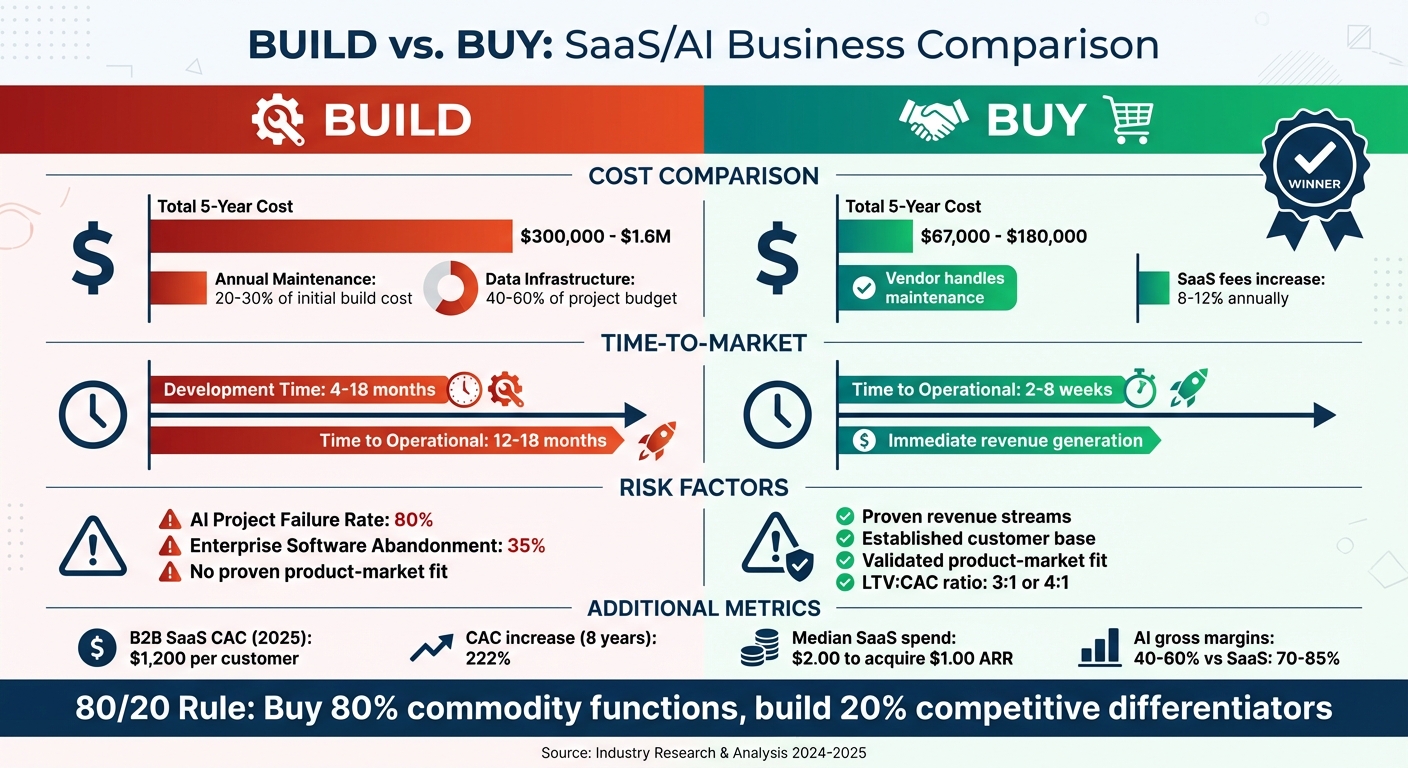
Build vs Buy SaaS Business: Cost, Time, and Risk Comparison
1. Starting a SaaS/AI Business from Scratch
Customer Acquisition Cost (CAC)
Launching a SaaS or AI business from the ground up presents immediate challenges with Customer Acquisition Cost (CAC), and many founders underestimate just how steep these hurdles can be. One major issue is the difference in gross margins: while traditional SaaS businesses enjoy margins of 70–85%, AI companies typically operate with margins closer to 40–60% [8]. This lower margin forces AI startups to either scale much faster or charge significantly higher prices just to break even on acquisition costs.
Another key difference lies in operational costs. In SaaS, serving additional customers is almost cost-free, but AI usage costs grow with customer engagement. For example, each AI call costs around $0.04, which directly cuts into your margins [9]. If you’re calculating CAC payback based solely on revenue instead of contribution margin, you might be underestimating the financial burden.
"If you're using legacy SaaS pricing with AI usage costs, you're scaling margin risk, not revenue." – James Colgan, Beyond the Build [9]
On top of this, the crowded nature of today’s tech stacks makes acquiring customers even harder and more expensive [7]. To match the EBITDA output of a traditional SaaS company, an AI startup typically needs to achieve 6x the revenue because of its lower gross margins [8].
But CAC is only part of the equation. The time it takes to scale can be just as critical.
Time-to-Scale
Even after overcoming CAC challenges, AI and SaaS startups face the daunting task of bridging the gap between development and revenue generation. Building a solution from scratch takes anywhere from 4 to 18 months, while acquiring or buying an existing solution can get you operational in just 2 to 8 weeks [1][3]. That 12–18 month delay can be the difference between survival and failure.
During this development phase, startups must also allocate significant engineering resources. For instance, 40–60% of the total project budget typically goes toward building data infrastructure [1]. On top of that, annual maintenance costs can consume another 20–30% of the initial build cost [1]. Meanwhile, competitors who opted to acquire or buy are already gaining market share and refining their offerings based on real customer feedback.
The takeaway? Starting from scratch not only demands more time and money - it also leaves you more vulnerable to competitors who are moving faster.
sbb-itb-9cd970b
2. Buying an Existing SaaS/AI Business
Customer Acquisition Cost (CAC)
When you purchase an established SaaS or AI business, you’re not just buying the product - you’re inheriting a network of proven distribution channels. These include SEO rankings, a recognizable brand, email lists, and existing partnerships, all of which drive organic traffic and help lower your blended CAC [10]. To put this into perspective, the average B2B SaaS CAC hit $1,200 per customer in 2025, with acquisition costs skyrocketing by 222% over the last eight years [11]. By acquiring an existing business, you skip the costly and uncertain validation phase. Today, the median SaaS company spends $2.00 in sales and marketing just to secure $1.00 in new ARR [11].
"The code itself? Worth almost nothing in the AI era. The hard-to-replicate stuff around it? That's where the value is." – Alex Boyd, Founder, Wildfront [10]
This built-in efficiency not only saves money but also accelerates your entry into the market.
Time-to-Scale
Buying an existing business can drastically reduce the time it takes to scale. While building a new solution can take anywhere from 4–12 months, an acquired business can often be operational in just 2–8 weeks [3]. Every month spent developing a new product is a month of lost revenue - revenue that an established business would already be generating. For example, a $150M manufacturing company scrapped a 22-month internal AI project that cost $720,000 and instead opted for a $180,000 vendor solution, which was up and running in just six weeks [1].
"The math is compelling: while building requires time and tons of mental effort spent being scrappy and looking for validation... acquiring gets you immediate revenue, and at least some degree of product-market fit." – Alex Boyd, Founder, Wildfront [10]
This speed gives you a head start, allowing you to focus on growth rather than development.
LTV:CAC Ratio
The long-term value of an acquisition becomes even clearer when you examine unit economics. A solid SaaS business typically boasts an LTV:CAC ratio of 3:1 or 4:1 [11]. Acquisitions come with proven metrics, reducing the risks associated with new builds, which fail at an alarming rate - over 80% for AI projects [1]. Additionally, purchased businesses often include functioning teams with established workflows, allowing for operational readiness in 3–6 months compared to the 18 months it might take to build from scratch. This also eliminates the need for costly recruiting fees (20%–30% of first-year salaries) and the inefficiencies of onboarding, where new hires typically operate at just 50% productivity initially [5].
Risk Reduction
Acquiring an established business significantly reduces the risks tied to untested ideas. You gain immediate product-market fit, a validated customer base, and steady revenue streams. The failure rate for internal AI builds is about 80%, roughly double that of other tech projects [1]. On the flip side, companies leveraging AI for customer acquisition have managed to cut costs by up to 50% [11]. These factors make acquisitions a more reliable option than starting from scratch. They let you focus on optimizing and expanding the business rather than worrying about whether your concept will take off. For transactions exceeding $25,000, it’s wise to use a third-party escrow service with a 5–10 day verification period. This ensures all assets - like code, domains, and Stripe access - are properly transferred before releasing funds. Always request read-only access to the payment processor to confirm that payouts match bank statements and to check for inflated metrics [10].
| Deal Structure | Pros | Cons | When to Use |
|---|---|---|---|
| Cash Upfront | Simple and clean; motivates seller. | High risk due to limited fraud protection. | Low-risk deals under $10,000. |
| Earn-Out | Aligns incentives; lowers fraud risk. | Can be complex to structure. | Standard for deals over $25,000. |
| Seller Financing | Requires less upfront capital. | Seller assumes risk; includes interest costs. | When cash flow can cover debt. |
| Asset Purchase | Cleaner; avoids hidden liabilities. | Might require contract renegotiations. | Best for SaaS under $500,000. |
Episode 650 | Building vs. Buying a SaaS, Day Job Constraints, an...
Advantages and Disadvantages
When deciding whether to build or buy, the key drivers often come down to speed, control, and cost. Buying an existing SaaS or AI solution gets you to market faster, while building from scratch offers greater flexibility and ownership - though it requires a hefty investment of time and resources. Let’s break down the pros and cons of each approach.
From a cost perspective, buying is initially more affordable. Over a 5-year period, the total cost of ownership (TCO) for a SaaS AI tool typically ranges between $67,000 and $180,000, compared to the $300,000 to $1.6 million needed for a custom build[3]. However, there are hidden costs to consider. For instance, integration can require an additional 30–200 engineering hours[4], and SaaS subscription fees tend to increase 8–12% annually[4]. On the other hand, building your own solution gives you complete ownership and the chance to create a proprietary advantage, but it also comes with ongoing maintenance costs - often called a "maintenance tax" - equal to 20–30% of the initial build cost each year[1].
When it comes to control, buying ties you to a vendor’s roadmap, which may limit your ability to stay competitive[6]. Building your own solution avoids this issue, but it introduces significant risks. For example, 80% of internal AI projects fail to deliver their expected ROI, which is nearly double the failure rate of non-AI technology projects[1]. Additionally, 35% of large enterprise custom software initiatives end up being abandoned altogether[2]. While buying shifts some of these risks to the vendor, it does come with its own challenges, like vendor lock-in and data ownership issues, which can make switching providers costly over time[4].
| Factor | Building from Scratch | Buying/Acquiring Existing |
|---|---|---|
| Maintenance Burden | 20–30% of build cost annually [1] | Handled by vendor |
| Competitive Edge | High (proprietary advantage) [6] | Low (commodity tool) [6] |
| Control & Flexibility | Full ownership of roadmap | Limited to vendor's roadmap [4] |
| Failure Risk | 80% failure rate for AI projects [1] | Vendor lock-in and price hikes (8–12% annually) [4] |
| Scalability | Costs grow with infrastructure [6] | Per-seat/usage fees at scale [6] |
Given these trade-offs, many companies are opting for a hybrid approach. This strategy blends the best of both worlds: leveraging SaaS tools for about 80% of their stack, while reserving custom development for the critical 20% that provides a competitive edge. By doing so, businesses can balance the need for speed with the ability to differentiate themselves in the long run.
Conclusion
Buying an existing SaaS or AI business offers a faster, less risky path to revenue compared to building one from scratch. The upfront cost for an acquisition typically ranges from $67,000 to $180,000, while building can cost anywhere from $300,000 to $1.6 million. Plus, acquisitions can have you operational in weeks, whereas building often takes months[3]. With more than 80% of internal AI projects failing to meet ROI expectations[1], the numbers strongly favor acquisition.
This approach aligns with the 80/20 rule: focus on purchasing commodity functions to keep the business running smoothly and only build (or acquire) the 20% that truly sets you apart competitively[3]. This strategy helps conserve engineering resources for high-impact work and avoids the 20–30% annual maintenance costs that custom builds often bring[1].
"The math is compelling: while building requires time and tons of mental effort... acquiring gets you immediate revenue, and at least some degree of product-market fit." – Alex Boyd, Founder, Wildfront[10]
It's critical to conduct a detailed 5-year total cost of ownership (TCO) analysis. This should account for direct expenses as well as lost revenue during the development phase. For instance, if a solution could generate $50,000 per month, delays in deployment could lead to significant opportunity costs over time[3]. By combining the speed of acquisition with selective custom development, businesses can achieve both rapid market entry and a competitive edge.
The real question isn't whether to build or buy - it's about understanding where owning technology gives you an advantage and where leveraging existing solutions makes more sense[3]. Use your resources strategically: invest in owning what differentiates you while relying on proven solutions to minimize risk and accelerate growth.
FAQs
How do I value a SaaS/AI business before buying it?
To determine the value of a SaaS or AI business, you can use valuation multiples based on important financial metrics like annual revenue or profit. These businesses often sell for 2.5x to 5x their annual profit, with factors like growth rate, level of automation, associated risks, and market demand influencing the final multiple.
For companies that are already profitable, EBITDA multiples are a common choice. On the other hand, revenue multiples are typically used for businesses experiencing rapid growth but may not yet be profitable. It's essential to account for current market conditions, thoroughly verify financial records, and compare the business to industry benchmarks to arrive at a fair and accurate valuation.
What metrics should I verify in due diligence?
During due diligence, it's crucial to assess several key metrics to get a clear picture of the business's health and potential. Start with revenue stability to ensure consistent income streams, and examine customer retention by analyzing the churn rate. Check net revenue retention (NRR) to understand how well the business retains and grows revenue from existing customers.
Evaluate the growth rate to gauge expansion potential and review profitability, particularly EBITDA, to measure financial performance. Ensure financial compliance is in order to avoid legal or regulatory issues. Look into security maturity to confirm robust measures are in place to protect data and systems. Finally, assess operational scalability and technology integration readiness to determine whether the business can handle growth and adapt to new tech seamlessly. Together, these metrics will help you decide if the business aligns with your growth and ROI objectives.
How should I structure an acquisition to reduce risk?
To lower the risks involved in an acquisition, prioritize detailed due diligence, well-structured deal terms, and seamless post-acquisition integration. Carefully examine the target company’s financials, technology, and customer base while identifying any potential liabilities that could pose challenges. Tools like earn-outs or escrow agreements can help align goals between parties and reduce uncertainties in the process. Lastly, focus on smooth integration by keeping key talent, strengthening customer relationships, and aligning operational processes to ensure the deal delivers value while minimizing disruptions.