The strategies that drove SaaS growth in 2020 are now outdated and costly. Acquisition-focused tactics like Google Ads and SDR-heavy teams have become less effective as customer acquisition costs soar and retention rates plummet. AI is reshaping the market, creating demand by solving new problems and driving faster growth through automation, predictive tools, and outcome-driven pricing.
Key insights from the article:
- Acquisition Costs: Skyrocketed from $1.24 per $1 of growth in 2021 to $2.01 in 2025.
- AI Impact: Companies like Cursor reached $100M ARR without traditional marketing, relying on AI-driven features and rapid product innovation.
- Retention Challenges: Customer retention is now more critical, with 74% of SaaS revenue coming from existing customers.
- Pricing Evolution: Seat-based pricing is being replaced by usage-based and outcome-driven models to align costs with value delivered.
- What Works Now: AI-powered automation, faster "time-to-aha", predictive churn management, and value-based pricing models.
If you're still relying on 2020-era strategies, it's time to shift focus. AI-first growth, retention-centric approaches, and dynamic pricing models are now essential for staying competitive.
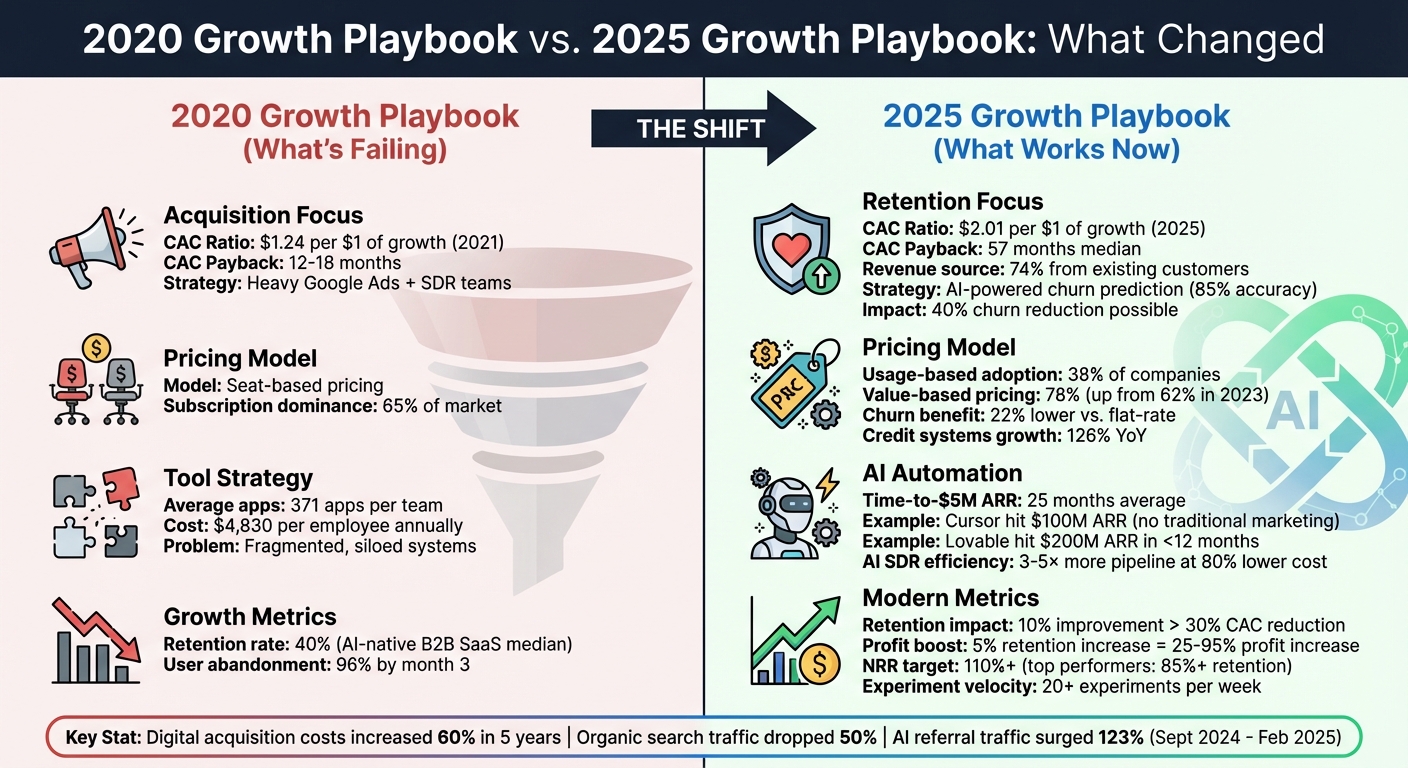
2020 vs 2025 SaaS Growth Strategies Comparison
The State of SaaS Pricing: Progress and Pitfalls in 2025
sbb-itb-9cd970b
Why 2020 Growth Tactics Fail Today
Growth strategies that worked in 2020 are now creating more problems than solutions, particularly when it comes to operational efficiency and financial viability. Let’s dig into three key areas where these old tactics are holding companies back.
The Problem with Prioritizing Acquisition Over Retention
Focusing too much on acquiring new customers while neglecting retention has become a costly mistake. Recovering customer acquisition costs now takes a median of 57 months for B2B SaaS companies - a massive jump from the previous standard of 12–18 months [9]. Adding to the issue, digital acquisition costs have skyrocketed by 60% in the last five years [5][7].
Retention rates paint an even bleaker picture. AI-native B2B SaaS companies report a median gross retention rate of just 40%, meaning over half their revenue disappears within a year [6]. This revenue loss forces companies to work harder - acquiring 70% more new revenue just to achieve a modest 20% growth [5]. Worse still, 96% of new users abandon the average product by the third month [5].
"Growth this quarter that churns next quarter isn't growth. It's expensive churn with extra steps." – Stuart, Growth Coach, Growth Method [5]
Many companies misinterpret temporary spikes in revenue from curious, short-term users as signs of product-market fit. But when the novelty wears off, those customers disappear [6]. On the other hand, improving retention by just 10% delivers more value than cutting customer acquisition costs by 30% [7]. Even a small 5% boost in retention can increase profits by 25% to 95% [8].
Retention challenges aside, another massive issue lies in how companies manage their tools and systems.
Why Too Many Tools Hurt Performance
The average team now juggles 371 apps, spending $4,830 per employee annually on software licenses [12]. This creates operational chaos, with marketing efforts fragmented across disconnected systems and no one managing the bigger picture [10].
The real cost? Wasted time. For example, preparing a single Quarterly Business Review can take over 10 hours because data is scattered across multiple platforms like CRM, helpdesk, Slack, and email [11]. Important customer information often slips through the cracks. A frustrated executive’s email might sit unread in an inbox while the support team remains completely unaware [11].
"We're overwhelmed by the tools we bought that created a bunch of silos and forced us into constant app-switching." – Joel Passen, Co-founder, Sturdy.ai [11]
Startups are especially vulnerable. Founders often adopt numerous tools early on, spending more time on setup and troubleshooting than on customer engagement [13]. This over-reliance on tools is one reason why 92% of SaaS startups fail within three years [13]. The solution isn’t adding more tools or staff; it’s creating unified systems that consolidate customer data and provide clear, actionable insights [11].
Why Seat-Based Pricing No Longer Works
The traditional seat-based pricing model is also showing its age. Today, more employees don’t necessarily mean more revenue. AI agents can now handle the work of 10–15 mid-level employees, reducing the need for software licenses [15]. Procurement teams are cutting 10–20% of low-usage seats, and widespread layoffs - 245,000 tech workers lost jobs in 2025 alone - are further shrinking license counts [14][16].
This shift is already impacting vendors. In early 2026, Atlassian reported its first-ever decline in enterprise seat counts, leading to a 35% drop in stock value as investors recognized the changing economics of software [15]. On top of that, AI-native products face higher operating costs, with inference expenses eating up 20–40% of revenue, making traditional pricing models unsustainable [15].
Subscription-based pricing has also declined, dropping from 65% to 43% of the SaaS market by 2025 [4]. To adapt, 65% of SaaS vendors have introduced usage-based metrics alongside seat pricing to better align with the value their products deliver [15].
"The companies that figure out how to bill for value created rather than humans employed will win the next era." – AI Business Dispatch [15]
Growth Strategies That Work in 2025
The SaaS industry in 2025 is evolving rapidly, leaving behind outdated tactics and embracing AI-powered strategies. Companies adopting these methods are scaling faster while improving profitability.
Using AI for Predictive Growth and Automation
AI is now the driving force behind growth. Tasks that once required entire teams are being handled by autonomous AI agents. Take 11x.ai's AI SDR "Alice" as an example - it generates 3–5× more pipeline at about 80% lower cost by autonomously researching prospects and personalizing outreach [1].
Predictive churn management has also become a game-changer. AI models analyze behavioral signals like reduced login frequency, increased support tickets, and shifts in feature usage to identify at-risk customers with 85% accuracy [18]. Businesses using these predictive systems report up to a 40% reduction in churn and a doubling of expansion revenue [19]. Instead of reacting to lost customers, companies can now intervene proactively weeks before a customer considers leaving.
Another key to growth is shortening the time-to-aha, the period before a user experiences a meaningful win with a product. Conversational AI used during onboarding can reduce time-to-value by 20–40%, creating immediate engagement that drives viral adoption [18].
AI is also reshaping demand creation. For instance, Perplexity, an AI search engine, was handling over 15 million daily queries by early 2026, relying on "spectator-value virality", where AI-synthesized answers become a primary distribution engine [1].
AI-first SaaS companies are hitting milestones faster than ever. They now reach $5 million ARR in just 25 months on average - much quicker than traditional approaches [4]. Lovable (formerly GPT Engineer) hit $200 million ARR in under 12 months by December 2025 by focusing on "Minimum Lovable Products" and leveraging influencer marketing, which proved 10× more effective than traditional paid ads [3].
"Only 30% to 40% of what I learned in 20 years of growth leadership still applies in the age of AI." – Elena Verna, Head of Growth, Lovable [3]
This shift to automation and AI-driven growth also demands a rethink of pricing models.
Switching to Usage-Based and Outcome-Driven Pricing
Traditional seat-based pricing is losing ground to usage-based models. By 2025, 38% of SaaS companies had adopted usage-based pricing, while 78% embraced value-based pricing - up from 62% in 2023 [20][4]. Usage-based models have 22% lower churn compared to flat-rate subscriptions [4].
This model aligns revenue with operational costs. For example, in usage-based pricing, revenue ties directly to AI-related expenses like tokens, GPU time, and API calls, ensuring gross margins remain intact [21]. Outcome-driven pricing goes a step further, charging for measurable results instead of access. Intercom's Fin AI agent, for instance, charges based on resolved customer inquiries rather than per seat [16].
| Feature | Seat-Based (2020 Playbook) | Usage/Outcome-Based (2025 Playbook) |
|---|---|---|
| Value Alignment | Tied to headcount, not value delivered | Tied to consumption or business results |
| Expansion Potential | Limited by workforce growth | Scales with customer success |
| Churn Risk | Higher during workforce reductions | Lower; costs scale with usage [4] |
| AI Cost Management | Fixed pricing risks margin erosion | Revenue scales with variable AI costs [21] |
Credit-based systems are also gaining traction, with 126% year-over-year growth in 2025 [17]. Companies like Clay offer flexible credit packages, such as 2,000 credits for $134 or 50,000 credits for $720 [17]. Many SaaS businesses are adopting hybrid models like "Seat + Credits" to balance predictability with flexibility. For example, Notion bundled AI into its Business plan and raised the price from $15/user/month to $20/user/month [17]. Features like real-time usage dashboards and automated spending alerts (at 50%, 80%, and 100% usage) help maintain trust and prevent bill shock [21].
AI-powered pricing optimization is delivering impressive results, with companies seeing a 30% boost in profitability and revenue improvements of 12–40% year-over-year [22][4][21].
"The future of SaaS pricing isn't just about what you charge, but when and how you adjust those charges based on real-time data." – Alex Yampolskiy, CEO, SecurityScorecard [22]
With pricing now a strategic asset, retaining customers becomes even more critical.
Making Retention Your Primary Growth Driver
Retaining customers is far more cost-effective than acquiring new ones. On average, acquiring a new customer costs 5 to 25 times more than retaining an existing one [8]. In B2B, the average acquisition cost is $536, compared to just $37 for retention - a 14× difference [8]. Notably, 74% of SaaS revenue now comes from existing customers [23].
Even small gains in retention can significantly impact profits. A 5% increase in retention can boost profits by 25–95% [8]. Repeat customers also spend 67% more than first-time buyers [8]. However, customer loyalty has been on the decline, dropping from 77% in 2022 to 69% in 2024, partly due to the rise of AI-powered comparison tools [8]. To combat this, companies need to focus on delivering value daily, especially during the critical first 90 days when most churn occurs. Encouraging users to complete at least 10 key actions per week within the first 7–30 days can make a big difference [19][6].
Specialized roles also improve Net Revenue Retention (NRR). For example, Customer Success Managers add +8 points to NRR, Customer Enablement adds +5, and Account Management contributes +4 [23]. Siemens achieved better renewal visibility and forecast submission rates above 70% by implementing a global forecasting and retention process across 4,000+ sellers in 190 countries using Outreach [23].
"Retention isn't a function. It's a culture." – Nadia Rashid, Chief Revenue Officer, Outreach [23]
AI-powered workflows are accelerating retention strategies. While traditional retention analysis could take weeks, AI workflows identify patterns and launch targeted campaigns within 4–6 hours [7]. Automated "save plays" trigger engagement as soon as product usage drops below a threshold, reducing churn by up to 40% and doubling expansion revenue [19].
Healthy SaaS companies in 2025 aim for NRR above 110%, with top performers achieving retention rates of 85% or higher, compared to the industry average of 68% [8]. If your NRR is below 100%, it may signal that your pricing model isn't effectively capturing growth opportunities [20]. This focus on retention underscores the importance of adopting modern strategies to achieve sustainable growth.
How Agile Growth Labs Supports Modern Growth
In today’s fast-changing market, where older growth strategies often fall short, Agile Growth Labs steps in to help businesses thrive by leveraging modern AI and SaaS tools. One of its standout features is a curated SaaS and AI Tool Directory, which simplifies the overwhelming process of choosing the right tools. Considering that businesses now use an average of 177 SaaS apps[24], finding the best-fit tools for predictive analytics, automation, and customer retention is more important than ever. The directory prioritizes vertical SaaS solutions, known for their higher switching costs and premium pricing models. These specialized platforms help businesses move away from one-size-fits-all tools, boosting both retention and operational efficiency[24].
The platform also offers AI-powered lead generation and marketing automation tools, which use behavioral analytics, personalized onboarding, and dynamic pricing to enhance customer acquisition. These tools align with Product-Led Growth (PLG) models, which are proven to lower expansion costs by 24% and generate over 10% of revenue for nearly half (44%) of SaaS companies[26]. On top of that, data shows that companies with strong AI-driven strategies are 1.6× more likely to achieve double-digit revenue growth[24].
Agile Growth Labs doesn’t stop at acquisition - it also provides resources for scaling and retention. For scaling businesses, the platform offers guidance on usage-based pricing, PLG frameworks, and AI-driven personalization to increase Monthly Recurring Revenue (MRR). These strategies emphasize retention as a more cost-effective path to growth, with cross-selling and expansion delivering better ROI than focusing solely on acquisition[26]. Additionally, the platform includes exit planning frameworks, covering topics like revenue architecture, AI audits, and vertical SaaS defensibility - key elements for smoother partnerships or acquisitions[25].
"SaaS is evolving to 'Service-as-a-Software' with ROI-based pricing." – Desiree-Jessica Pely[25]
Conclusion: Building a Growth Strategy for 2025 and Beyond
The strategies that worked in 2020 aren’t just outdated - they’re holding companies back in today’s AI-driven market. The move from traditional funnels to AI Growth Loops demands that your product not only learns from every interaction but also adapts automatically to stay competitive[2]. Just look at Cursor, which hit $100M ARR with minimal traditional marketing[1], or Midjourney, which raked in over $200M in revenue without spending a dime on paid ads, relying entirely on viral momentum and spectator-driven value[1].
These changes make it clear why older growth methods are no longer cutting it. Organic search traffic has plummeted by more than 50% as AI-powered search tools reshape the landscape. Meanwhile, referral traffic from generative AI platforms has surged 123% between September 2024 and February 2025[27]. The focus has shifted from traditional SEO to Answer Engine Optimization (AEO) and Generative Engine Optimization (GEO). To stay relevant, your brand needs to be cited by AI tools like ChatGPT, Claude, and Perplexity[28].
"I thought AI wouldn't be that different from other growth strategies. I'm discovering it's very different." - Sean Ellis, Founder of GrowthHackers[1]
Succeeding in 2026 will require a mindset shift toward experimentation velocity. Companies need to run 20 or more fundamental experiments every week - a dramatic increase compared to traditional SaaS benchmarks[1][29]. For the first 3-6 months, leadership teams should devote more than 50% of their time to acquisition experiments to uncover their growth flywheel[1]. The focus must evolve from optimizing funnels to driving feature velocity, as 95% of growth will come from launching new capabilities rather than fine-tuning existing features[3].
To support this rapid pace of experimentation, businesses need strong systems in place. Platforms like Agile Growth Labs offer the tools and frameworks to help companies navigate this shift. From vertical SaaS tools to AI-driven lead generation and exit planning, these resources are designed to accelerate time-to-value, implement usage-based pricing, and build a competitive edge. With customer acquisition costs up 40% since 2023[30] and product-market fit becoming a "perishable good" that must be re-earned every 90 days[3], only companies embracing dynamic, AI-first strategies will thrive in this new era.
FAQs
What’s the fastest way to shift from acquisition-first to retention-first growth?
Focusing on retention right away is the fastest way to transition and drive consistent growth. By reducing churn, leveraging predictive analytics to spot customers who might leave, and rolling out loyalty strategies, you can dramatically improve retention rates. This approach doesn’t just cut down on acquisition costs - it also amplifies profitability, making retention one of the most powerful tools for growth.
Which AI signals best predict churn before customers cancel?
The best AI signals for spotting potential churn often revolve around noticeable behavioral shifts. These include reduced login frequency, stopping the use of essential features, and failed payments. By analyzing these signals collectively, businesses can predict customer churn as far as 90 days ahead. This gives them a crucial window to act and keep users who might otherwise leave.
How do I switch from seat-based pricing to usage or outcome pricing without losing revenue?
To maintain revenue while transitioning, consider implementing a hybrid pricing model. This approach blends traditional seat-based charges with elements tied to usage or outcomes. Start by pinpointing specific, measurable metrics that showcase your product's value - like tasks completed or money saved. Communicate these metrics clearly to your customers so they understand the benefits. Make sure your billing systems can handle flexible pricing structures, and invest time in educating customers about how this model aligns with the value they gain. This can help build trust, strengthen loyalty, and encourage long-term retention.